MCQ
The probability, that in a randomly selected $3-$digit number at least two digits are odd, is
  • $\frac{19}{36}$
  • B
    $\frac{15}{36}$
  • C
    $\frac{13}{36}$
  • D
    $\frac{23}{36}$

Answer

Correct option: A.
$\frac{19}{36}$
a
$=$ exactly two digits are odd $+$ exactly there 3 digits are odd

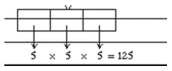
For exactly three digits are odd

For exactly two digits odd :

If $0$ is used then $: 2 \times 5 \times 5=50$

If $0$ is not used then : ${ }^{3} C _{1} \times 4 \times 5 \times 5=300$

Required Probability $=\frac{475}{900}=\frac{19}{36}$
Need a full question paper?

Generate a complete, print-ready paper with questions like this in minutes — across 16+ boards, with answer keys.

Start Generating Free

Similar questions

Let $a_1, a_2, a_3, a_4$ be real numbers such that $a_1+a_2+a_3+a_4=0$ and $a_1^2+a_2^2+a_3^2+a_4^2=1$. Then, the smallest possible value of the expression $\left(a_1-a_2\right)^2+\left(a_2-a_3\right)^2+\left(a_3-a_4\right)+\left(a_4-a_1\right)^2$ lies in the interval
If $F(\alpha ) = \left[ {\begin{array}{*{20}{c}}{\cos \alpha }&{ - \sin \alpha }&0\\{\sin \alpha }&{\cos \alpha }&0\\0&0&1\end{array}} \right]$ and $G\,(\beta ) = \left[ {\begin{array}{*{20}{c}}{\cos \beta }&0&{\sin \beta }\\0&1&0\\{ - \sin \beta }&0&{\cos \beta }\end{array}} \right]$, then ${[F(\alpha )\,G(\beta )]^{ - 1}} = $
If $^8{C_r}{ = ^8}{C_{r + 2}}$, then the value of $^r{C_2}$ is
Product of real roots of the equation ${t^2}{x^2} + |x| + \,9 = 0$
$\mathop {Lim}\limits_{n\, \to \infty } \,\,\frac{\pi }{{6n}}\left[ {{{\sec }^2}\left( {\frac{\pi }{{6n}}} \right) + {{\sec }^2}\left( {2\,\cdot\,\frac{\pi }{{6n}}} \right) + ..... + {{\sec }^2}(n - 1)\frac{\pi }{{6n}} + \frac{4}{3}} \right]$ has the value equal to
The function $\sin x - \cos x$ is increasing in the interval
The equation of the lines on which the perpendiculars from the origin make ${30^o}$ angle with $x$-axis and which form a triangle of area $\frac{{50}}{{\sqrt 3 }}$ with axes, are
Let $y = y(x)$ be the solution of the differential equation, $x\frac{{dy}}{{dx}} + y = x\,{\log _e}\,x,\,\left( {x > 1} \right)$ If $2y(2) = log_e\, 4 -1$, then $y(e)$ is equal to
A line passing through the point A(9, 0) makes an angle of 30º with the positive direction of x-axis. If this line is rotated about A through an angle of 15º in the clockwise direction, then its equation in the new position is
The last two digits of $2015! + 3^{2015}$ is-