Question
The process by which a heavy nucleus splits into light nuclei is known as

Answer

(a)

Need a full question paper?

Generate a complete, print-ready paper with questions like this in minutes — across 16+ boards, with answer keys.

Start Generating Free

Similar questions

The equation of motion of a projectile is:   $y = 12x - \frac{5}{9}{x^2}$. The horizontal component of velocity is $3\ ms^{- 1}$ . Given that $g = 10\ ms^{- 2}$ , .......... $m$ is the range of the projectile .
A particle performs simple harmonic motion with a period of $2$ second. The time taken by the particle to cover a displacement equal to half of its amplitude from the mean position is $\frac{1}{ a } s .$ The value of $'a'$ to the nearest integer is.........
In a region, if electric field is defined as $\vec E = \left( {\hat i + 2\hat j + \hat k} \right)\,V/m$ , then the potential difference between two points $A (0, 0, 0)$ and $B (2, 3, 4)$ in that region, is ......$V$
Body of mass $M$ is much heavier than the other body of mass $m$. The heavier body with speed $v$ collides with the lighter body which was at rest initially elastically. The speed of lighter body after collision is
The charge flowing through a resistance $R$ varies with time according to $Q = at -bt^2.$ The total heat produced in $R$ is : (assume that direction of current not reversed)
An electron of a hydrogen like atom, having $Z=4$, jumps from $4^{\text {th }}$ energy state to $2^{\text {nd }}$ energy state, The energy released in this process, will be $.........eV$

$($ Given $Rch =13.6\,eV )$

Where $R =$ Rydberg constant

$c=$ Speed of light in vacuum

$h =$ Planck's constant
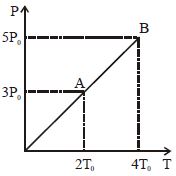
Pressure $Vs$ temperature graph of an ideal gas is shown in figure. Density of the gas at point $A$ is $\rho _0$ , Density at $B$ will be
In a certain region static electric and magnetic fields exist. The magnetic field is given by $\vec B = {B_0}\left( {\hat i + 2\hat j - 4\hat k} \right)$. If a test charge moving with a velocity $\vec v = {v_0}\left( {3\hat i - \hat j + 2\hat k} \right)$ experiences no force in that region, then the electric field in the region, in $SI\, units$, is
The minimum kinetic energy needed by an alpha particle to cause the nuclear reaction ${ }_7^{16} N +{ }_2^4 He \rightarrow{ }_1^1 H +{ }_8^{19} O$ in a laboratory frame is $n$ (in $MeV$. Assume that ${ }_7^{16} N$ is at rest in the laboratory frame. The masses of ${ }_7^{16} N ,{ }_2^4 He ,{ }_1^1 H$ and ${ }_8^{19} O$ can be taken to be $16.006 u, 4.003 u$, $1.008 u$ and $19.003 u$, respectively, where $1 u=930 MeVc ^{-2}$. The value of $n$ is. . . . .
Two coils have mutual inductance $0.002 \ \mathrm{H}$. The current changes in the first coil according to the relation $\mathrm{i}=\mathrm{i}_0 \sin \omega \mathrm{t}$, where $\mathrm{i}_0=5 \mathrm{~A}$ and $\omega=50 \pi$ $\mathrm{rad} / \mathrm{s}$. The maximum value of $\mathrm{emf}$ in the second coil is $\frac{\pi}{\alpha} \mathrm{V}$. The value of $\alpha$ is_______.