MCQ
The process of adding impurities to the pure semiconductor is called
  • A
    Drouping
  • B
    Drooping
  • Doping
  • D
    None of these

Answer

Correct option: C.
Doping
c
(c) In semiconductor production, doping intentionally introduces impurities into an extremely pure (also referred to as intrinsic) semiconductor for the purpose of modulating its electrical properties.

Hence, The process of adding impurities to semiconductors is called doping.

Need a full question paper?

Generate a complete, print-ready paper with questions like this in minutes — across 16+ boards, with answer keys.

Start Generating Free

Similar questions

A conducting sphere of radius $R$ is given a charge $Q$. The electric potential and the electric field at the centre of the sphere respectively are
If we increase the driving frequency in a circuit with a purely resistive load, then amplitude $VR​.$
A telescope using light having wavelength $5000\, Å$ and using lenses of focal $2.5$ and $30\, cm$. If the diameter of the aperture of the objective is $10\, cm$, then the resolving limit and magnifying power of the telescope is respectively
In a compound microscope, the focal length of two lenses are $1.5\,cm$ and $6.25\,cm$. If an object is placed at $2\,cm$ from objective and the final image is formed at $25\,cm$ from eye lens the distance between two lenses is......$cm$
Assertion : The electric bulbs glows immediately when switch is on.

Reason : The drift velocity of electrons in a metallic wire is very high.
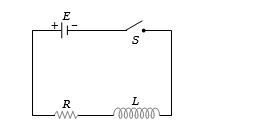
Switch $S$ of the circuit shown in figure. is closed at $t = 0$. If e denotes the induced emf in $L$ and i, the current flowing through the circuit at time $t $, which of the following graphs is correct
A plano-convex lens is made of a material of refractive index $n$. When a small object is placed $30 \mathrm{~cm}$ away in front of the curved surface of the lens, an image of double the size of the object is produced. Due to reflection from the convex surface of the lens, another faint image is observed at a distance of $10 \mathrm{~cm}$ away from the lens. Which of the following statement($s$) is(are) true?

($A$) The refractive index of the lens is $2.5$

($B$) The radius of curvature of the convex surface is $45 \mathrm{~cm}$

($C$) The faint image is erect and real

($D$) The focal length of the lens is $20 \mathrm{~cm}$

The refractive index of a certain glass is $1.5$ for light whose wavelength in vacuum is $6000\;\mathring A.$ The wavelength of this light when it passes through glass is.......$\mathring A$
Two conductors made of the same material are connected across a common potential difference. Conductor A has twice the diameter and twice the length of conductor B. The power delivered to the two conductors $P_A$ and $P_B$ respectively is such that $P_A/P_B$ equals to
Consider the following two statements.
  1. If heat is added to a system, its temperature must increase.
  2. If positive work is done by a system in a thermodynamic process, its volume must increase.