Question

The production of e.m.f. by maintaining a difference of temperature between the two junctions of two different metals is known as

(a) Joule effect

(b) Seebeck effect

(c) Peltier effect

(d) Thomson effect

Answer

(b) Seebeck effect

Need a full question paper?

Generate a complete, print-ready paper with questions like this in minutes — across 16+ boards, with answer keys.

Start Generating Free

Similar questions

 When electron remains between orbits, its momentum is:

An object is placed at a distance of 20 cm from a convex lens of focal length 10 cm. The image is formed on the other side of the lens at a distance

(a) 20 cm

(b) 10 cm

(c) 40 cm

(d) 30 cm

The waves used in telecommunication are

(a) IR

(b) UV

(c) Microwave

(d) Cosmic rays

Two opposite and equal charges 4 ×   when placed 2  cm away, form a dipole. If this dipole is placed in an external electric field 4 ,  the value of maximum torque and the work done in rotating it through 180°  will be

(a) 64  and  64

(b) 32   and 32  

(c) 64  and 32  

(d) 32  and 64  

Einstein's theory of relativity is based on:
If the two ends of a p-n junction are joined by a wire:
  1. There will not be a steady current in the circuit.
  2. There will be a steady current from the n-side to the p-side.
  3. There 'will a steady current from the p-side. to the n-side.
  4. There may or may not be a current depending upon the resistance of the connecting wire.
Quantisation of charge was experimentally demonstrated by:

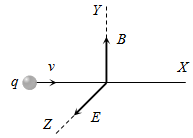
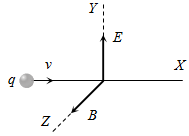
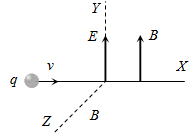
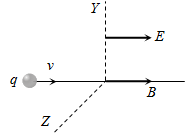
A particle of charge q and mass m is moving along the x -axis with a velocity v and enters a region of electric field E and magnetic field B as shown in figure below for which figure the net force on the charge may be zero

(a)

(b)

(c)

(d)

A current-carrying, straight wire is kept along the axis of a circular loop carrying a current. The straight wire:
  1. Will exert an inward force on the circular loop.
  2. Will exert an outward force on the circular loop.
  3. Will not exert any force on the circular loop.
  4. Will exert a force on the circular loop parallel to itself.
In a transistor: