MCQ
The property which differentiates two kinds of charges is called ____________?
- AEquality of charge
- BPolarity of charge
- CFraction of charge
- DNone of the option
Explanation:
The property which differentiates two kinds of charges is called polarity of charge.
Generate a complete, print-ready paper with questions like this in minutes — across 16+ boards, with answer keys.
Assertion : Magnetic moment of an atom is due to both, the orbital motion and spin motion of every electron.
Reason : A charged particle produces a magnetic field.
|
(a) If both assertion and reason are true and the reason is the correct explanation of the assertion. |
|
(b) If both assertion and reason are true but reason is not the correct explanation of the assertion. |
|
(c) If assertion is true but reason is false. |
|
(d) If the assertion and reason both are false. |
Light of wavelength 4000 Å is incident on a sodium surface for which the threshold wave length of photo – electrons is 5420 Å. The work function of sodium is
|
(a) 4.58 eV |
(b) 2.29 eV |
(c) 1.14 eV |
(d) 0.57 eV |
The photo-electrons emitted from a surface of sodium metal are such that
|
(a) They all are of the same frequency |
|
(b) They have the same kinetic energy |
|
(c) They have the same de Broglie wavelength |
|
(d) They have their speeds varying from zero to a certain maximum |
Curie-Weiss law is obeyed by iron at a temperature ......
|
(a) Below Curie temperature |
(b) Above Curie temperature |
|
(c) At Curie temperature only |
(d) At all temperatures |
The current carrying wire and the rod AB are in the same plane. The rod moves parallel to the wire with a velocity v. Which one of the following statements is true about induced emf in the rod
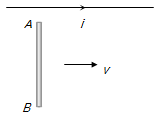
|
(a) End A will be at lower potential with respect to B |
|
(b) A and B will be at the same potential |
|
(c) There will be no induced e.m.f. in the rod |
|
(d) Potential at A will be higher than that at B |
The working of optical instruments like camera, microscope, telescope, etc. having glass lenses is based on a phenomenon of light. Identify the phenomenon.
Three α - particles and one β - particle decaying takes place in series from an isotope  . Finally the isotope obtained will be
|
(a) |
(b) |
(c) |
(d) |
Match the List I with the List II from the combinations shown
|
(I) |
Presbiopia |
(A) |
Sphero-cylindrical lens |
|
(II) |
Hypermetropia |
(B) |
Convex lens of proper power may be used close to the eye |
|
(III) |
Astigmatism |
(C) |
Concave lens of suitable focal length |
|
(IV) |
Myopia |
(D) |
Bifocal lens of suitable focal length |
|
(a) I-A; II-C; III-B; IV-D |
(b) I-B; II-D; III-C; IV-A |
(c) I-D; II-B; III-A; IV-C |
(d) I-D; II-A; III-C; IV-B |


