MCQ
The quantities remaining constant in a collision are
  • A
    Momentum, kinetic energy and temperature
  • B
    Momentum and kinetic energy but not temperature
  • C
    Momentum and temperature but not kinetic energy
  • Momentum but neither kinetic energy nor temperature
Answer

Correct option: D.
Momentum but neither kinetic energy nor temperature
d
(d) since velocities of the colliding bodies change, the $K.E.$ will change. The shapes of the bodies at the time of collision change due to the force, hence temperature will also change.

Only the momentum will remain constant.

Need a full question paper?

Generate a complete, print-ready paper with questions like this in minutes — across 16+ boards, with answer keys.

Start Generating Free

Similar questions

In an experiment, mass of an object is measured by applying a known force on it, and then measuring its acceleration. If in the experiment, the measured values of applied force and the measured acceleration are $F=10.0 \pm 0.2 \,N$ and $a=1.00 \pm 0.01 \,m / s ^2$, respectively. Then, the mass of the object is ............... $kg$
What is the number of significant figures in $ 0.310\times 10^3$
If the initial tension on a stretched string is doubled, then the ratio of the initial and final speeds of a transverse wave along the string is :
For a particle executing simple harmonic motion, the acceleration is proportional to:
  1. Displacement from the mean position.
  2. Distance from the mean position.
  3. Distance travelled since t = 0.
  4. Speed.
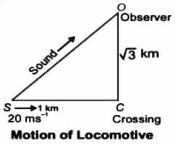
A locomotive approaching a crossing at a speed of $20 \,ms ^{-1}$ sounds a whistle of frequency $640 \,Hz$ when $1 \,km$ from the crossing. There is no wind and the speed of sound in air is $330 \,ms ^{-1}$. What frequency is heard by an observer $\sqrt{3} \,km$ on the straight road from the crossing at right angle ......... $Hz$
The top of a lake gets frozen at a place where the surrounding air is at a temperature of -20°C.
Then:
One mole of an ideal gas requires $207\, J$ heat to raise the temperature by $10 \,K$ when heated at constant pressure. If the same gas is heated at constant volume to raise the temperature by the same $10\, K,$ the heat required is ...... $J$

(Given the gas constant $R = 8.3J/mol{\rm{ - }}K$)

A projectile projected at an angle ${30^o}$ from the horizontal has a range $2\upsilon ,\,\sqrt 2 \upsilon \,\,{\rm{ and}}\,{\rm{zero}}$. If the angle of projection at the same initial velocity be ${60^o}$, then the range will be
The mass density of a planet of radius $R$ varies with the distance $r$ from its centre as $\rho( r )=\rho_{0}\left(1-\frac{ r ^{2}}{ R ^{2}}\right) .$ Then the gravitational field is maximum at
A solid cylinder $(i)$ rolls down $(ii)$ slides down an inclined plane. The ratio of the accelerations in these conditions