Question
For a particle executing simple harmonic motion, the acceleration is proportional to:
  1. Displacement from the mean position.
  2. Distance from the mean position.
  3. Distance travelled since t = 0.
  4. Speed.

Answer

  1. Displacement from the mean position.

Explanation:

For S.H.M.,

F = -kx

ma = -kx (F = ma)

or,

$\text{a}=-\frac{\text{k}}{\text{m}}\text{x}$

Thus, acceleration is proportional to the displacement from the mean position but in opposite direction.

Need a full question paper?

Generate a complete, print-ready paper with questions like this in minutes — across 16+ boards, with answer keys.

Start Generating Free

Similar questions

Let $\vec{\text{F}}$ be a force acting on a particle having position vector $\vec{\text{r}}.$ Let $\vec{\tau}$ be the torque of this force about the origin, then:

  1. $\vec{\text{r}}.\vec{\text{F}}=0$ and $\vec{\text{F}}.\vec{\tau}=0$

  2. $\vec{\text{r}}.\vec{\tau}=0$ but $\vec{\text{F}}.\vec{\tau}\neq0$

  3. $\vec{\text{r}}.\vec{\tau}\neq0$ but $\vec{\text{F}}.\vec{\tau}=0$

  4. $\vec{\text{r}}.\vec{\tau}\neq0$ and $\vec{\text{F}}.\vec{\tau}\neq0$

A man raises a box of mass 50kg to a height of 2m in 2minthes, while another man raises the same box to the same height in 5minthes. What is the ratio of work done by them?
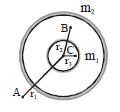
Two concentric shells of different masses $m_1$ and $m_2$ are having a sliding particle of mass $m$. The forces on the particle at position $A, B$ and $C$ are
In a transverse wave the distance between a crest and neighbouring trough at the same instant is $4.0\, cm$ and the distance between a crest and trough at the same place is $1 .0\, cm$ . The next crest appears at the same place after a time interval of $0.4\,s$. The maximum speed of the vibrating particles in the medium is
Ratio between maximum range and square of time of flight in projectile motion is
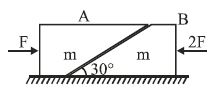
Two blocks $'A$' and $'B'$ each of mass $'m'$ are placed on a smooth horizontal surface. Two horizontal force $F$ and $2F$ are applied on the $2$ blocks $'A'$ and $'B'$ respectively as shown in figure. The block $A$ does not slide on block $B$. Then the normal reaction acting between the two blocks is
Two vessels having equal volume contain molecular hydrogen at one atmosphere and helium at two atmosphere pressure respectively. If both samples are at the same temperature the mean velocity of hydrogen molecule is:
Two guns $A$ and $B$ can fire bullets at speed $1\, km/s$ and $2\, km/s$ respectively. From a point on a horizontal ground, they are fired in all possible directions. The ratio of maximum areas covered by the bullets fired by the two guns, on the ground is
Three forces are acting simultaneously at one point. Two forces $\overrightarrow{ P }, \overrightarrow{ Q }$ are $(2 \hat{i}-3 \hat{j})$ and $(\hat{i}-\hat{j})$ respectively. If the object is in equilibrium then which will be the third:
Two identical piano wires, kept under the same tension $T$ have a fundamental frequency of $600\,\, Hz.$ The fractional increase in the tension of one of the wires which will lead to occurrence of $6\,\, beats/s$ when both the wires oscillate together would be