The coefficient of linear expansion of brass and steel are ${\alpha _1}$ and ${\alpha _2}$. If we take a brass rod of length ${l_1}$ and steel rod of length ${l_2}$ at $0°C$, their difference in length $({l_2} - {l_1})$ will remain the same at a temperature if
Diffcult


Download our appand get started for free
Experience the future of education. Simply download our apps or reach out to us for more information. Let's shape the future of learning together!No signup needed.*
Similar Questions
- 1A black body is at a temperature of $5760\ K$. The energy of radiation emitted by the body at wavelength $250\ nm$ is $U_1$, at wavelength $500\ nm$ is $U_2$ and that at $1000\ nm$ is $U_3$. Wien's constant, $b = 2.88 \times 10^6\ nm\ K$. Which of the following is correct?View Solution
- 2An incandescent bulb has a thin filament of tungsten that is heated to high temperature by passing an electric current. The hot filament emits black-body radiation. The filament is observed to break up at random locations after a sufficiently long time of operation due to non-uniform evaporation of tungsten from the filament. If the bulb is powered at constant voltage, which of the following statement($s$) is(are) true?View Solution
($A$) The temperature distribution over the filament is uniform
($B$) The resistance over small sections of the filament decreases with time
($C$) The filament emits more light at higher band of frequencies before it breaks up
($D$) The filament consumes less electrical power towards the end of the life of the bulb
- 3A hollow copper sphere $S$ and a hollow copper cube $ C$ , both of negligible thin walls of same area, are filled with water at $90°C$ and allowed to cool in the same environment. The graph that correctly represents their cooling isView Solution
- 4A black metal foil is warmed by radiation from a small sphere at temperature $T$ and at a distance $d$. It is found that the power received by the foil is $`P$ '. If both the temperature and the distance are doubled, the power received by the foil will beView Solution
- 5A black body radiates $ 20\,W$ at temperature ${227^o}C$. If temperature of the black body is changed to ${727^o}C$ then its radiating power will be ..... $W$View Solution
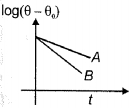
- 6Two bodies $A$ and $B$ of equal masses, area and emissivity cooling under Newton's law of cooling from same temperature are represented by the graph. If $\theta$ is the instantaneous temperature of the body and $\theta_0$ is the temperature of surroundings, then relationship between their specific heats is ..........View Solution
- 7View SolutionA body, which emits radiations of all possible wavelengths, is known as
- 8A black body at a temperature of $127°C$ radiates heat at the rate of $1 cal/cm^2 × sec$. At a temperature of $527°C$ the rate of heat radiation from the body in ($cal/cm^2 × sec$) will beView Solution
- 9An object kept in a large room having air temperature of $25^{\circ} \mathrm{C}$ takes $12$ minutes to cool from $80^{\circ} \mathrm{C}$ to $70^{\circ} \mathrm{C}$. The time taken to cool for the same object from $70^{\circ} \mathrm{C}$ to $60^{\circ} \mathrm{C}$ would be nearly.....$min$View Solution
- 10Four spheres $A, B, C$ and $D$ are of same radius but made of different metals. Their densities are in ratio $6 : 3 : 4 : 5$ and specific heats are in ratio $2 : 5 : 4 : 6$ . These are initially kept at the same temperature and placed in the same surroundings. The sphere which has the slowest rate of cooling isView Solution