MCQ
The Raman effect deals with:
  • A
    Diffraction of light with medium particles.
  • B
    Refraction of light with medium particles.
  • Scattering of light with medium particles.
  • D
    Reflection of light by medium particles.

Answer

Correct option: C.
Scattering of light with medium particles.

Need a full question paper?

Generate a complete, print-ready paper with questions like this in minutes — across 16+ boards, with answer keys.
Start Generating Free

Similar questions

A solid sphere falls with terminal velocity of $10 \,cm/s$ in the earth's gravitational field. If  it is allowed to fall freely in a region outside the gravitational field of the earth, the terminal  velocity, will be :-
When a train is at rest, rain drops fall vertically. When it moves along east with a velocity equal to that of rain, the rain will appear to fall, for a passenger in the train
In an experiment of simple pendulum time period measured was $50\,sec$ for $25$ vibrations when the length of the simple pendulum was taken $100\,cm$ . If the least count of stop watch is $0.1\,sec$ . and that of meter scale is $0.1\,cm$ then maximum possible error in value of $g$ is .......... $\%$
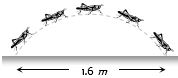
A grasshopper can jump maximum distance $1.6\; m$. It negligible time of the ground. How far can it go in $10 \;s$?
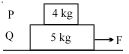
The coefficient of friction between $4kg$ and $5\, kg$ blocks is $0.2$ and between $5kg$ block and ground is $0.1$ respectively. Choose the correct statements
A heavy solid sphere is thrown on a horizontal rough surface with initial velocity $u$ without rolling. What will be its speed, when it starts pure rolling motion?
The position of a projectile launched from the origin at $t = 0$ is given by $\vec r = \left( {40\hat i + 50\hat j} \right)\,m$ at $t = 2\,s$. If the projectile was launched at an angle $\theta$ from the horizontal, then $\theta$ is (take $g = 10\, ms^{-2}$)
When the displacement is half the amplitude, the ratio of potential energy to the total energy is
The pressure exerted by a gas is dependent on its density:
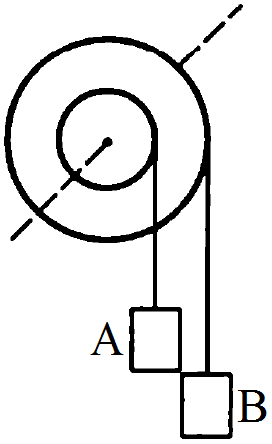
Figure shows a small wheel fixed coaxially on a bigger one of double the radius. The system rotates about the common axis. The strings supporting A and B do not slip on the wheels. If x and y be the distance travelled by A and B in the same time interval, then: