MCQ
The range of a projectile when launched at angle $\theta$ is same as when launched at angle $2 \theta$. What is the value of $\theta$ ?
  • A
    $15$
  • $30$
  • C
    $45$
  • D
    $60$

Answer

Correct option: B.
$30$
b
(b)

$2 \theta=90^{\circ}-\theta$

or $3 \theta=90^{\circ} \text { or } \theta=30^{\circ}$

Need a full question paper?

Generate a complete, print-ready paper with questions like this in minutes — across 16+ boards, with answer keys.
Start Generating Free

Similar questions

The initial velocity $v_{i}$ required to project a body vertically upward from the surface of the earth to reach a height of $10\, R ,$ where $R$ is the radius of the earth, may be described in terms of escape velocity $v_{ e }$ such that $v_{i}=\sqrt{\frac{x}{y}} \times v_{ e } .$ The value of $x$ will be ...... .
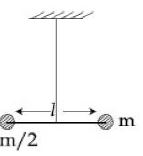
Two masses $m$ and $\frac{m}{2}$ are connected at the two ends of a massless rigid rod of length $l$. The rod is suspended by a thin wire of torsional constant $k$ at the centre of mass of the rodmass system (see figure). Because of torsional constant $k$, the restoring torque is $\tau  = k\,\theta $ for angular displacement $\theta $. If the rod is rotated by $\theta _0$ and released, the tension in it when it passes through its mean position will be
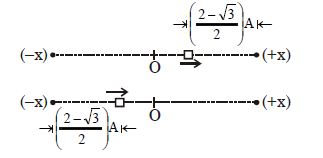
Two bodies performing $SHM$ have same amplitude and frequency. Their phases at a certain instant are as shown in the figure. The phase difference between them is
The equation of motion of a projectile is $y = Ax -Bx^2$ where $A$ and $B$ are the constants of motion. The horizontal range of the projectile is
If the resultant of $n$ forces of different magnitudes acting at a point is zero, then the minimum value of $n$ is
$A$ block of mass $m$ moving with a velocity $v_0$ on a smooth horizontal surface strikes and compresses a spring of stiffness $k$ till mass comes to rest as shown in the figure. This phenomenon is observed by two observers:

$A$: standing on the horizontal surface

$B$: standing on the block 

To an observer $A$, the work done by spring force is 

Three particles have speeds of $2u$ , $10u$ and $11u$. Which of the following statements is correct?
Water rises to a height of $10\,cm$ in a certain capillary tube. An another identical tube when dipped in mercury the level of mercury is depressed by $3.42\,cm$. Density of mercury is $13.6\, g/cc$. The angle of contact for water in contact with glass is $0^o$ and mercury in contact with glass is $135^o$. The ratio of surface tension of water to that of $Hg$ is :-
A convex lens is made of a material having refractive index $1.2.$ Both the surfaces of the lens are convex. If it is dipped into water $(\mu=1.33),$ it will behave like:
A particle initially at rest starts moving from reference point. $\mathrm{x}=0$ along $\mathrm{x}$-axis, with velocity $v$ that varies as $v=4 \sqrt{\mathrm{x} m} / \mathrm{s}$. The acceleration of the particle is __________$ \mathrm{ms}^{-2}$.