The rate of flow of liquid in a tube of radius $r,$ length $ l,$ whose ends are maintained at a pressure difference $P$ is $V = \frac{{\pi QP\,{r^4}}}{{\eta l}}$ where $\eta $ is coefficient of the viscosity and $Q$ is
Medium


Download our appand get started for free
Experience the future of education. Simply download our apps or reach out to us for more information. Let's shape the future of learning together!No signup needed.*
Similar Questions
- 1An open glass tube is immersed in mercury in such a way that a length of $8\ cm$ extends above the mercury level. The open end of the tube is then closed and sealed and the tube is raised vertically up by additional $46\ cm$. What will be length of the air column above mercury in the tube now ....... $cm$ ?View Solution
( Atmospheric pressure = $76\ cm$ of $Hg$)
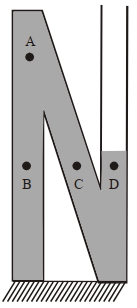
- 2Consider a mercury-filled tube as shown in the figure belowView Solution
Which of the following options about the pressures at the lettered locations $(A, B, C, D)$ is true?
- 3The reading of spring balance when a block is suspended from it in air, is $60\,N$. This reading is changed to $40\, N$ when the block is immersed in water. The specific density of the block isView Solution
- 4Air is streaming past a horizontal air plane wing such that its speed in $ 120 m/s$ over the upper surface and $ 90 m/s$ at the lower surface. If the density of air is $1.3 kg$ per $metre^3 $ and the wing is $10 m $ long and has an average width of $2 m$, then the difference of the pressure on the two sides of the wing of ....... $Pascal$View Solution
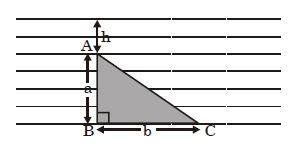
- 5A vertical triangular plate $ABC$ is placed inside water with side $BC$ parallel to water surface as shown. The force on one surface of plate by water is (density of water is $\rho $ and atmospheric pressure $P_0$ )View Solution
- 6Radius of an air bubble at the bottom of the lake is $r$ and it becomes $ 2r $ when the air bubbles rises to the top surface of the lake. If $P $ $cm$ of water be the atmospheric pressure, then the depth of the lake isView Solution
- 7The pressure of water in a water pipe when tap is opened and closed is respectively $3 \times 10^5\,N/m^2$ and $3.5 \times 10^5\,N/m^2$ . With open tap, the velocity of water flowing is ........... $m/s$View Solution
- 8A $50 \;kg$ girl wearing high heel shoes balances on a single heel. The heel is circular with a diameter $1.0 \;cm$. What is the pressure exerted by the heel on the horizontal floor ?View Solution
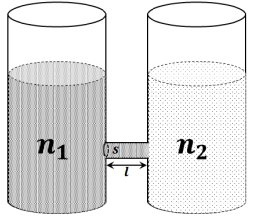
- 9As shown schematically in the figure, two vessels contain water solutions (at temperature $T$ ) of potassium permanganate $\left( KMnO _4\right)$ of different concentrations $n_1$ and $n_2\left(n_1>n_2\right)$ molecules per unit volume with $\Delta n=\left(n_1-n_2\right) \ll n_1$. When they are connected by a tube of small length $\ell$ and cross-sectional area $S , KMnO _4$ starts to diffuse from the left to the right vessel through the tube. Consider the collection of molecules to behave as dilute ideal gases and the difference in their partial pressure in the two vessels causing the diffusion. The speed $v$ of the molecules is limited by the viscous force $-\beta v$ on each molecule, where $\beta$ is a constant. Neglecting all terms of the order $(\Delta n)^2$, which of the following is/are correct? ( $k_B$ is the Boltzmann constant)-View Solution
$(A)$ the force causing the molecules to move across the tube is $\Delta n k_B T S$
$(B)$ force balance implies $n_1 \beta v \ell=\Delta n k_B T$
$(C)$ total number of molecules going across the tube per sec is $\left(\frac{\Delta n}{\ell}\right)\left(\frac{k_B T}{\beta}\right) S$
$(D)$ rate of molecules getting transferred through the tube does not change with time
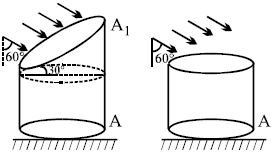
- 10A vertical cylindrical container of base area $A$ and upper cross-section area $A_1$ making an angle $30^o $ with the horizontal is placed in an open rainy field as shown near another cylindrical container having same base area $A$. The ratio of rates of collection of water in the two containers will beView Solution