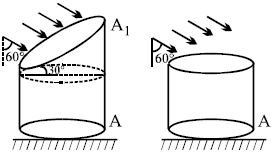
A vertical cylindrical container of base area $A$ and upper cross-section area $A_1$ making an angle $30^o $ with the horizontal is placed in an open rainy field as shown near another cylindrical container having same base area $A$. The ratio of rates of collection of water in the two containers will be
A$2/\sqrt 3$
B$4/\sqrt 3$
C$2$
D
None
Diffcult
Download our app for free and get started
C$2$
c In first container the Area vector is along the direction of rain. Rate of water collection in first container is $A_{1} \times$ velocity of rain.
In second cylinder the component of Area vector along the direction of rain is $A_{1} \cos 60^{\circ}=$$A_{1} / 2 .$ So, rate of water collection in second container is $0.5 A_{1} \times$ velocity of rain. The ratio of water collection is $2 .$
Download our app
and get started for free
Experience the future of education. Simply download our apps or reach out to us for more information. Let's shape the future of learning together!No signup needed.*
Small water droplets of radius $0.01 \mathrm{~mm}$ are formed in the upper atmosphere and falling with a terminal velocity of $10 \mathrm{~cm} / \mathrm{s}$. Due to condensation, if $8 \mathrm{such}$ droplets are coalesced and formed a larger drop, the new terminal velocity will be ........... $\mathrm{cm} / \mathrm{s}$.
A liquid is kept in a cylindrical vessel which rotated along its axis. The liquid rises at the sides. If the radius of the vessel is $0.05\,m$ and the speed of rotation is $2\,rev/s$ , The difference in the height of the liquid at the centre of the vessel and its sides will be .............. $\mathrm{cm}$ $(\pi ^2 = 10)$
A barometer kept in an elevator reads $76 \,cm$ when the elevator is accelerating upwards. The most likely pressure inside the elevator (in $cm$ of $Hg$ ) is ........
The shown $H$ shaped apparatus contains an ideal incompressible liquid and has dimension as shown in figure . The diameters of the Tubes are small as compared to $h$ and $R$. The apparatus is rotated with a constant angular velocity $\omega$ about a symmetric vertical axis as shown in figure. The pressure at point $A$ is
If a ball of steel (density $\rho=7.8 \;gcm ^{-3}$) attains a terminal velocity of $10 \;cms ^{-1}$ when falling in a tank of water (coefficient of viscosity $\eta_{\text {water }}=8.5 \times 10^{-4} \;Pa - s$ ) then its terminal velocity in glycerine $\left(\rho=12 gcm ^{-3}, \eta=13.2\right)$ would be nearly
Pressure at the bottom of a tank of water is $3P$, where $P$ is atmospheric pressure. If water is drawn out till the level of water is lowered by one fifth, then the pressure at the bottom of the tank is