MCQ
The ratio $h$ : $2 r$ for which $S$ to be minimum will be equal to
  • A
    $2 \pi: \pi+2$
  • B
    $2 \pi: \pi+1$
  • C
    $\pi: \pi+1$
  • D
    $\pi: \pi+2$

Answer

$\because V=\frac{1}{2} \pi r^2 h$
and $S$ will be minimum, when $(\pi+2) V =\pi^2 r^3$
$\Rightarrow V=\frac{\pi^2 r^3}{\pi+2}$
From (i) and (ii), we get
$\Rightarrow \frac{1}{2} \pi r^2 h=\frac{\pi^2 r^3}{\pi+2} \Rightarrow \pi r^2 h(\pi+2)=2 \pi^2 r^3$
$\Rightarrow h(\pi+2)=2 \pi r \Rightarrow \frac{h}{2 r}=\frac{\pi}{\pi+2}$
Thus, required ratio i.e., $h: 2 r$ is $\pi: \pi+2$.

Need a full question paper?

Generate a complete, print-ready paper with questions like this in minutes — across 16+ boards, with answer keys.

Start Generating Free

Similar questions

If $\text{f(x)}=|\log_{10}\text{x}|\text{fx}=\log_{10}\text{x},$ then at $x = 1:$
 
Let $A$ and $B$ be two events such that $P ( B \mid A )=\frac{2}{5}$, $P ( A \mid B )=\frac{1}{7}$ and $P ( A \cap B )=\frac{1}{9} .$ Consider

$( S 1) P \left( A ^{\prime} \cup B \right)=\frac{5}{6}$

$( S 2) P \left( A ^{\prime} \cap B ^{\prime}\right)=\frac{1}{18}$. Then.
4 white and 3 black balls are in a bag. 3 white and 4 black balls are in other bag. If a ball is drawn, that is black then find the probability of ball is black drawn from second bag.
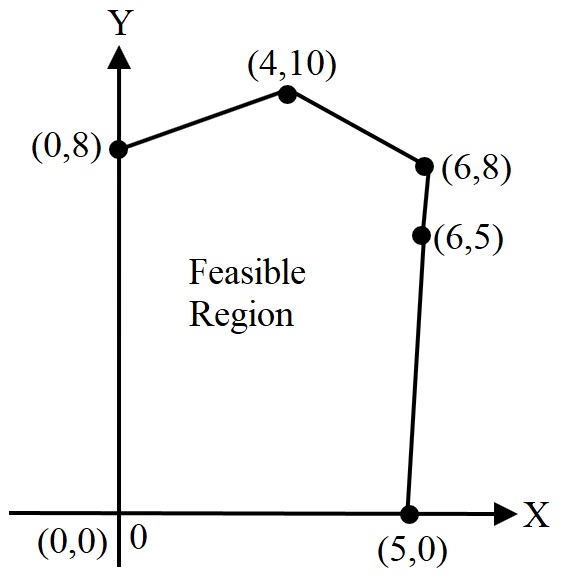
The feasible, region for an LPP is shown shaded in the figure. Let Z = 3x - 4y be the objective function. A minimum of Z occurs at:
Let $g(x) = \int_0^x {f(t)\,dt} $ where $\frac{1}{2} \le f(t) \le 1,\,t \in [0,\,1]$ and $0 \le f(t) \le \frac{1}{2}$ for $t \in (1,\,2]$, then
The differential equation of the family of curves $y = a\cos (x + b)$ is
The value of the determinant $\begin{vmatrix}\text{x}&\text{x}+\text{y}&\text{x}+2\text{y}\\\text{x}+2\text{y}&\text{x}&\text{x}+\text{y}\\\text{x}+\text{y}&\text{x}+2\text{y}&\text{x}\end{vmatrix}$ is:
If A and B are two events such that $\text{P(A)}=\frac{1}{2},\text{P(B)}=\frac{1}{3},\text{P}(\text{A}|\text{B})=\frac{1}{4},$ then $\text{P}(\overline{\text{A}}\cap\overline{\text{B}})$ equals.
Among all sectors of a fixed perimeter, choose the one with maximum area. Then, the angle at the centre of this sector (i.e., the angle between the bounding radii) is
Let $\mathrm{f}(\mathrm{x})=\cos \left(2 \tan ^{-1} \sin \left(\cot ^{-1} \sqrt{\frac{1-\mathrm{x}}{\mathrm{x}}}\right)\right)$ $0<\mathrm{x}<1$. Then :