MCQ
The ratio of gravitational acceleration at height $3R$ to that at height $4R$ from the surface of the earth is : (where $R$ is the radius of the earth)
  • A
    $9/16$
  • $25/16$
  • C
    $16/25$
  • D
    $16/9$

Answer

Correct option: B.
$25/16$
b

Need a full question paper?

Generate a complete, print-ready paper with questions like this in minutes — across 16+ boards, with answer keys.

Start Generating Free

Similar questions

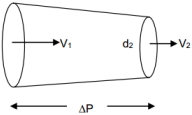
Determine the pressure difference in tube of non$-$uniform cross sectional area as shown in figure. $\Delta P =?$ (in $pa$)

$d_{1}=5\, cm , V_{1}=4\, cm , d_{2}=2\, cm , V_{2}=?$
Four light waves are represented by
  1. $\text{y}=\text{a}_1\sin\omega\text{t}$
  2. $\text{y}=\text{a}_2\sin(\omega\text{t}+\in)$
  3. $\text{y}=\text{a}_1\sin2\omega\text{t}$
  4. $\text{y}=\text{a}_2\sin2(\omega\text{t}+\in)$
Interference fringes may be observed due to superposition of:
The ratio of kinetic energies of two spheres rolling with equal centre of mass velocities is $2 : 1$. If their radii are in the ratio $2 : 1$; then the ratio of their masses will be
Match List$-I$ with List$-II$

List$-I$ List$-II$
$(a)$ Isothermal $(i)$ Pressure constant
$(b)$ Isochoric $(ii)$ Temperature constant
$(c)$ Adiabatic $(iii)$ Volume constant
$(d)$ Isobaric $(iv)$ Heat content is constant

Choose the correct answer from the options given below
Which of the following statements is correct for any thermodynamic system
In a rocket, fuel burns at the rate of $2 \,kg / s$. This fuel gets efected from the rocket with a velocity of $80 \,km / s$. Force exerted on the rocket is ............. $N$
If $1\; g$ of steam is mixed with $1\; g$ of ice, then the resultant temperature of the mixture is ........ $^oC$
A cord is wound round the circumference of wheel of radius $r$. The axis of the wheel is horizontal and the moment of inertia about it is $I. \,A$ weight $mg$ is attached to the cord at the end. The weight falls from rest. After falling through a distance $ 'h '$, the square of angular velocity of wheel will be ..... .
An object moving in a circular path at constant speed has constant
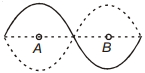
In the standing wave shown, particles at the positions $A$ and $B$ have a phase difference of