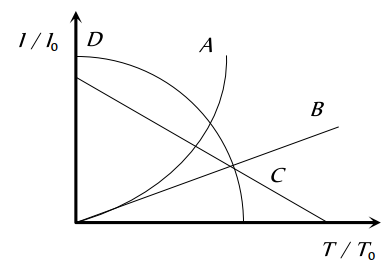
The ratio of thermionic currents $(I / I)$ for a metal when the temperature is slowly increased $T_0$ to $T$ as shown in figure. ( $I$ and $I$ are currents at $T$ and respectively). Then which one is correct?


Download our appand get started for free
Experience the future of education. Simply download our apps or reach out to us for more information. Let's shape the future of learning together!No signup needed.*
Similar Questions
- 1View SolutionThe mutual characteristic of triode is
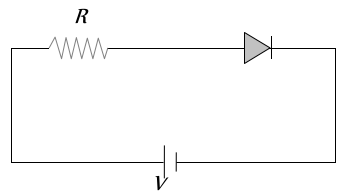
- 2View SolutionWhich one is in forward bias
- 3The slope of plate characteristic of a vacuum tube diode for certain operating point on the curve is $10^{-3} \frac{ mA }{ V }.$ The plate resistance of the diode and its nature respectivelyView Solution
- 4For a thermionic emitter (metallic) if $J$ represents the current density and $T$ is its absolute temperature then the correct curve between $\log _e \frac{J}{T^2}$ and $\frac{1}{T}$ isView Solution
- 5Which is the wrong statement in following sentences? A device in which $P$ and $N$-type semiconductors are used is more useful then a vacuum type becauseView Solution
- 6View SolutionA semiconductor dopped with a donor impurity is
- 7View SolutionIn comparison to a half wave rectifier, the full wave rectifier gives lower
- 8View SolutionIn a junction diode, the holes are due to
- 9In the case of constants $\alpha$ and $\beta$ of a transistorView Solution
- 10For the given circuit of $P N$-junction diode, which of the following statement is correctView Solution