MCQ
The ratio of vapour densities of two gases at the same temperature is $\frac{4}{25}$, then the ratio of r.m.s. velocities will be :
  • A
    $\frac{25}{4}$
  • B
    $\frac{2}{5}$
  • C
    $\frac{5}{2}$
  • D
    $\frac{4}{25}$

Answer

C.
$\frac{\rho_{1}}{\rho_{2}}=\frac{4}{25}$
Ratio of rms velocities $=\sqrt{\frac{\rho_{2}}{\rho_{1}}}=\frac{5}{2}$

Need a full question paper?

Generate a complete, print-ready paper with questions like this in minutes — across 16+ boards, with answer keys.
Start Generating Free

Similar questions

A student performs an experiment to determine the Young's modulus of a wire, exactly $2 \mathrm{~m}$ long, by Searle's method. In a particular reading, the student measures the extension in the length of the wire to be $0.8 \mathrm{~mm}$ with an uncertainty of $\pm 0.05 \mathrm{~mm}$ at a load of exactly $1.0 \mathrm{~kg}$. The student also measures the diameter of the wire to be $0.4 \mathrm{~mm}$ with an uncertainty of $\pm 0.01 \mathrm{~mm}$. Take $g=9.8 \mathrm{~m} / \mathrm{s}^2$ (exact). The Young's modulus obtained from the reading is
A particle of mass $M,$ starting from rest , undergoes uniform acceleration. If the speed acquired in time $T$ is $V,$ the power delivered to the particle is
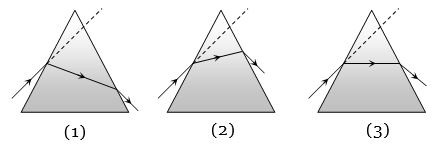
The figures represent three cases of a ray passing through a prism of angle $A.$ The case corresponding to minimum deviation is
A passenger train of length $60\, m$ travels at a speed of $80\, km/hr$. Another freight train of length $120\, m$ travels at a speed of $30\, km/hr$. The ratio of times taken by the passenger train to completely cross the freight train when:

$(i)$ they are moving in the same direction, and

$(ii)$ in the opposite directions is
A body starts from rest. What is the ratio of the distance travelled by the body during the $4^{th}$ and $3^{rd}$ second
A $3\,^oC$ rise in temperature is observed in a conductor by passing a certain current. When the current is doubled, the rise in temperature will be ............. $^oC$
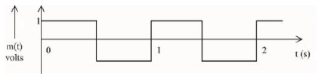
A modulating signal is a square wave, as shown in the figure.
If the carrier wave is given as $c ( t )=2 \sin (8 \pi t )$ volts, the modulation index is:
A point charge $q$ is placed at a distance $a/2$ directly above the centre of a square of side $a$. The electric flux through the square is
A $1\,m$ long copper wire carries a current of $1\,A$. If the cross section of the wire is $2.0\,mm ^{2}$ and the resistivity of copper is $1.7 \times 10^{-8}\,\Omega\,m$. the force experienced by moving electron in the wire is $\times 10^{-23}\,N$. (charge on electron $=1.6 \times 10^{-19}\,C$ )
In semiconductors at a room temperature