Questions

SECTION - A [PHYSICS MCQ]

Take a timed test

20 questions · self-marked practice — reveal the answer and mark yourself.

MCQ 14 Marks
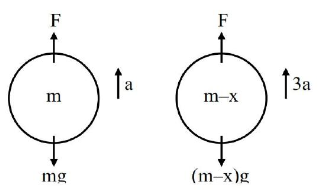
A balloon and its content having mass $M$ is moving up with an acceleration 'a'. The mass that must be released from the content so that the balloon starts moving up with an acceleration ' $3 \mathrm{a}^{\prime}$ will be : (Take ' g ' as acceleration due to gravity)
  • A
    $\frac{3 \mathrm{Ma}}{2 \mathrm{a}-\mathrm{g}}$
  • B
    $\frac{3 \mathrm{Ma}}{2 \mathrm{a}+\mathrm{g}}$
  • C
    $\frac{2 \mathrm{Ma}}{3 \mathrm{a}+\mathrm{g}}$
  • D
    $\frac{2 \mathrm{Ma}}{3 \mathrm{a}-\mathrm{g}}$
Answer
C.
Image
$\mathrm{F}-\mathrm{mg}=\mathrm{ma}$
$\mathrm{F}=\mathrm{ma}+\mathrm{mg}$
$F-(m-x) g=(m-x) 3 a$
Put F
$M a+m g-m g+x g=3 m a-3 x a$
$x=\frac{2 m a}{g+3 a}$
View full question & answer
MCQ 24 Marks
The magnetic field of an E.M. wave is given by $\vec{B}=\left(\frac{\sqrt{3}}{2} \hat{i}+\frac{1}{2} \hat{j}\right) 30 \sin \left[\omega\left(t-\frac{z}{c}\right)\right]$ (S.I. Units) The corresponding electric field in S.I. units is :
  • A
    $\overrightarrow{\mathrm{E}}=\left(\frac{1}{2} \hat{\mathrm{i}}-\frac{\sqrt{3}}{2} \hat{\mathrm{j}}\right) 30 \operatorname{cosin}\left[\omega\left(\mathrm{t}-\frac{\mathrm{z}}{\mathrm{c}}\right)\right]$
  • B
    $\overrightarrow{\mathrm{E}}=\left(\frac{3}{4} \hat{\mathrm{i}}+\frac{1}{4} \hat{\mathrm{j}}\right) 30 \mathrm{c} \cos \left[\omega\left(\mathrm{t}-\frac{\mathrm{z}}{\mathrm{c}}\right)\right]$
  • C
    $\overrightarrow{\mathrm{E}}=\left(\frac{1}{2} \hat{\mathrm{i}}+\frac{\sqrt{3}}{2} \hat{\mathrm{j}}\right) 30 \mathrm{c} \sin \left[\omega\left(\mathrm{t}+\frac{\mathrm{z}}{\mathrm{c}}\right)\right]$
  • D
    $\overrightarrow{\mathrm{E}}=\left(\frac{\sqrt{3}}{2} \hat{\mathrm{i}}-\frac{1}{2} \hat{\mathrm{j}}\right) 30 \mathrm{c} \sin \left[\omega\left(\mathrm{t}+\frac{\mathrm{z}}{\mathrm{c}}\right)\right]$
Answer
A.
$\quad \vec{B}=\left(\frac{\sqrt{3}}{2} \hat{i}+\frac{1}{2} \hat{j}\right) 30 \sin \left[\omega\left(t-\frac{z}{c}\right)\right]$
$\overrightarrow{\mathrm{E}}=\overrightarrow{\mathrm{B}} \times \overrightarrow{\mathrm{c}}$ and $\mathrm{E}=\mathrm{B}_{0} \mathrm{c}$
Here $\overrightarrow{\mathrm{E}}\left(\frac{\sqrt{3}}{2}(-\hat{\mathrm{j}})+\frac{1}{2} \hat{\mathrm{i}}\right)$
$\mathrm{E}_{0}=30 \mathrm{c}$
$\overrightarrow{\mathrm{E}}=\left(\frac{1}{2} \hat{\mathrm{i}}-\frac{\sqrt{3}}{2} \hat{\mathrm{j}}\right) 30 \operatorname{csin}\left[\omega\left(\mathrm{t}-\frac{\mathrm{z}}{\mathrm{c}}\right)\right]$
View full question & answer
MCQ 34 Marks
a 400 g solid cube having an edge of length 10 cm floats in water. How much volume of the cube is outside the water?
(Given : density of water $=1000 \mathrm{~kg} \mathrm{~m}^{-3}$ )
  • A
    $1400 \mathrm{~cm}^{3}$
  • B
    $4000 \mathrm{~cm}^{3}$
  • C
    $400 \mathrm{~cm}^{3}$
  • D
    $600 \mathrm{~cm}^{3}$
Answer
D.
$\mathrm{Mg}=\mathrm{F}_{\mathrm{B}} \Rightarrow\left(400 \times 10^{-3}\right)=10^{3} \times \mathrm{V}_{\mathrm{d}}$
$\mathrm{V}_{\mathrm{d}}=400 \times 10^{-6} \mathrm{~m}^{3}$
(Vol. $)_{\text {outside }}=\left(10 \times 10^{-2}\right)^{3}-400 \times 10^{-6}$
$=600 \times 10^{-6} \mathrm{~m}^{2}=600 \mathrm{~cm}^{3}$
View full question & answer
MCQ 44 Marks
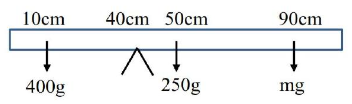
A uniform rod of mass 250 g having length 100 cm is balanced on a sharp edge at 40 cm mark. A mass of 400 g is suspended at 10 cm mark. To maintain the balance of the rod, the mass to be suspended at 90 cm mark, is
  • A
    300 g
  • B
    190 g
  • C
    200 g
  • D
    290 g
Answer
B.
Image
$\tau_{\text {Net }}=0 \Rightarrow(400 \mathrm{~g} \times 30)=(250 \mathrm{~g} \times 10)(\mathrm{mg} \times 50)$
$\mathrm{m}=\frac{12000-2500}{50}=\frac{9500}{50}$
$\mathrm{M}=190 \mathrm{~g}$
View full question & answer
MCQ 54 Marks
Image
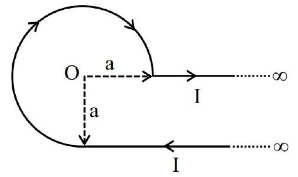
An infinite wire has a circular bend of radius a, and carrying a current I as shown in figure. The magnitude of magnetic field at the origin O of the arc is given by :
  • A
    $\frac{\mu_{0}}{4 \pi} \frac{I}{a}\left[\frac{\pi}{2}+1\right]$
  • B
    $\frac{\mu_{0}}{4 \pi} \frac{I}{a}\left[\frac{3 \pi}{2}+1\right]$
  • C
    $\frac{\mu_{0}}{2 \pi} \frac{I}{a}\left[\frac{\pi}{2}+2\right]$
  • D
    $\frac{\mu_{0}}{4 \pi} \frac{I}{\mathrm{a}}\left[\frac{3 \pi}{2}+2\right]$
Answer
B.
Image
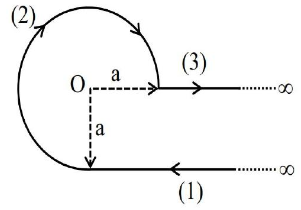
$\mathrm{B}_{1}=\frac{\mu_{0} \mathrm{i}}{4 \pi \mathrm{a}} \otimes$
$\mathrm{B}_{2}=\frac{\mu_{0}}{4 \pi} \frac{\mathrm{i}}{\mathrm{a}}\left(\frac{3 \pi}{2}\right) \otimes$
$B_{3}=0$
$\mathrm{B}=\frac{\mu_{0}}{4 \pi} \frac{\mathrm{i}}{\mathrm{a}}\left(1 \frac{3 \pi}{2}\right) \otimes$
View full question & answer
MCQ 64 Marks
Image
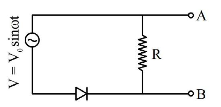
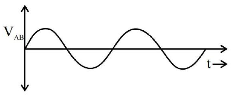
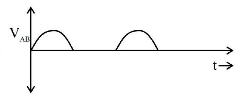
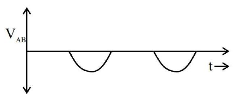
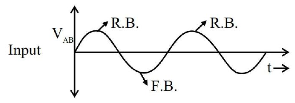
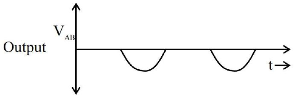
In the circuit shown here, assuming threshold voltage of diode is negligibly small, then voltage $\mathrm{V}_{\mathrm{AB}}$ is correctly represented by :
  • A
    $V_{A B}$ would be zero at all times
  • B


    Image
  • C


    Image
  • D


    Image
Answer
D.
$\mathrm{V}=\mathrm{V}_{0} \sin \omega \mathrm{t}$
Image
Image
View full question & answer
MCQ 74 Marks
A body of mass 4 kg is placed on a plane at a point $P$ having coordinate $(3,4) \mathrm{m}$. Under the action of force $\vec{F}=(2 \hat{i}+3 \hat{j}) N$, it moves to a new point $Q$ having coordinates $(6,10) \mathrm{m}$ in 4 sec . The average power and instantaneous power at the end of 4 sec are in the ratio of :
  • A
    $13: 6$
  • B
    $6: 13$
  • C
    $1: 2$
  • D
    $4: 3$
Answer
B.
<p>$=\frac{(2 \hat{ i }+3 \hat{ j }) \cdot(3 \hat{ i }+6 \hat{ j })}{4}=6$
$\vec{a}=\left(\frac{\vec{F}}{m}=\frac{1}{2} \hat{i}+\frac{3}{4} \hat{j}\right)$
$\overrightarrow{\mathrm{v}}$ at $\mathrm{t}=4 \mathrm{sec}=\left(\frac{1}{2} \hat{\mathrm{i}}+\frac{3}{4} \hat{\mathrm{j}}\right) \times 4=(2 \hat{\mathrm{i}}+3 \hat{\mathrm{j}})$
$P_{\text {ins }}=(2 \hat{i}+3)(2 \hat{i}+3 \hat{j})=13$
$\frac{\langle\mathrm{P}\rangle}{\mathrm{P}_{\mathrm{ins}}}=\frac{6}{13}$
Note : Given data is not matching.
$S=u t+\frac{1}{2} a t^{2}$
$S=0+\frac{1}{2} \frac{(2 \hat{i}+3 \hat{j})}{4}(4)^{2}=4 \hat{i}+6 \hat{\mathrm{j}}$
If $\overrightarrow{\mathrm{r}}_{\mathrm{i}}=3 \hat{i}+4 \hat{\mathrm{j}}$ then $\overrightarrow{\mathrm{r}}_{\mathrm{f}}=7 \hat{\mathrm{i}}+10 \hat{\mathrm{j}}$
But Final position given in the question is $(6,10)$.
View full question & answer
MCQ 84 Marks
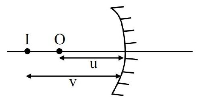
A concave mirror produces an image of an object such that the distance between the object and image is 20 cm . If the magnification of the image is ' -3 ', then the magnitude of the radius of curvature of the mirror is :
  • A
    3.75 cm
  • B
    30 cm
  • C
    7.5 cm
  • D
    15 cm
Answer
D.
Image
$\mathrm{m}=-3=-\frac{\mathrm{v}}{\mathrm{u}}$ and $\mathrm{v}-\mathrm{u}=20 \mathrm{~cm}$
$\mathrm{f}=\frac{\mathrm{vu}}{\mathrm{v}+\mathrm{u}}=\frac{(-30)(-10)}{-30-10}$
$\therefore \mathrm{R}=+15$
View full question & answer
MCQ 94 Marks
Given below are two statements. One is labelled as Assertion (A) and the other is labelled as Reason (R).
Assertion (A) : Knowing initial position $\mathrm{x}_{0}$ and initial momentum $\mathrm{p}_{0}$ is enough to determine the position and momentum at any time t for a simple harmonic motion with a given angular frequency $\omega$.
Reason (R) : The amplitude and phase can be expressed in terms of $\mathrm{x}_{0}$ an $\mathrm{p}_{0}$.
In the light of the above statements, choose the correct answer from the options given below :
  • A
    Both (A) and (R) are true but (R) is NOT the correct explanation of (A).
  • B
    (A) is false but (R) is true.
  • C
    (A) is true but ( $\mathbf{R}$ ) is false.
  • D
    Both (A) and (R) are true and (R) is the correct explanation of (A).
Answer
D.
$\mathrm{x}=\mathrm{A} \sin (\omega \mathrm{t}+\phi)$
$\mathrm{x}_{0}=\mathrm{A} \sin \phi\\\ldots(1)$
$\mathrm{p}=\mathrm{mA} \omega \cos (\omega \mathrm{t}+\phi)$
$\mathrm{p}_{0}=\mathrm{mA} \omega \cos \phi\\\ldots(2)$
$(2) /(1) \Rightarrow \tan \phi=\left(\frac{\mathrm{x}_{0}}{\mathrm{p}_{0}}\right) \mathrm{m} \omega$
$\sin \phi=\frac{\mathrm{x}_{0} \mathrm{~m} \omega}{\sqrt{\left(\mathrm{~m} \omega \mathrm{x}_{0}\right)^{2}+\mathrm{p}_{0}^{2}}}$
From (1), $A=\frac{x_{0}}{\sin \phi}=\frac{\sqrt{\left(m \omega x_{0}\right)^{2}+p_{0}^{2}}}{m \omega}$
This means we can explain assertion with the given reason.
View full question & answer
MCQ 104 Marks
Earth has mass 8 times and radius 2 times that of a planet. If the escape velocity from the earth is 11.2 $\mathrm{km} / \mathrm{s}$, the escape velocity in $\mathrm{km} / \mathrm{s}$ from the planet will be :
  • A
    11.2
  • B
    5.6
  • C
    2.8
  • D
    8.4
Answer
B.
$\mathrm{V}_{\text {escape }}=\sqrt{\frac{2 \mathrm{GM}}{\mathrm{R}}}$
$\frac{\left(\mathrm{V}_{\text {escape }}\right)_{\text {Planet }}}{\left(\mathrm{V}_{\text {escape }}\right)_{\text {Earth }}}=\sqrt{\left(\frac{\mathrm{M}_{\mathrm{P}}}{\mathrm{M}_{\mathrm{E}}}\right) \times\left(\frac{\mathrm{R}_{\mathrm{E}}}{\mathrm{R}_{\mathrm{P}}}\right)}=\frac{1}{2}$
$\left(\mathrm{V}_{\text {escape }}\right)_{\text {Planet }}=\frac{1}{2}\left(\mathrm{~V}_{\text {escape }}\right)_{\text {Earth }}=5.6 \mathrm{~km} / \mathrm{s}$
View full question & answer
MCQ 114 Marks
Image
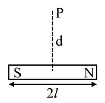
A bar magnet has total length $2 l=20$ units and the field point P is at a distance $\mathrm{d}=10$ units from the centre of the magnet. If the relative uncertainty of length measurement is $1 \%$, then uncertainty of the magnetic field at point P is :
  • A
    $10 \%$
  • B
    $4 \%$
  • C
    $3 \%$
  • D
    $5 \%$
Answer
B,C.
Method-1 :
Without considering uncentainity in $\ell$.
$\mathrm{B}=\frac{\mu_{0}}{4 \pi} \frac{\mathrm{~m}}{\mathrm{r}^{3}}$
$\mathrm{B} \propto \frac{1}{\mathrm{r}^{3}}$
$\frac{\Delta \mathrm{B}}{\mathrm{B}}=3 \times\left(\frac{\Delta \mathrm{r}}{\mathrm{r}}\right)$
$\%$ uncertainity in $\mathrm{B}=3 \%$
Method-2 :
With considering uncentainity in $\ell$.
$\mathrm{B} \propto \frac{1}{\mathrm{r}^{3}}$
$\frac{\Delta \mathrm{B}}{\mathrm{B}}=\frac{\Delta \ell}{\ell}+3 \times\left(\frac{\Delta \mathrm{r}}{\mathrm{r}}\right)=1+3 \times 1=4 \%$
$\%$ uncertainity in $\mathrm{B}=4 \%$
View full question & answer
MCQ 124 Marks
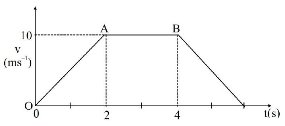
The velocity-time graph of an object moving along a straight line is shown in figure. What is the distance covered by the object between $t=0$ to $\mathrm{t}=4 \mathrm{~s}$ ?
Image
  • A
    30 m
  • B
    10 m
  • C
    13 m
  • D
    11 m
Answer
A.
Distance $=$ Area under v v/s t graph
Distance $=\frac{1}{2} \times 2 \times 10+2 \times 10=30 \mathrm{~m}$
View full question & answer
MCQ 134 Marks
Which of the following phenomena can not be explained by wave theory of light?
  • A
    Reflection of light
  • B
    Diffraction of light
  • C
    Refraction of light
  • D
    Compton effect
Answer
D.
Comptan effect is based on particle nature of light.
View full question & answer
MCQ 144 Marks
The frequency of revolution of the electron in Bohr's orbit varies with $n$, the principal quantum number as
  • A
    $\frac{1}{\mathrm{n}}$
  • B
    $\frac{1}{n^{3}}$
  • C
    $\frac{1}{n^{4}}$
  • D
    $\frac{1}{n^{2}}$
Answer
B.
Frequency of revolution $\propto \frac{1}{\mathrm{n}^{3}}$
View full question & answer
MCQ 154 Marks
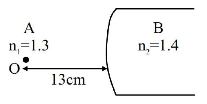
In a long glass tube, mixture of two liquids $A$ and B with refractive indices 1.3 and 1.4 respectively, forms a convex refractive meniscus towards A . If an object placed at 13 cm from the vertex of the meniscus in A forms an image with a magnification of ' -2 ' then the radius of curvature of meniscus is :
  • A
    1 cm
  • B
    $\frac{1}{3} \mathrm{~cm}$
  • C
    $\frac{2}{3} \mathrm{~cm}$
  • D
    $\frac{4}{3} \mathrm{~cm}$
Answer
C.
Image
$\frac{\mathrm{n}_{2}}{\mathrm{v}}-\frac{\mathrm{n}_{1}}{\mathrm{u}} \frac{\mathrm{n}_{2}-\mathrm{n}_{1}}{\mathrm{R}}$
$\frac{1.4}{\mathrm{v}}-\frac{1.3}{-13}=\frac{0.1}{\mathrm{R}}$
$\frac{1.4}{\mathrm{~V}}=\frac{1-\mathrm{R}}{10 \mathrm{R}}$
$\mathrm{m}=\frac{\mathrm{v} / \mathrm{n}_{2}}{\mathrm{u} / \mathrm{n}_{1}}$
$-2 \times \frac{(-13)}{1.3}=\frac{10 \mathrm{R}}{1-\mathrm{R}}$
$\mathrm{R}=\frac{2}{3} \mathrm{~cm}$
View full question & answer
MCQ 164 Marks
The kinetic energy of translation of the molecules in 50 g of $\mathrm{CO}_{2}$ gas at $17^{\circ} \mathrm{C}$ is :
  • A
    3986.3 J
  • B
    4102.8 J
  • C
    4205.5 J
  • D
    3582.7 J
Answer
B.
$(\mathrm{KE})_{\text {Translational }}=\left[\frac{3}{2} \mathrm{KT}\right] \times$ no. of molecule
No. of molecule $=\left[\frac{50}{44} \times 6.023 \times 10^{23}\right]$
$(\mathrm{KE})_{\text {Translational }}=4108.644 \mathrm{~J}$
View full question & answer
MCQ 174 Marks
The ratio of vapour densities of two gases at the same temperature is $\frac{4}{25}$, then the ratio of r.m.s. velocities will be :
  • A
    $\frac{25}{4}$
  • B
    $\frac{2}{5}$
  • C
    $\frac{5}{2}$
  • D
    $\frac{4}{25}$
Answer
C.
$\frac{\rho_{1}}{\rho_{2}}=\frac{4}{25}$
Ratio of rms velocities $=\sqrt{\frac{\rho_{2}}{\rho_{1}}}=\frac{5}{2}$
View full question & answer
MCQ 184 Marks
Match List-I with List-II
List-IList-II
(A) Angular Impulse(I) $\left[\mathrm{M}^{0} \mathrm{~L}^{2} \mathrm{~T}^{-2}\right]$
(B) Latent Heat(II) $\left[\mathrm{M} \mathrm{L}^{2} \mathrm{~T}^{-3} \mathrm{~A}^{-1}\right]$
(C) Electrical resistivity(III) $\left[\mathrm{M} \mathrm{L}^{2} \mathrm{~T}^{-1}\right]$
(D) Electromotive force(IV) $\left[\mathrm{M} \mathrm{L}^{3} \mathrm{~T}^{-3} \mathrm{~A}^{-2}\right]$

Choose the correct answer from the options given below:
  • A
    (A)-(III), (B)-(I), (C)-(IV), (D)-(II)
  • B
    (A)-(I), (B)-(III), (C)-(IV), (D)-(II)
  • C
    (A)-(III), (B)-(I), (C)-(II), (D)-(IV)
  • D
    (A)-(II), (B)-(I), (C)-(IV), (D)-(III)
Answer
A.
Angular impulse $=\left[\mathrm{M} \mathrm{L}^{2} \mathrm{~T}^{-1}\right]$
Latent Heat $=\left[\mathrm{M}^{0} \mathrm{~L}^{2} \mathrm{~T}^{-2}\right]$
Electrical resistivity $=\left[\mathrm{M} \mathrm{L}^{3} \mathrm{~T}^{-3} \mathrm{~A}^{-2}\right]$
Electromotive force $=\left[\mathrm{M} \mathrm{L}^{2} \mathrm{~T}^{-3} \mathrm{~A}^{-1}\right]$
View full question & answer
MCQ 194 Marks
A parallel plate capacitor of capacitance $1 \mu \mathrm{~F}$ is charged to a potential difference of 20 V . The distance between plates is $1 \mu \mathrm{~m}$. The energy density between plates of capacitor is :
  • A
    $1.8 \times 10^{3} \mathrm{~J} / \mathrm{m}^{3}$
  • B
    $2 \times 10^{-4} \mathrm{~J} / \mathrm{m}^{3}$
  • C
    $2 \times 10^{2} \mathrm{~J} / \mathrm{m}^{3}$
  • D
    $1.8 \times 10^{5} \mathrm{~J} / \mathrm{m}^{3}$
Answer
A.
$\mathrm{C}=1 \mu \mathrm{~F}$
$\mathrm{V}=20 \mathrm{~V}$
$\mathrm{d}=1 \mu \mathrm{~m}$
Energy density $==\frac{1}{2} \in_{0} E^{2}$
$E=\frac{V}{d}=20 \times 10^{6} v / m$
$\mathrm{U}=1.77 \times 10^{3} \mathrm{~J} / \mathrm{m}^{3}$
View full question & answer
MCQ 204 Marks
A uniform magnetic field of 0.4 T acts perpendicular to a circular copper disc 20 cm in radius. The disc is having a uniform angular velocity of $10 \pi \mathrm{rad} \mathrm{s}^{-1}$ about an axis through its centre and perpendicular to the disc. What is the protential difference developed between the axis of the disc and the rim ? $(\pi=3.14)$
  • A
    0.0628 V
  • B
    0.5024 V
  • C
    0.2512 V
  • D
    0.1256 V
Answer
C.
$\mathrm{B}=0.4 \mathrm{~T}$
$\mathrm{r}=20 \mathrm{~cm}$
$\omega=10 \pi \mathrm{rad} / \mathrm{s}$
$\mathrm{E}=\frac{1}{2} \mathrm{~B} \omega \mathrm{R}^{2}$
$=0.2512 \mathrm{~V}$
View full question & answer