MCQ
The reaction, $(CH_3)_2C = CH_2 + B{{r}^{\centerdot }} \to (CH_3)_2 \overset{\centerdot }{\mathop{C}}\,- CH_2Br$

is an example of a/an ................ step in a radical chain reaction.

  • A
    initiation
  • B
    termination
  • propagation
  • D
    heterolytic cleavage

Answer

Correct option: C.
propagation
c
$(c)$ Attack of free radical on alkene is an propagation step.

Need a full question paper?

Generate a complete, print-ready paper with questions like this in minutes — across 16+ boards, with answer keys.

Start Generating Free

Similar questions

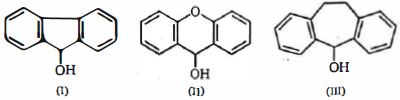
Arrange the following alcohols in decreasing order of the ease of ionization under acidic conditions.
The formation of the oxide ion $O^{2-}(g)$ requires first an exothermic and then  an endothermic step as shown below

$O(g) + e^- \to O^-(g);  \Delta H = - 142 \,kJ \,mol^{-1}$

$O^-(g) + e \to O^{2-} (g); \Delta H = 844\, kJ \,mol^{-1}$

This is because

Which has the shortest $C - C$ bond length
${H_2}{O_{\left( g \right)}} + {C_{\left( s \right)}} \to C{O_{\left( g \right)}} + {H_2}\left( g \right)\,;\,\Delta H = 100\,kJ$

$C{O_{\left( g \right)}} + \frac{1}{2}{O_{2\left( g \right)}} \to C{O_{2\left( g \right)}}\,;\,\Delta H =  - 300\,kJ$

${H_2}_{\left( g \right)} + \frac{1}{2}{O_2}_{\left( g \right)} \to {H_2}{O_{\left( g \right)}}\,;\,\Delta H =  - 250\,kJ$

$C_{(s)} + O_{2(g)} \to  CO_{2(g)} ; \Delta H = -x\, kJ$

The value of $x$ will be

In the gaseous equilibrium ${H_2}{X_2} + $ heat  $\rightleftharpoons$  $2HX$, the formation of $HX$ will be favoured by
Assign $A, B, C, D$ from given type of reaction. $C{l_2}\left( g \right) + KI\left( {aq.} \right) \longrightarrow KCl + {I_2}$
Which of the following repersents same configuration as given molecule
What concentration of $Ac^-$ ions will reduce $H_3O^+$ ion to $2 × 10^{-4}\ M$ in $0.40\ M$ solution of $HAc$ ? $K_a (HAc) = 1.8 × 10^{-5}$ ?
Which of the following is the most stable
The formation of the oxide ion, ${O^{2 - }}\left( g \right)$, from oxygen atom requires first an exothermic and then an endothermic step as shown below

$O\left( g \right) + {e^ - } \to O_{\left( g \right)}^ - \,\,\,\,;\,\,\,\,{\Delta _f}{H^\Theta } =  - 141\,kJ\,mo{l^{ - 1}}$

${O^ - }\left( g \right) + {e^ - } \to O_{\left( g \right)}^{2 - }\,\,\,\,;\,\,\,\,{\Delta _f}{H^\Theta } =  + 780\,kJ\,mo{l^{ - 1}}$

Thus process of formation of $O_2^-$ in gas phase is unfavourable even thought $O_2^-$ is isoelectronic with neon. It is due to the fact that,