MCQ
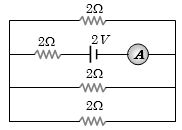
The reading of the ammeter as per figure shown is
- A$\frac{1}{8}\,A$
- ✓$\frac{3}{4}\,A$
- C$\frac{1}{2}\,A$
- D$2\, A$
Total resistance
$ = 2 + \frac{2}{3} = \frac{8}{3}\,\Omega $
Current through ammeter
$ = \frac{2}{{8/3}} = \frac{6}{8} = \frac{3}{4}\,A$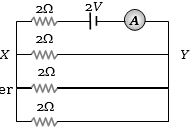
Generate a complete, print-ready paper with questions like this in minutes — across 16+ boards, with answer keys.
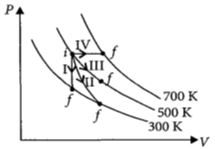
Match the following
$\begin{array}{|l|l|} \hline Column\,\,-\,\,1 & Column\,\,-\,\,2 \\ \hline P\,:\,Process\,\,-\,\,I & \,\,A\,\,:\,\,Adiabatic \\ \hline Q\,:\,Process\,\,-\,\,II & \,\,B\,\,:\,\,Isobaric \\ \hline R\,:\,Process\,\,-\,\,III & \,\,C\,\,:\,\,Isochoric \\ \hline S\,:\,Process\,\,-\,\,IV & \,\,D\,\,:\,\,Isothermal \\ \hline \end{array}$