MCQ
The reagent needed for converting

$Ph - C \equiv C - Ph \to $ 
  • A
    Cat. Hydrogenation
  • B
    $H_2/$ Lindlar Cat.
  • $Li/NH_3$
  • D
    $LiAlH_4$

Answer

Correct option: C.
$Li/NH_3$
c
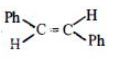
With Lithium in liquid ammonia, trans-alkene is almost an exclusive product.

$Ph-C\equiv C-Ph\xrightarrow[Brich\,reduction]{Li\,in\,liq.N{{H}_{3}}}\begin{matrix}
   ^{Ph}  \\
   _{H}  \\
\end{matrix}\begin{matrix}
   \text{ }\!\!\backslash\!\!\text{ }  \\
   /  \\
\end{matrix}C=C\begin{matrix}
   /  \\
   \text{ }\!\!\backslash\!\!\text{ }  \\
\end{matrix}_{Ph}^{H}$

Need a full question paper?

Generate a complete, print-ready paper with questions like this in minutes — across 16+ boards, with answer keys.
Start Generating Free

Similar questions

Which of the following does not exists as ionic substance in solid state
The liquified gas that is used in dry cleaning along with a suitable detergent is
Product $(A)$ is
No work is done on the system, but $q$ amount of heat is taken out from the system and given to the surrounding. The change in internal energy of a system is :
Among the given compound choose the two that yield same carbocation on ionization.
Assign $A, B, C, D$ from given type of reaction. $P{b_3}{O_4} + HN{O_3}\,\left( {dil} \right)\xrightarrow{{R.T.}}Pb{\left( {N{O_3}} \right)_2} + Pb{O_2} \downarrow $
How many isomers are possible for the following molecule ?
Addition of $HCl$ to $3, 3$ -dimethyl- $1$ -butene yields two products, one of  which has a rearranged carbon skeleton. Among the following carbocations,  select the possible intermediates in that  reaction ?

$\mathop {{{(C{H_3})}_3}C\mathop C\limits^ +  HC{H_2}Cl}\limits_1 $         $\mathop {{{(C{H_3})}_3}C\mathop C\limits^ +  HC{H_3}}\limits_2 $             $\mathop {\begin{array}{*{20}{c}}
  {{{(C{H_3})}_2}C\mathop C\limits^ +  {{(C{H_3})}_2}} \\ 
  {|\,\,\,\,} \\ 
  {Cl\,\,\,} 
\end{array}}\limits_3 $              $\mathop {{{(C{H_3})}_2}\mathop C\limits^ +  CH{{(C{H_3})}_2}}\limits_4 $

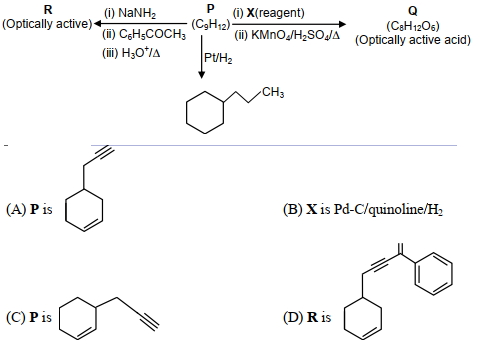
Consider the following transformations of a compound $P$.

(image)

Choose the correct option($s$).

(image)
The complete combustion of $0.492\, g$ of an organic compound containing $'C', 'H'$ and $'O'$ gives $0.793\, g$ of $CO _{2}$ and $0.442\,g$ of $H _{2} O$. The percentage of oxygen composition in the organic compound is .... (nearest integer)