MCQ
The reagent which could distinguish between $1-$ hexyne and $1-$ hexene is 
  • Tollen's reagent
  • B
    Baeyer's reagent
  • C
    Bromine water test
  • D
    All

Answer

Correct option: A.
Tollen's reagent
a
$Ag \left( NH _3\right)_2^{+}$is called Tollen's reagent.

It reacts with terminal alkynes ($1-$hexyne) but not with alkenes ($1-$hexene).

$CH \equiv CCH _2 CH _2 CH _3+ Ag \left( NH _3\right)_2^{+} \rightarrow CH _3 CH _2 CH _2 C \equiv C - Ag + NH _4 OH$

Need a full question paper?

Generate a complete, print-ready paper with questions like this in minutes — across 16+ boards, with answer keys.
Start Generating Free

Similar questions

An electron moving in a circular orbit of radius $r$ makes $n$ rotations per second. The magnetic field produced at the centre has magnitude
A convex lens of focal length $25 cm$ and a concave lens of focal length $10 cm$ are joined together. The power of the combination will be
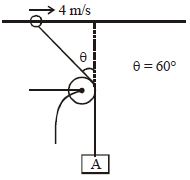
For the given fig. find the speed of block $A$ when $\theta  = {60^o}$
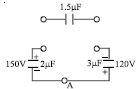
Two capacitors of $2$ $\mu F$ and $3$ $\mu F$ are charged to $150$ $volt$ and $120$ $volt$ respectively. The plates of capacitor are connected as shown in the figure. A discharged capacitor of capacity $1.5$ $\mu F$ falls to the free ends of the wire. Then
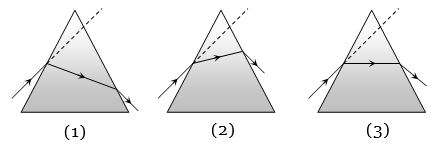
The figures represent three cases of a ray passing through a prism of angle $A.$ The case corresponding to minimum deviation is
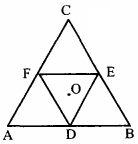
The equilateral triangle $ABC$ is cut from a thin solid sheet of wood. (See figure) $D, E$ and $F$ are the mid points of its sides as shown and $G$ is the centre of the triangle. The moment of inertia of the triangle about an axis passing through $G$ and perpendicular to the plane of the triangle is $I_0.$ If the smaller triangle $DEF$ is removed from $ABC,$ the moment of inertia of the remaining figure about the same axis is $I.$ Then
Photon and electron are given same energy $({10^{ - 20}}J)$. Wavelength associated with photon and electron are ${\lambda _{Ph}}$ and ${\lambda _{el}}$ then correct statement will be
A charge $Q$ is uniformly distributed over the surface of nonconducting disc of radius $R$. The disc rotates about an axis perpendicular to its plane and passing through its centre with an angular velocity $\omega$. As a result of this rotation a magnetic field ofinduction $B$ is obtained at the centre of the disc. If we keep both the amount of charge placed on the disc and its angular velocity to be constant and vary the radius of the disc then the variation of the magnetic induction at the centre of the disc will be represented by the figure
$1$ mole of gas occupies a volume of $100\, ml$ at $50\, mm$ pressure. What is the volume occupied by two moles of gas at $100\, mm$ pressure and at same temperature ..... $ml$
Dispersion of light is due to