MCQ
The reason for the energy associated with a moving charge is:
- ✓electric field
- Bmagnetic field
- Cboth electric and magnetic fields
- Dnone of these
Generate a complete, print-ready paper with questions like this in minutes — across 16+ boards, with answer keys.
If a proton and anti-proton come close to each other and annihilate, how much energy will be released
|
(a) 1.5 |
(b) 3 |
(c) 4.5 |
(d) None of these |
Radioactive nuclei that are injected into a patient collect at certain sites within its body, undergoing radioactive decay and emitting electromagnetic radiation. These radiations can then be recorded by a detector. This procedure provides an important diagnostic tool called
|
(a) Gamma camera |
(b) CAT scan |
|
(c) Radiotracer technique |
(d) Gamma ray spectroscopy |
The instrument that is based on the principle that when an object is placed between first principal focus and the optic centre of convex lens, an upright, virtual and enlarged image on the same side of the object is formed, is:
Energy generation in stars is mainly due to
|
(a) Chemical reactions |
(b) Fission of heavy nuclei |
|
(c) Fusion of light nuclei |
(d) Fusion of heavy nuclei |
The intensity distribution of X-rays from two coolidge tubes operated on different voltages V1 and V2 and using different target materials of atomic numbers Z1 and Z2 is shown in the figure. Which one of the following inequalities is true?
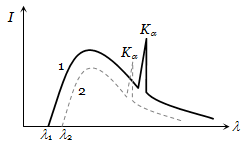
|
(a) V1 > V2, Z1 < Z2 |
(b) V1 > V2, Z1 > Z2 |
(c) V1 < V2, Z1 > Z2 |
(d) V1 = V2, Z1 < Z2 |
The energy of a photon of wavelength  is given by
|
(a) h |
(b) ch |
(c) |
(d) |
In an interference arrangement similar to Young's double slit experiment, the slits S1 and S2 are illuminated with coherent microwave sources each of frequency 106 Hz. The sources are synchronized to have zero phase difference. The slits are separated by distance d = 150 m. The intensity I (𝜃) is measured as a function of q, where q is defined as shown. If I0 is maximum intensity, then I(θ) for 0 ≤ θ ≤ 90° is given by
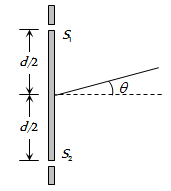
|
(a) I(θ) = |
(b) I(θ) = |
|
(c) I(θ) = |
(d) a, b |


