- A$C{H_3} - CH(C{H_3}) - CH(C{H_3}) - CH(C{H_3}) - C{H_3}$
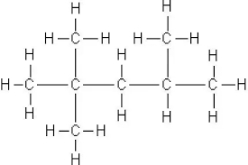
- ✓$C{H_3} - C{(C{H_3})_2} - C{H_2} - CH(C{H_3}) - C{H_3}$
- C$C{H_3} - C{(C{H_3})_2} - CH(C{H_3}) - C{H_2} - C{H_3}$
- D$C{H_3} - C{(C{H_3})_2} - C{(C{H_3})_2} - C{H_3}$
Generate a complete, print-ready paper with questions like this in minutes — across 16+ boards, with answer keys.
$HC \equiv CH\,\xrightarrow[{H{g^{2 + }}}]{{{H_2}S{O_4}}}\,'P'$
Product $'P'$ will not give
Statement-$I$: The orbitals having same energy are called as degenerate orbitals.
Statement-$II$: In hydrogen atom, $3 \mathrm{p}$ and $3 \mathrm{~d}$ orbitals are not degenerate orbitals.
In the light of the above statements, choose the most appropriate answer from the options given

${H_2}C = CH - CH = C{H_2}\xrightarrow[{0{\,^o}C}]{{HBr}}$ $\begin{array}{*{20}{c}}
{{H_2}C = CH - CH - C{H_3}} \\
{\,\,\,\,\,\,\,\,\,\,\,|} \\
{\,\,\,\,\,\,\,\,\,\,\,\,\,\,\,\,\,\,\,Br\,\,\,\,\,\,}
\end{array}\xrightarrow{{ + 25{\,^o}C}}$ $\begin{array}{*{20}{c}}
{C{H_2}CH = CHC{H_3}} \\
{|\,\,\,\,\,\,\,\,\,\,\,\,\,\,\,\,\,\,\,\,\,\,\,\,\,\,\,\,\,\,\,\,\,\,\,\,\,\,\,} \\
{Br\,\,\,\,\,\,\,\,\,\,\,\,\,\,\,\,\,\,\,\,\,\,\,\,\,\,\,\,\,\,\,\,\,\,\,\,}
\end{array}$
These provide an example of $......1......$ control at low temperature and $......2......$ control at higher temperature