MCQ
The relation between equilibrium constant ${K_p}$ and ${K_c}$ is
- A${K_c} = {K_p}\,{(RT)^{\Delta n}}$
- ✓${K_p} = {K_c}{(RT)^{\Delta n}}$
- C${K_p} = {\left( {\frac{{{K_c}}}{{RT}}} \right)^{\Delta n}}$
- D${K_p} - {K_c} = {(RT)^{\Delta n}}$
$aA _{( g )}+ bB _{( g )} \rightleftharpoons cC _{( g )}+ dD _{( g )}$
Let $p _{ A }, p _{ B }, p _{ C }$ and $p _{ D }$ be the partial pressure of $A , B , C$ and $D$ repectively. Therefore,
$K _{ c }=\frac{[ C ]^{ c }[ D ]^{ d }}{[ A ]^{ a }[ B ]^{ b }} \ldots . .(1)$
$K _{ p }=\frac{ pC ^c p _{ D }^{ d }}{ p _{ A }^{ a } p _{ B }^{ b }} \ldots \ldots .(2)$
For an ideal gas-
$PV = nRT$
$\Rightarrow P =\frac{ n }{ V } RT = CRT$
Whereas $C$ is the concentration.
Therefore,
$p _{ A }=[ A ] RT$
$p _{ B }=[ B ] RT$
$p _{ C }=[ C ] RT$
$p _{ D }=[ D ] RT$
Substituting the values in equation $(2),$ we have
$K _{ p }=\frac{[ C ]^{ c }( RT )^{ c }[ D ]^{ d }( RT )^{ d }}{[ A ]^{ a }( RT )^{ a }[ B ]^{ b }( RT )^{ b }}$
$\Rightarrow K _{ p }=\frac{[ C ]^{ c }[ D ]^{ d }}{[ A ]^{ a }[ B ]^{ b }}( RT )^{[( c c )-( a + b )]}$
$\left.\Rightarrow K _{ p }= K _{ c }( RT )^{\Delta n_{ g }} \quad \text { (From (1) }\right]$
Here,
$\Delta n _{ g }=$ Total no. of moles of gaseous product $-$ Total no. of moles of gaseous reactant
Hence the relation between $K_p$ and $K_c$ is-
$K _{ p }= K _{ c }( RT )^{\Delta n _{ g }}$
Generate a complete, print-ready paper with questions like this in minutes — across 16+ boards, with answer keys.
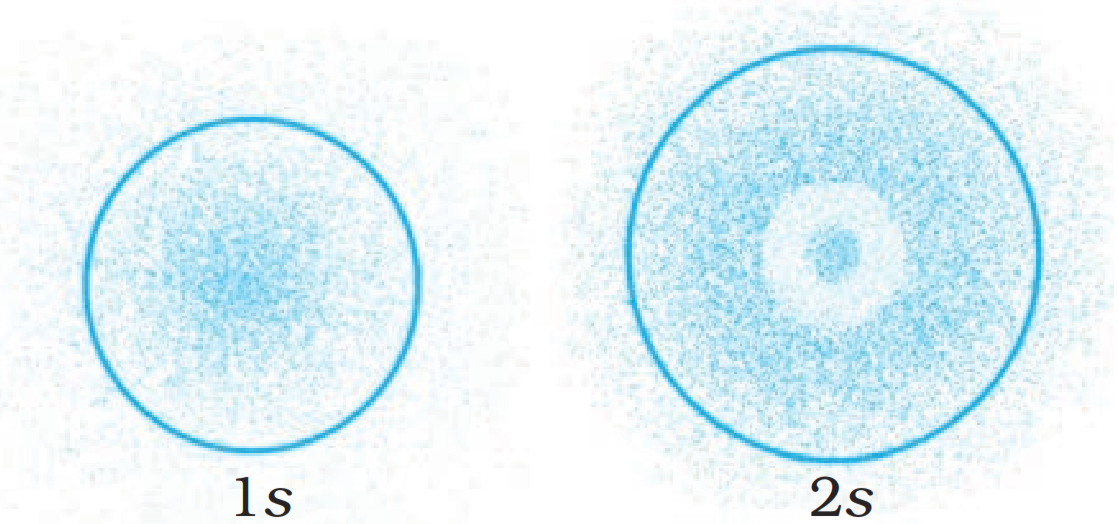
$(A)$ Uncertainty principle rules out the existence of definite paths for electrons.
$(B)$ The energy of an electron in $2 s$ orbital of an atom is lower than the energy of an electron that is infinitely far away from the nucleus.
$(C)$ According to Bohr's model, the most negative energy value for an electron is given by $n=1$, which corresponds to the most stable orbit.
$(D)$ According to Bohr's model, the magnitude of velocity of electrons increases with increase in values of $n$.
| List$-I$ | List$-II$ |
| $A$ $16\,g \text { of } CH _{4( g )}$ | $I$ Weighs $28\,g$ |
| $B$ $1\,g \text { of } H _{2( g )}$ | $II$ $60.2 \times 10^{23}$ electrons |
| $C$ $1\,mole \text { of } N _{2( g )}$ | $III$ Weighs $32\,g$ |
| $D$ $0.5\,mol$ of $SO _{2( g )}$ | $IV$ Occupies $11.4\,L$ volume at STP |
Choose the correct answer from the options given below: