MCQ
The relation between frequency $‘n’$ wavelength ‘$\lambda$’ and velocity of propagation $‘v’$ of wave is
  • A
    $n = v\lambda $
  • B
    $n = \lambda /v$
  • $n = v/\lambda $
  • D
    $n = 1/v$

Answer

Correct option: C.
$n = v/\lambda $
c
(c) Velocity of the wave,

$v=v \lambda$ or $\frac{v}{\lambda}$

Need a full question paper?

Generate a complete, print-ready paper with questions like this in minutes — across 16+ boards, with answer keys.

Start Generating Free

Similar questions

An object, moving with a speed of $6.25\ m/s$, is decelerated at a rate given by:

$\frac{{dv}}{{dt}} = - 2.5\sqrt v $ where $v$ is the instantaneous speed. The time taken by the object, to come to rest, would be........$s$
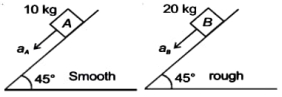
The ratio of acceleration of blocks $A$ placed on smooth incline with block $B$ placed on rough incline is $2: 1$. The coefficient of kinetic friction between block $B$ and incline is .........
An air bubble of volume $1\,cm ^3$ rises from the bottom of a lake $40\,m$ deep to the surface at a temperature of $12^{\circ}\,C$. The atmospheric pressure is $1 \times 10^5 Pa$, the density of water is $1000\,kg / m ^3$ and $g =10\,m / s ^2$. There is no difference of the temperature of water at the depth of $40\,m$ and on the surface. The volume of air bubble when it reaches the surface will be $..........\,cm^{3}$
Periodic time of a satellite revolving above Earth’s surface at a height equal to $R$, radius of Earth, is $R$ [$g$ is acceleration due to gravity at Earth’s surface]
A cyclist turns around a curve at $15\, miles/hour$. If he turns at double the speed, the tendency to overturn is
A capacitor acts as an infinite resistance for:
Choose the correct alternatives:
  1. For a general rotational motion, angular momentum $L$ and angular velocity $\omega$ need not be parallel.
  2. For a rotational motion about a fixed axis, angular momentum $L \omega$ are always parallel.
  3. For a general translational motion , momentum $P$ and velocity $v$ are aways parallel.
  4. For a general translational motion, acceleration $a$ and velocity $v$ are always parallel.
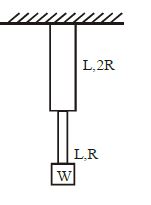
Two wires of the same material (Young's modulus  $Y$ ) and same length $L$  but radii  $R$  and  $2R$  respectively are joined end to end and a weight  $W$  is suspended from the combination as shown in the figure. The elastic potential energy in the system is
Given that; $A = B = C$. If $\vec A + \vec B = \vec C,$ then the angle between $\vec A$ and $\vec C$ is $\theta _1$. If $\vec A + \vec B+ \vec C = 0,$ then the angle between $\vec A$ and $\vec C$ is $\theta _2$. What is the relation between $\theta _1$ and $\theta _2$ ?
A black body at a temperature of $127°C$ radiates heat at the rate of $1 cal/cm^2 × sec$. At a temperature of $527°C$ the rate of heat radiation from the body in ($cal/cm^2 × sec$) will be