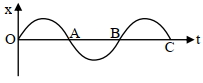
The relation between phase difference $ (\Delta \phi) $ and path difference $ (\Delta x) $ is
Easy
Download our app for free and get started
(a)
Download our app
and get started for free
Experience the future of education. Simply download our apps or reach out to us for more information. Let's shape the future of learning together!No signup needed.*
A car $'A'$ chasing another car $'B'$ with a speed of $20\, m/s$ sounding a horn of $180\, Hz$. While both cars are moving towards a stationary siren of frequency $170\, Hz$. What is the speed of car $B$ so that it can't hear any beat ....$m/s$ (speed of sound $= 340\, m/s$)
When a tuning fork of frequency $341$ is sounded with another tuning fork, six beats per second are heard. When the second tuning fork is loaded with wax and sounded with the first tuning fork, the number of beats is two per second. The natural frequency of the second tuning fork is
The mass per unit length of a uniform wire is $0.135\, g / cm$. A transverse wave of the form $y =-0.21 \sin ( x +30 t )$ is produced in it, where $x$ is in meter and $t$ is in second. Then, the expected value of tension in the wire is $x \times 10^{-2} N$. Value of $x$ is . (Round-off to the nearest integer)
Wave has simple harmonic motion whose period is $4\; sec$ while another wave which also possesses simple harmonic motion has its period $3\; sec$. If both are combined, then the resultant wave will have the period equal to ....... $sec$
Two tuning forks of frequencies $256$ and $258$ vibrations/sec are sounded together, then time interval between consecutive maxima heard by the observer is ..... $sec$
A string fixed at both ends is in resonance in its $2^{nd}$ harmonic with a tuning fork of frequency $f_1$. Now its one end becomes free. If the frequency of the tuning fork is increased slowly from $f_1$ then again a resonance is obtained when the frequency is $f_2$. If in this case the string vibrates in $n^{th}$ harmonic then