MCQ
The relation between position $( x )$ and time ( $t$ ) are given below for a particle moving along a straight line. Which of the following equation represents uniformly accelerated motion? [where $\alpha$ and $\beta$ are positive constants]
  • A
    $\beta x=\alpha t+\alpha \beta$
  • B
    $\alpha x=\beta+t$
  • C
    $x t=\alpha \beta$
  • $\alpha t=\sqrt{\beta+x}$

Answer

Correct option: D.
$\alpha t=\sqrt{\beta+x}$
d
(d)

For uniformly accelerated motion,

$v^2=u^2+2 a s$ 

$\quad \downarrow$

Constant

or 

$s=ut+\frac{1}{2} a t^2$

$\quad \downarrow$

Constant

$x=\frac{1}{2} a t^2+u t$

Or the maximum power of $t$ has to be two.

So, $4$.

Need a full question paper?

Generate a complete, print-ready paper with questions like this in minutes — across 16+ boards, with answer keys.

Start Generating Free

Similar questions

A substance of mass $m\, kg$ requires a power input of $P$ watts to remain in the molten state at its melting point. When the power is turned off, the sample completely solidifies in time $t$ sec. What is the latent heat of fusion of the substance
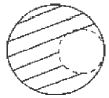
From a solid sphere of mass $M$ and radius $R$, a spherical portion of radius $R/2$ is removed, as shown in the figure. Taking gravitational potential $V = 0$ at $r = \infty$, the potential at the centre of the cavity thus formed is 
( $G =$ gravitational constant)
Four rods of same material and having the same cross section and length have been joined, as shown. The temperature of the junction of four rods will be ............... $^{\circ} C$
A scooter accelerates from rest for time $t_{1}$ at constant rate $a _{1}$ and then retards at constant rate $a _{2}$ for time $t _{2}$ and comes to rest. The correct value of $\frac{t_{1}}{t_{2}}$ will be ..... .
When a capillary tube is dipped in water it rises upto $8$ $cm$ in the tube. What happens when the tube is pushed down such that its end is only $5$ $cm$ above the outside water level
One mole of an ideal gas $(\gamma  = 1.4)$ is adiabatically compressed so that its temperature rises from $27\,^oC$ to $35\,^oC$. The change in the internal energy of the gas is  .... $J$ (given $R = 8.3 \,J/mole/K$)
A firecracker is thrown with velocity of $30 \,ms ^{-1}$ in a direction which makes an angle of $75^{\circ}$ with the vertical axis. At some point on its trajectory, the firecracker splits into two identical pieces in such a way that one piece falls $27 \,m$ far from the shooting point. Assuming that all trajectories are contained in the same plane, how far will the other piece fall from the shooting point? (Take, $g=10 \,ms ^{-2}$ and neglect air resistance)
The angle between the vectors $\overrightarrow A $ and $\overrightarrow B $ is $\theta .$ The value of the triple product $\overrightarrow A \,.\,(\overrightarrow B \times \overrightarrow A \,)$ is
When a gas filled in a closed vessel is heated by raising the temperature by $1^{\circ} C$, its pressure increase by $0.4 \%$. The initial temperature of the gas is ..........$K$
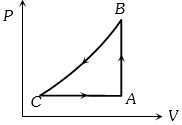
A sample of an ideal gas is taken through a cycle a shown in figure. It absorbs $50J$ of energy during the process $AB$, no heat during $BC$, rejects $70J$ during $CA.$ $40J$ of work is done on the gas during $BC$. Internal energy of gas at $A$ is $1500J$, the internal energy at $C$ would be ........ $J$