MCQ
The relation between root mean square speed $\left( v _{ rms }\right)$ and most probable speed $\left( v _{ p }\right)$ for the molar mass $M$ of oxygen gas molecule at the temperature of $300\, K$ will be
  • A
    $v _{ rms }=\sqrt{\frac{2}{3}} v _{ p }$
  • $v _{ rms }=\sqrt{\frac{3}{2}} v _{ p }$
  • C
    $v _{ rms }= v _{ p }$
  • D
    $v _{ rms }=\sqrt{\frac{1}{3}} v _{ p }$

Answer

Correct option: B.
$v _{ rms }=\sqrt{\frac{3}{2}} v _{ p }$
b
$v _{ rms }=\sqrt{\frac{3 RT }{ M }} \text { and } v _{ mp }=\sqrt{\frac{2 RT }{ M }}$

Thus $v _{ rms }=\sqrt{\frac{3}{2}} v _{ mp }$

Need a full question paper?

Generate a complete, print-ready paper with questions like this in minutes — across 16+ boards, with answer keys.

Start Generating Free

Similar questions

The pressure $P,$ volume $V$ and temperature $T$ of a gas in the jar $A$ and the other gas in the jar $B$ at pressure $2P,$ volume $V/4$ and temperature $2T,$ then the ratio of the number of molecules in the jar $A$ and $B$ will be
A projectile of mass $3m$ is moving at $40\, m/s$ at is highest point, where it breaks into two parts $m$ and $2m$. Mass $2m$ moves vertically up at $25\, m/s$. The other part will move at speed  .................... $\mathrm{m}/ \mathrm{s}$
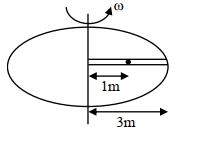
A circular table is rotating with an angular velocity of $\omega \mathrm{rad} / \mathrm{s}$ about its axis (see figure). There is a smooth groove along a radial direction on the table. A steel ball is gently placed at a distance of $1 \mathrm{~m}$ on the groove. All the surface are smooth. If the radius of the table is $3 \mathrm{~m}$, the radial velocity of the ball w.r.t. the table at the time ball leaves the table is $x \sqrt{2} \omega \mathrm{m} / \mathrm{s}$, where the value of $x$ is............
A tuning fork resonates with a sonometer wire of length $1 \mathrm{~m}$ stretched with a tension of $6 \mathrm{~N}$. When the tension in the wire is changed to $54 \mathrm{~N}$, the same tuning fork produces $12$ beats per second with it. The frequency of the tuning fork is $\mathrm{Hz}$.
Consider a Vernier callipers in which each $1 \ cm$ on the main scale is divided into $8$ equal divisions and a screw gauge with $100$ divisions on its circular scale. In the Vernier callipers, $5$ divisions of the Vernier scale coincide with $4$ divisions on the main scale and in the screw gauge, one complete rotation of the circular scale moves it by two divisions on the linear scale. Then:

$(A)$ If the pitch of the screw gauge is twice the least count of the Vernier callipers, the least count of the screw gauge is $0.01 \ mm$.

$(B)$ If the pitch of the screw gauge is twice the least count of the Vernier callipers, the least count of the screw gauge is $0.005 \ mm$.
$(C)$ If the least count of the linear scale of the screw gauge is twice the least count of the Vernier callipers, the least count of the screw gauge is $0.01 \ mm$.

$(D)$ If the least count of the linear scale of the screw gauge is twice the least count of the Vernier callipers, the least count of the screw gauge is $0.005 \ mm$.

Which of the following is unitless quantity ?
A person walks $25.0^{\circ}$ north of east for $3.18 \,km$. How far would she have to walk due north and then due east to arrive at the same location?
The escape speed of a projectile on the earth's surface is $11.2\; km s ^{-1} .$ A body is projected out with thrice this speed. What is the speed (in $km/s$) of the body far away from the earth? Ignore the presence of the sun and other planets.
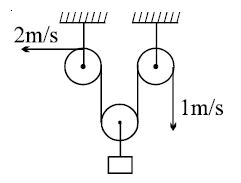
Find the velocity of the hanging block if the velocities of the free ends of the rope are as indicated in the figure.
A wave of frequency $100 Hz$ is sent along a string towards a fixed end. When this wave travels back after reflection, a node is formed at a distance of $10 cm$ from the fixed end of the string. The speed of incident (and reflected) wave are .... $m/s$