Question
The relation between the linear magnification m, the object distance u and the focal length f is
|
(a) |
(b) |
(c) |
(d) |
The relation between the linear magnification m, the object distance u and the focal length f is
|
(a) |
(b) |
(c) |
(d) |
(b) 
Generate a complete, print-ready paper with questions like this in minutes — across 16+ boards, with answer keys.
Lenz’s law applies to
|
(a) Electrostatics |
(b) Lenses |
|
(c) Electro-magnetic induction |
(d) Cinema slides |
The wavelength of light visible to eye is of the order of
|
(a) |
(b) |
(c) 1 m |
(d) 6 |
When  is bombarded with one neutron, the fission occurs and the products are three neutrons,
  and
and
(a) 
|
(b) 
|
(c) 
|
(d) 
|
The amplification factor of a triode valve is 15. If the grid voltage is changed by 0.3 volt the change in plate voltage in order to keep the plate current constant (in volt) is
|
(a) 0.02 |
(b) 0.002 |
(c) 4.5 |
(d) 5.0 |
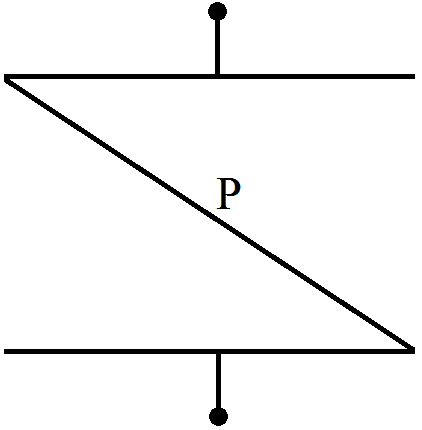
A lens of focal power 0.5 D is
|
(a) A convex lens of focal length 0.5 m |
|
(b) A concave lens of focal length 0.5 m |
|
(c) A convex lens of focal length 2 m |
|
(d) A concave lens of focal length 2 m |
A closely wound coil of 100 turns and area of cross-section  has a coefficient of self-induction 1 mH. The magnetic induction in the centre of the core of the coil when a current of 2A flows in it, will be
|
(a) |
(b) |
(c) |
(d) |
prism can produce a minimum deviation $\delta$ in a light beam. If three such prisms are combined, the minimum deviation that can be produced in this beam is:
A particle with  of charge and
  mass is moving with a velocity of
  along the y-axis. A uniform static magnetic field B = 0.5 Tesla is acting along the x-direction. The force on the particle is
|
(a) 5 × |
(b) 5 |
|
(c) 5 × |
(d) 5 |


