MCQ
The relaxation time in conductors
  • A
    Increases with the increase of temperature
  • Decreases with the increase of temperature
  • C
    It does not depend on temperature
  • D
    All of sudden changes at $400\, K$

Answer

Correct option: B.
Decreases with the increase of temperature
b
(b) Because as temperature increases, the resistivity increases and hence the relaxation time decreases for conductors $\left( {\tau \propto \frac{1}{\rho }} \right).$

Need a full question paper?

Generate a complete, print-ready paper with questions like this in minutes — across 16+ boards, with answer keys.
Start Generating Free

Similar questions

The pointer of a dead-beat galvanometer gives a steady deflection because
Water rises in a capillary tube to a certain height such that the upward force due to surface tension is balanced by $75 \times {10^{ - 4}}\,N$ force due to the weight of the liquid. If the surface tension of water is $6 \times {10^{ - 2}}\,N{m^{ - 1}}$, the inner circumference of the capillary must be
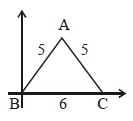
A thin uniform wire is bent to form the two equal sides $AB$ and $AC$ of triangle $ABC$, where $AB = AC = 5\,cm.$ The third side $BC$, of length $6\,cm,$ is made from  uniform wire of twice the density of the first. The distance of centre of mass from $A$ is
The molar heat capacity in a process of a diatomic gas if it does a work of $\frac{Q}{4}$ when a heat of $Q$ is supplied to it is
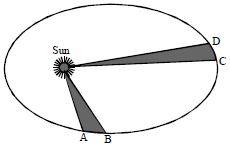
The fig. shows the motion of a planet around the un in an elliptical orbit with sun at the  focus. The shaded areas can be assumed to be equal. If $t_1$ and $t_2$ represent the  time taken for the planet to move from $A$ to $B$ and $C$ to $D$ respectively, then
Vector product of two vectors $2\hat i\, + \,\hat j\,$ and $\hat i\, + \,2\hat j\,$ is
A sphere of density $\rho $ , specific heat capacity $c$ and radius $r$ is hung by a thermally insulating thread in an enclosure which is kept at a lower temperature than the sphere. The temperature of the sphere starts to drop at a rate which depends upon the temperature difference between the sphere and the enclosure and the nature of the surface of sphere and is proportional to
The ionisation potential of hydrogen atom is $13.6\, volt$. The energy required to remove an electron in the $n = 2$ state of the hydrogen atom is.....$eV$
A straight wire carrying a current $10\, A$ is bent into a semicircular arc of radius $5\, cm.$ The magnitude of magnetic field at the center is
An electric dipole has the magnitude of its charge as $q$ and its dipole moment is $p$. It is placed in a uniform electric field $E$. If its dipole moment is along the direction of the field, the force on it and its potential energy are respectively