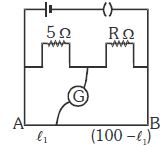
The resistance in the two arms of a meter bridge are $5\,\Omega $ and $R\,\Omega $, respectively. When the resistance $R$ is shunted with an equal resistance, the new balance point is at $1.6\, l_1$. The resistance $‘R’$ is ................. $\Omega$
Medium
Download our app for free and get started
$\frac{5}{\mathrm{R}}=\frac{\ell_{1}}{100-\ell_{1}}$ and $\frac{5}{\mathrm{R} / 2}=\frac{1.6 \ell_{1}}{100-1.6 \ell_{1}}$
$\Rightarrow \mathrm{R}=15\, \Omega$

Download our appand get started for free
Experience the future of education. Simply download our apps or reach out to us for more information. Let's shape the future of learning together!No signup needed.*
Similar Questions
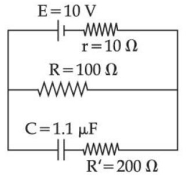
- 1As show in the figure, in steady state, the charge stored in the capacitor is....... $\times 10^{-6}\,C$.View Solution
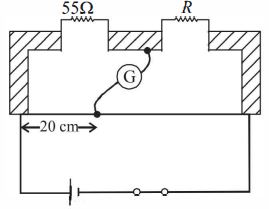
- 2Shown in the figure below is a meter-bridge set up with null deflection in the galvanometer. The value of the unknown resistor $R$ is ............. $\Omega$View Solution
- 3A resistance wire connected in the left gap of a meter bridge balances a $10\, \Omega$ resistance in the right gap at a point which divides the bridge wire in the ratio $3: 2 .$ If the length of the resistance wire is $1.5 m ,$ then the length of $1\, \Omega$ of the resistance wire is $....... \times 10^{-2}\;m$View Solution
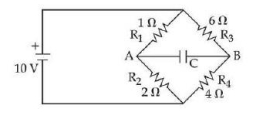
- 4The charge accumulated on the capacitor connected in the following circuit is________ $\mu \mathrm{C}$ (Given $\mathrm{C}=150\ \mu \mathrm{F}$ )View Solution
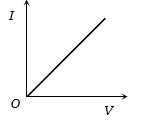
- 5$I-V$ characteristic of a copper wire of length $L$ and area of cross-section $A$ is shown in figure. The slope of the curve becomesView Solution
- 6At what temperature will the resistance of a copper wire become three times its value at $0\,^oC$ ................. $^oC$ (Temperature coefficient of resistance for copper = $4 × 10^{-3} \,per\, \,^oC$ )View Solution
- 7View SolutionEmf is most closely related to
- 8In a region $10^{19}$ $\alpha -$ particels and $10^{19}$ protons per second move to the left, while $10^{19}$ electrons moves to the right per second. The current isView Solution
- 9View SolutionThe lead wires should have
- 10Two rods of same material and length have their electric resistance in ratio $1:2$. When both rods are dipped in water, the correct statement will beView Solution