The resistance of a conductor at $15^{\circ} {C}$ is $16\, \Omega$ and at $100\, {C}$ is $20\, \Omega$. What will be the temperature coefficient of resistance of the conductor?
JEE MAIN 2021, Medium
Download our app for free and get started
variation of resistance with temperature
$16=R_{0}\left[1+\alpha\left(15-T_{0}\right)\right]$
$20=R_{0}\left[1+\alpha\left(100-T_{0}\right)\right]$
Assuming ${T}_{0}=0^{\circ} {C}$, as a general convention.
$\Rightarrow \frac{16}{20}=\frac{1+\alpha \times 15}{1+\alpha \times 100} \Rightarrow \alpha=0.003^{\circ} {C}^{-1}$

Download our appand get started for free
Experience the future of education. Simply download our apps or reach out to us for more information. Let's shape the future of learning together!No signup needed.*
Similar Questions
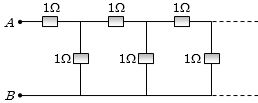
- 1The equivalent resistance between points $A$ and $B$ of an infinite network of resistances each of $1\,\Omega $ connected as shown, isView Solution
- 2An electric fan and a heater are marked as $100\, watt$, $220\, volt$ and $1000\, watt$, $220\, volt$ respectively. The resistance of the heater isView Solution
- 3A wire has a resistance of $12\, ohm$. It is bent in the form of equilateral triangle. The effective resistance between any two corners of the triangle isView Solution
- 4View SolutionAssertion : Kirchoff 's junction rule follows from conservation of charge.
Reason : Kirchoff 's loop rule follows from conservation of momentum.
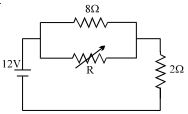
- 5The value of the resistance $R$ in figure is adjusted such that power dissipated in the $2\,\Omega$ resistor is maximum. Under this conditionView Solution
- 6We have a galvanometer of resistance $25\,\Omega $. It is shunted by a $2.5\,\Omega $ wire. The part of total current that flows through the galvanometer is given asView Solution
- 7ln a balanced wheat stone bridge, current in the galvanometer is zero. It remains zero when:View Solution
$[1]$ battery emf is increased
$[2]$ all resistances are increased by $10\,ohms$
$[3]$ all resistances are made five times
$[4]$ the battery and the galvanometer are interchanged
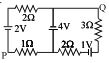
- 8In the circuit shown, what is the potential difference $V_{PQ}$? ................ $V$View Solution
- 9This question has Statement $1$ and Statement $2.$ Of the four choices given after the Statements, choose the one that best describes the two Statements.View Solution
Statement $1 :$ The possibility of an electric bulb fusing is higher at the time of switching $ON.$
Statement $2:$ Resistance of an electric bulb when it is not lit up is much smaller than when it is lit up.
- 10Eight copper wire of length $l$ and diameter $d$ are joined in parallel to form a single composite conductor of resistance $R$. If a single copper wire of length $2\,l$ have the same resistance $(R)$ then its diameter will be $.....d$.View Solution