The resistance of the filament of an electric bulb changes with temperature. If an electric bulb rated $220\, volt$ and $100\, watt$ is connected $(220 \times 0.8)$ $volt$ sources, then the actual power would be
Diffcult
Download our app for free and get started
(d) ${P_1} = \frac{{{{(220)}^2}}}{{{R_1}}}$ and ${P_2} = \frac{{{{(220 \times 0.8)}^2}}}{{{R_2}}}$
$\frac{{{P_2}}}{{{P_1}}} = \frac{{{{(220 \times 0.8)}^2}}}{{{{(220)}^2}}} \times \frac{{{R_1}}}{{{R_2}}}$ $⇒$ $\frac{{{P_2}}}{{{P_1}}} = {(0.8)^2} \times \frac{{{R_1}}}{{{R_2}}}$ Here $R_2 < R_1$
(because voltage decreases from $220 V ⇒ 220 × 0.8 \,V$
It means heat produced $⇒$ decreases)
So $\frac{{{R_1}}}{{{R_2}}} > 1$ $⇒$ ${P_2} > {(0.8)^2}{P_1}$ $⇒$ ${P_2} > {(0.8)^2} \times 100\,W$
Also $\frac{{{P_2}}}{{{P_1}}} = \frac{{(220 \times 0.8){i_2}}}{{220\,{i_1}}},$ Since ${i_2} < {i_1}$ (we expect)
So $\frac{{{P_2}}}{{{P_1}}} < 0.8$ $⇒$ ${P_2} < (100 \times 0.8)$
Hence the actual power would be between $100 \times {(0.8)^2}\,W$ and $(100 × 0.8)\, W$
$\frac{{{P_2}}}{{{P_1}}} = \frac{{{{(220 \times 0.8)}^2}}}{{{{(220)}^2}}} \times \frac{{{R_1}}}{{{R_2}}}$ $⇒$ $\frac{{{P_2}}}{{{P_1}}} = {(0.8)^2} \times \frac{{{R_1}}}{{{R_2}}}$ Here $R_2 < R_1$
(because voltage decreases from $220 V ⇒ 220 × 0.8 \,V$
It means heat produced $⇒$ decreases)
So $\frac{{{R_1}}}{{{R_2}}} > 1$ $⇒$ ${P_2} > {(0.8)^2}{P_1}$ $⇒$ ${P_2} > {(0.8)^2} \times 100\,W$
Also $\frac{{{P_2}}}{{{P_1}}} = \frac{{(220 \times 0.8){i_2}}}{{220\,{i_1}}},$ Since ${i_2} < {i_1}$ (we expect)
So $\frac{{{P_2}}}{{{P_1}}} < 0.8$ $⇒$ ${P_2} < (100 \times 0.8)$
Hence the actual power would be between $100 \times {(0.8)^2}\,W$ and $(100 × 0.8)\, W$

Download our appand get started for free
Experience the future of education. Simply download our apps or reach out to us for more information. Let's shape the future of learning together!No signup needed.*
Similar Questions
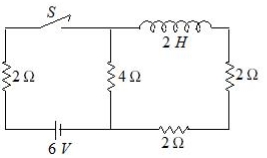
- 1For the given circuit the current through battery of $6\,V$ just after closing the switch ' $S$ ' will be$.......A$.View Solution
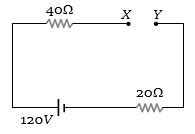
- 2Potential difference across the $40\,\Omega $ resistance will be ............ $V$View Solution
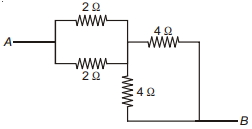
- 3Effective resistance across $A B$ in the network shown in .......... $\Omega$View Solution
- 4View SolutionAs the temperature of a conductor increases, its resistivity and conductivity change. The ratio of resistivity to conductivity
- 5A rise of temperature of $4\,^oC$ is observed in a conductor by passing a current. If the current is tripled, the rise temperature will be .............. $^oC$View Solution
- 6A resistor develops $300 \,J$ of thermal energy in $15 \,s$, when a current of $2\, A$ is passed through it. If the current increases to $3 \,A$, the energy developed in $10\,\,s$ is........$J.$View Solution
- 7The total current supplied to the circuit by the battery is ............. $A$View Solution
- 8View SolutionThe drift velocity does not depend upon
- 9A cell, shunted by a $8 \; \Omega$ resistance, is balanced across a potentiometer wire of length $3 \; m$. The balancing length is $2 \; m$ when the cell is shunted by $4 \; \Omega$ resistance. The value of internal resistance of the cell will be $\dots \; \Omega .$View Solution
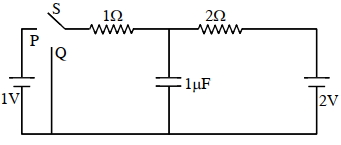
- 10In the circuit shown below, the switch $S$ is connected to position $P$ for a long time so that the charge on the capacitor becomes $q _1 \mu C$. Then $S$ is switched to position $Q$. After a long time, the charge on the capacitor is $q _2 \mu C$.View Solution
($1$) The magnitude of $q_1$ is
($2$) The magnitude of $q _2$ is
Give the answer of question ($1$) and ($2$)