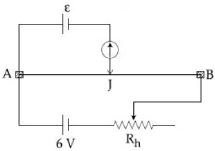
The resistance of the meter bridge $AB$ in given figure is $4\,\Omega $. With a cell of emf $\varepsilon \, = 0.5\,\,V$ and rheostat resistance $R_h = 2\,\Omega $ the null point is obtained at some point $J.$ When the cell is replaced by another one of emf $\varepsilon \, = {\varepsilon _2}$ the same null point $J$ is found for $R_h = 6\,\Omega .$ The $emf$ ${\varepsilon _2}$ is ................. $V$
JEE MAIN 2019, Diffcult
Download our app for free and get started
$0.5=\frac{6}{(2+\lambda L)} \lambda x$ ......$(1)$
$E_{2}=\frac{6}{(6+\lambda L)} \lambda x$ .......$(2)$
So dividing equation $( 1)$ and $( 2)$
$\frac{E_{2}}{0.5}=\frac{2+4}{6+4}=\frac{3}{5}$
$\Rightarrow \quad E_{2}=0.3$ $volt$

Download our appand get started for free
Experience the future of education. Simply download our apps or reach out to us for more information. Let's shape the future of learning together!No signup needed.*
Similar Questions
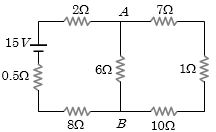
- 1The current from the battery in circuit diagram shown is .............. $A$View Solution
- 2Given below are two statements:View Solution
Statement $I$ : A uniform wire of resistance $80\,\Omega$ is cut into four equal parts. These parts are now connected in parallel. The equivalent resistance of the combination will be $5\,\Omega$.
Statement $II :$ Two resistance $2\,R$ and $3\,R$ are connected in parallel in a electric circuit. The value of thermal energy developed in $3\,R$ and $2\,R$ will be in the ratio $3:2.$
In the light of the above statements, choose the most appropriate answer from the options given below
- 3Given below are two statementsView Solution
Statement $I:$ The equivalent resistance of resistors in a series combination is smaller than least resistance used in the combination.
Statement $II$ : The resistivity of the material is independent of temperature.
In the light of the above statements, choose the correct answer from the options given below
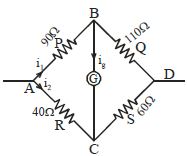
- 4In a Wheatstone bridge, $P = 90\,\Omega $, $Q = 110\,\Omega $ , $R = 40\,\Omega $ and $S = 60\,\Omega $ and a cell of $4\,V\,emf$. Then the potential difference between the diagonal along which a galvanometer is connected is ............. $V$View Solution
- 5A capacitor is connected to a cell of $emf$ $E$ having some internal resistance $r$. The potential difference across theView Solution
- 6View SolutionAssertion : In a simple battery circuit, the point of the lowest potential is negative terminal of the battery.
Reason : The current flows towards the point of the higher potential, as it does in such a circuit from the negative to the positive terminal.
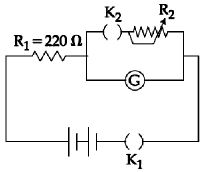
- 7The galvanometer deflection, when key $K_1$ is closed but $K_2$ is open, equals $\theta_0$ (see figure). On closing $K_2$ also and adjusting $R_2$ to $5\,\Omega $ , the deflection in galvanometer becomes $\frac{{\theta _0}}{5}$. The resistance of the galvanometer is, then, given by [Neglect the internal resistance of battery]: .................. $\Omega$View Solution
- 8Thomson coefficient of a conductor is $10\,\mu V/K$. The two ends of it are kept at ${50\,^o}C$ and ${60\,^o}C$ respectively. Amount of heat absorbed by the conductor when a charge of $10\,C$ flows through it isView Solution
- 9Column $- I$ gives certain physical terms associated with flow of current through a metallic conductor. Column $- II$ gives some mathematical relations involving electrical quantities. Match Column $- I$ and Column $- II$ with appropriate relations.View Solution
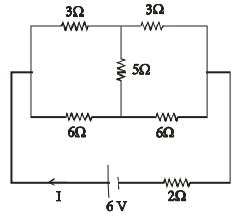
Column $- I$ Column $- II$ $(A)$ Drift Velocity $(P)$ $\frac{m}{n e^{2} \rho}$ $(B)$ Electrical Resistivity $(Q)$ $\mathrm{ne} v_{\mathrm{d}}$ $(C)$ Relaxation Period $(R)$ $\frac{\mathrm{eE}}{\mathrm{m}} \tau$ $(D)$ Current Density $(S)$ $\frac{E}{J}$ - 10A battery of $6\,V$ is connected to the circuit as shown below. The current I drawn from the battery is:View Solution