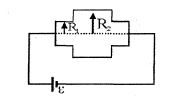
Thomson coefficient of a conductor is $10\,\mu V/K$. The two ends of it are kept at ${50\,^o}C$ and ${60\,^o}C$ respectively. Amount of heat absorbed by the conductor when a charge of $10\,C$ flows through it is
Easy
Download our app for free and get started
(d) By using $H = \sigma Q\theta $
$ \Rightarrow $ $H = (10 \times {10^{ - 6}}) \times 10 \times (60 - 50) = {10^{ - 3}}J = 1\,\,mJ$
$ \Rightarrow $ $H = (10 \times {10^{ - 6}}) \times 10 \times (60 - 50) = {10^{ - 3}}J = 1\,\,mJ$

Download our appand get started for free
Experience the future of education. Simply download our apps or reach out to us for more information. Let's shape the future of learning together!No signup needed.*
Similar Questions
- 1At room temperature $\left(27^{\circ} \mathrm{C}\right)$, the resistance of a heating element is $50 \Omega$. The temperature coefficient of the material is $2.4 \times 10^{-4}{ }^{\circ} \mathrm{C}^1$. The temperature of the element, when its resistance is $62 \Omega$, is $\qquad$ ${ }^{\circ} \mathrm{C}$.View Solution
- 2Four wires $AB,\,\,BC,\,\,CD,\,\,DA$ of resistance $4\, \Omega$ each and a fifth wire $BD$ of resistance $8\, \Omega$ are joined to form a rectangle $ABCD$ of which $BD$ is a diagonal. The effective resistance between the points $A$ and $B$ isView Solution
- 3The Kirchhooff's first law $\left(\sum i=0\right)$ and second law ( $\left.\sum i R=\sum E\right)$, where the symbols have their usual meanings, are respectively based onView Solution
- 4Ratio of thermal energy released in two resistor $R$ and $3 R$ connected in parallel in an electric circuit is :View Solution
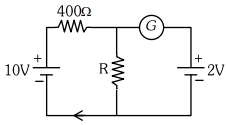
- 5If the galvanometer $G$ does not show any deflection in the circuit shown, the value of $R$ is given by $............\Omega$View Solution
- 6View SolutionAn energy source will supply a constant current into the load if its internal resistance is
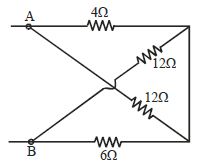
- 7In given Network the equivalent resistance between $A$ and $B$ is .............. $\Omega$View Solution
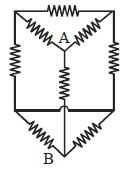
- 8Effective resistance between points $A$ and $B$ for following network is (each branch of resistance is $R$)View Solution
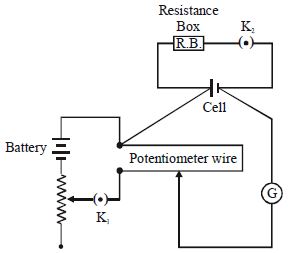
- 9The adjoining figure shows the connections of potentiometer experiment to determine internal resistance of of a leclanche cell. When the cell is on open circuit the balancing length of the potentiometer wire is $3.4\, m$ and on closing the key $K_2$ the balancing length becomes $1.7\, m$ . If the resistance $R$ through which current is drawn is $10\,\Omega $ then the internal resistance of the cell is .............. $\Omega$View Solution
- 10A cylindrical resistance is connected across battery $\varepsilon $ . Cylinder has uniform free electron density, mid part of cylinder has larger radius as shown in figure. Then $V_d$ (drift velocity) $V/S$ (distance across the length of the resistance)View Solution