The resistivity of a wire depends on its
Easy
Download our app for free and get started
(d) Resistivity depends only on the material of the conductor.

Download our appand get started for free
Experience the future of education. Simply download our apps or reach out to us for more information. Let's shape the future of learning together!No signup needed.*
Similar Questions
- 1The length of the resistance wire is increased by $10\%$. What is the corresponding change in the resistance of wire ................ $\%$View Solution
- 2View SolutionAn electric heater kept in vacuum is heated continuously by passing electric current. Its temperature
- 3View SolutionWhen the length and area of cross-section both are doubled, then its resistance
- 4A bulb of $100\, W$ is connected in parallel with an ideal inductance of $1\, H$. This arrangement is connected to a $90\,V$ battery through a switch. On pressing the switch, theView Solution
- 5In a meter bridge, the balancing length from the left end (standard resistance of $1 \,ohm$ is in the right gap) is found to be $20\, cm$. The value of the unknown resistance is ............... $\Omega$View Solution
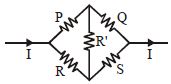
- 6Wheat stone bridge is balanced. Find ratio of electric power dissipated in $(P + Q)$ to $(R + S)$View Solution
- 7A certain wire has a resistance $R$. The resistance of another wire identical with the first except having twice its diameter isView Solution
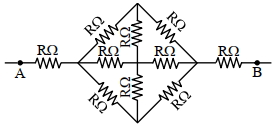
- 8The effective resistance between $A$ and $B$, if resistance of each resistor is $R$, will beView Solution
- 9A filament bulb $(500 \,W,\,\, 100 \,V)$ is to be used in a $230\, V$ main supply. When a resistance $R$ is connected in series, it works perfectly and the bulb consumes $500\,W.$ The value of $R$ is .................. $\Omega$View Solution
- 10Calculate the amount of charge flowing in $2$ minutes in a wire of resistance $10$ $\Omega$ when a potential difference of $20\,V$ is applied between its ends ............ $C$View Solution