MCQ
The resolving power of a telescope depends on
  • A
    Focal length of eye lens
  • B
    Focal length of objective lens
  • C
    Length of the telescope
  • Diameter of the objective lens

Answer

Correct option: D.
Diameter of the objective lens
d
(d) Resolving power of telescope $ = \frac{d}{{1.22\;\lambda }}$

Need a full question paper?

Generate a complete, print-ready paper with questions like this in minutes — across 16+ boards, with answer keys.
Start Generating Free

Similar questions

The distance of the centres of moon and earth is $D$. The mass of earth is $81$ times the mass of the moon. At what distance from the centre of the earth, the gravitational force will be zero
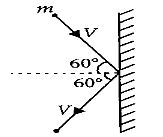
A rigid ball of mass $m$ strikes a rigid wall at $60^\circ $ and gets reflected without loss of speed as shown in the figure. The value of impulse imparted by the wall on the ball will be
Three liquids of densities $\rho _1,\rho _2$ and $\rho _3$ (with $\rho _1 > \rho _2 > \rho_3),$ having the same value of surface tension $T,$ rise to the same height in three identical capillaries. The angles of contact $\theta_1 \,,\theta_2$ and $\theta_3$ obey  
The total charge on the system of capacitance $C _{1}=1\,\mu F , C _{2}=2\,\mu F , C _{3}=4\,\mu F$ and $C _{4}=3\,\mu F$ connected in parallel is $......\mu C$ (Assume a battery of $20\,V$ is connected to the combination)
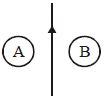
$A$ and $B$ are two metallic rings placed at opposite sides of an infinitely long straight  conducting wire as shown. If current in the wire is slowly decreased, the direction of  induced current will be :
$80\, gm$ of water at $30°C$ are poured on a large block of ice at $0°C.$ The mass of ice that melts is ........ $gm$
$1\  mole$ of a gas with $\gamma$ = $7/5$ is mixed with $1\  mole$ of a gas with $\gamma$ = $5/3$, then the value of $\gamma$  for the resulting mixture is
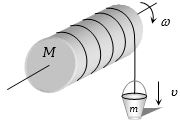
A cylinder of mass $M$ and radius $r$ is mounted on a frictionless axle over a well. A rope of negligible mass is wrapped around the cylinder and a bucket of mass $m$ is suspended from the rope. The linear acceleration of the bucket will be
A dipole consisting of two charge $\pm q$ separated by a distance $2 a$ is placed with its centre $D$ away from the center of a grounded sphere of radius $R ( D > > a )$. When the dipole moment vector is perpendicular to the line joining the two centres (those of the dipole and sphere) the charge induced on the sphere is
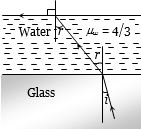
A ray of light is incident at the glass-water interface at an angle $i$, it emerges finally parallel to the surface of water, then the value of ${\mu _g}$ would be