MCQ
The resolving power of a telescope depends on
  • A
    Focal length of eye lens
  • B
    Focal length of objective lens
  • C
    Length of the telescope
  • Diameter of the objective lens

Answer

Correct option: D.
Diameter of the objective lens
d
(d) Resolving power of telescope $ = \frac{d}{{1.22\;\lambda }}$

Need a full question paper?

Generate a complete, print-ready paper with questions like this in minutes — across 16+ boards, with answer keys.
Start Generating Free

Similar questions

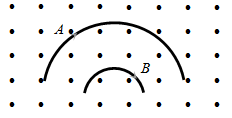
Two particles A and B of masses $m_{A}$ and $m_{B}$ respectively and having the same charge are moving in a plane. A uniform magnetic field exists perpendicular to this plane. The speeds of the particles are $v_A$ and $v_B$ respectively, and the trajectories are as shown in the figure. Then

The capacity of a parallel plate capacitor with no dielectric substance but with a separation of 0.4 cm is 2 μF. The separation is reduced to half and it is filled with a dielectric substance of value 2.8. The final capacity of the capacitor is
In an experiment of single slit diffraction pattern, first minimum for red light coincides with first maximum of some other wavelength . If wavelength of red light is $6600\,\mathop A\limits^o$ , then wavelength of first maximum will be.....$\mathop A\limits^o $
In Bohr's model of the hydrogen atom, the ratio between the period of revolution of an electron in the orbit of $n=1$ to the period of revolution of the electron in the orbit $n=2$ is
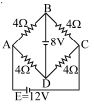
The given figure shows $a$ network of resistances and $a$ battery. Identify the correct statement $(s)$
A positively charged particle projected towards east is deflected towards north by a magnetic field. The field may be:
In above question the energy of the characteristic X-rays given out is
For high frequency, a capacitor offers
The charge flowing through a resistance $R$ varies with time according to $Q = at -bt^2.$ The total heat produced in $R$ is : (assume that direction of current not reversed)
In the hysteresis cycle, the value of $H$  needed to make the intensity of magnetisation zero is called