MCQ
For high frequency, a capacitor offers
  • A
    More reactance
  • Less reactance
  • C
    Zero reactance
  • D
    Infinite reactance

Answer

Correct option: B.
Less reactance
b
${X_C} = \frac{1}{{2\pi \nu C}}\, \Rightarrow {X_C} \propto \frac{1}{\nu }$

Need a full question paper?

Generate a complete, print-ready paper with questions like this in minutes — across 16+ boards, with answer keys.

Start Generating Free

Similar questions

A coil develops heat of $800\, cal/sec$. When $20\, volts$ is applied across its ends. The resistance of the coil is .............. $\Omega$ ($1$ $cal$ = $4.2$ $joule$)
An inductance of $2\,H$ carries a current of $2\,A$. To prevent sparking when the circuit is broken a capacitor of $4\,\mu F$ is connected across the inductance. The voltage rating of the capacitor is of the order of
The half life of a radioactive nucleus is $50$ days. The time interval $\left( t _2-t_1\right)$ between the time $t _2$ when $\frac{2}{3}$ ot it has decayed and the time $t_1$, when $\frac{1}{3}$ of it had decayed is ......days
An $AC$ source rated $220\, V , 50\, Hz$ is connected to a resistor. The time taken by the current to change from its maximum to the rms value is
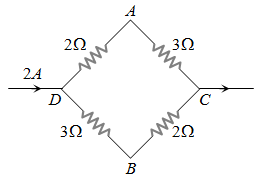
A current of 2 A flows in a system of conductors as shown. The potential difference $(V_A - V_B)$ will be
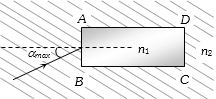
A rectangular glass slab ABCD, of refractive index $n_1$, is immersed in water of refractive index $n_2 (n_1>n_2)$. A ray of light in incident at the surface AB of the slab as shown. The maximum value of the angle of incidence $\alpha_{max}$, such that the ray comes out only from the other surface CD is given by
The rate of disintegration of fixed quantity of a radioactive element can be increased by
Two identical metal balls of radius $r$ are at a distance $a (a >> r)$ from each other and are charged, one with potential $V_1$ and other with potential $V_2$. The charges $q_1$ and $q_2$ on these balls in $CGS$ esu are
Two charges of magnitude $+ q$ and $-\,3q$ are placed $100\,cm$ apart. The distance from $+ q$ between the charges where the electrostatic potential is zero is.......$cm$
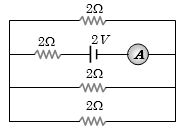
The reading of the ammeter as per figure shown is