MCQ 11 Mark
Which of the following molecules is nonpolar?
- A
$N _2 O$
- B
$H _2 O$
- C
$HCl$
- ✓
$CO _2$
AnswerCorrect option: D. $CO _2$
$CO _2$
View full question & answer→MCQ 21 Mark
The potential energy of a dipole iii a uniform electric held $\vec{E}$ is minimum when the dipole moment is
AnswerCorrect option: B. parallel to $\vec{E}$
parallel to $\vec{E}$
View full question & answer→MCQ 31 Mark
The figure shows three capacitors $C_1 C_2$ and $C_3$. The dashed lines are equipotential surfaces within each capacitor. In which of the capacitors is the po. between the two equipotentials $\Delta V =50 V$ ?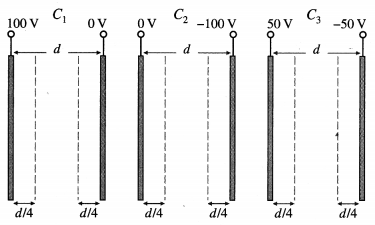
View full question & answer→MCQ 41 Mark
In the diagram, $\vec{E}$ is a uniform electric field. Point $B$ is to the west of point $A$ while point $C$ is to the east and point $D$ is to the south. Which of the following is correct?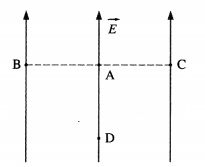
- A
$V_B>V_A>V_C$
- B
$V_B<V_A<V_C$
- ✓
$V_B=V_C$
- D
$V_D=V_A$
AnswerCorrect option: C. $V_B=V_C$
$V_B=V_C$
View full question & answer→MCQ 51 Mark
The intensity of electric field at a point clone but outside a charged conducting cylinder is proportional to
[r is the distance of the point from the axis of the cylinder]
- ✓
$\frac{1}{r}$
- B
$\frac{1}{r^2}$
- C
$\frac{1}{r^3}$
- D
$r$.
AnswerCorrect option: A. $\frac{1}{r}$
$\frac{1}{r}$
View full question & answer→MCQ 61 Mark
If the radius of a sphere is doubled without chianging the charge on it then the electric flux originating from the sphere is
MCQ 71 Mark
Two parallel capacitors of capacitances $C$ and $2 C$ are connected in parallel and charged to a potential $V$. The battery is then disconnected and the space between the plates of the first capacitor is filled with a material of dielectric constant $k$. The potential difference across the capacitors is
- A
$\frac{3 V}{k}$
- ✓
$\frac{3 V}{k+2}$
- C
$\frac{3 V}{3 k+2}$
- D
$\frac{4 V}{2 k+3}$
AnswerCorrect option: B. $\frac{3 V}{k+2}$
$\frac{3 V}{k+2}$ $\left[\right.$ Hint : Common potential, $\left.V^{\prime}=\frac{\text { total charge }}{\text { total capacitance }}=\frac{C V+2 C V}{k C+2 C}\right]$
View full question & answer→MCQ 81 Mark
An uncharged parallel-plate capacitor filled with a material of dielectric constant $k$ is connected to a parallel-plate air capacitor of identical geometry charged to a potential V. At equilibrium, common potential difference across them is $V^{\prime}$. The dielectric constant $k$ is equal to $V^{\prime}-V$
- A
$\frac{V^{\prime}-V}{V^{\prime}}$
- B
$\frac{V^{\prime}-V}{V^{\prime}+V}$
- ✓
$\frac{V-V^{\prime}}{V^{\prime}}$
- D
$\frac{V+V^{\prime}}{V-V^{\prime}}$.
AnswerCorrect option: C. $\frac{V-V^{\prime}}{V^{\prime}}$
$\frac{V-V^{\prime}}{V^{\prime}}$ $\left[\right.$ Hint : Common potential, $\left.V^{\prime}=\frac{\text { total charge }}{\text { total capacitance }}=\frac{C V}{k C+C}\right]$
View full question & answer→MCQ 91 Mark
The electric field intensity in free space at a distance r outside a charged conducting sphere of radius $R$, in terms of its surface charge density $e$ is
- ✓
$\frac{\sigma}{\varepsilon_0}\left(\frac{R}{r}\right)^2$
- B
$\frac{\varepsilon_0}{\sigma}\left(\frac{R}{r}\right)^2$
- C
$\frac{R}{r}\left(\frac{\sigma}{\varepsilon_0}\right)^2$
- D
$\frac{R}{\sigma}\left(\frac{r}{\varepsilon_0}\right)^2$.
AnswerCorrect option: A. $\frac{\sigma}{\varepsilon_0}\left(\frac{R}{r}\right)^2$
$\frac{\sigma}{\varepsilon_0}\left(\frac{R}{r}\right)^2$
View full question & answer→MCQ 101 Mark
A copper plate of thickness $b$ is inserted between the plates of a parallel-plate capacitor of plate separation $d$. If $b=d / 3$, the capacitances before and after the insertion of the plate are in the ratio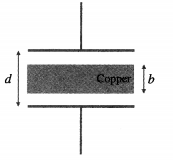
- ✓
$2: 3$
- B
$3: 2$
- C
$1: \sqrt{3}$
- D
$\sqrt{3}: 1$.
AnswerCorrect option: A. $2: 3$
$2: 3$
View full question & answer→MCQ 111 Mark
Three capacitors $C_1, C_2$ and $C_3$ are connected to a battery of p.d. $V$ as shown. Which of the following are the correct relations for the charges on the capacitors and the p.d.s across them ?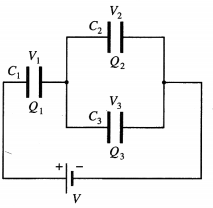
- A
$Q_1=Q_1=Q_3$ and $V_1=V_2=V_3=V$
- B
$Q_1=Q_2+Q_3$ and $V=V_1+V_2+V_3$
- ✓
$Q_1=Q_2+Q_3$ and $V=V_1+V_2$
- D
$Q_2-Q_3$ and $V_2=V_3$
AnswerCorrect option: C. $Q_1=Q_2+Q_3$ and $V=V_1+V_2$
$Q_1=Q_2+Q_3$ and $V=V_1+V_2$
View full question & answer→MCQ 121 Mark
A capacitor of plate separation $0.02 mm$ is completely filled with a dielectric material of strength $20 kV / mm$. The maximum voltage rating of the capacitor is
- A
$100 V$
- B
$200 V$
- ✓
$400 V$
- D
$800 V$
AnswerCorrect option: C. $400 V$
$400 V$
View full question & answer→MCQ 131 Mark
The energy stored in a charged capacitor is U. The capacitor is isolated and connected across the terminals of an identical uncharged capacitor. The energy stored in each capacitor is
MCQ 141 Mark
With three $6 \mu F$ capacitors, which of the capacitance values are available to you ?
- A
$2 \mu F$ and $18 \mu F$
- B
$2 \mu F , 9 \mu F , 12 \mu F$ and $18 \mu F$
- C
$2 \mu F , 9 \mu F$ and $18 \mu F$
- ✓
$2 \mu F , 6 \mu F , 9 \mu F , 12 \mu F$ and $18 \mu F$
AnswerCorrect option: D. $2 \mu F , 6 \mu F , 9 \mu F , 12 \mu F$ and $18 \mu F$
$2 \mu F, 6 \mu F, 9 \mu F, 12 \mu F$ and $18 \mu F$
View full question & answer→MCQ 151 Mark
A parallel-plate capacitor, of plate area A and plate separation d, is filled with dielectrics of dielectric constants $k _1, k _2$ and $k _3$,as shown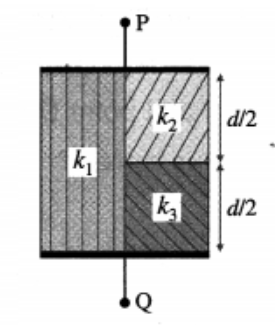
- A
$\frac{\varepsilon_0 A}{d}\left(k_1+k_2+k_3\right)$
- B
$\frac{\varepsilon_0 A}{d}\left(k_1+\frac{k_2+k_3}{k_2 k_3}\right)$
- ✓
$\frac{\varepsilon_0 A}{d}\left(\frac{k_1}{2}+\frac{k_2 k_3}{k_2+k_3}\right)$
- D
$\frac{\varepsilon_0 A}{d}\left(k_1+\frac{k_2 k_3}{k_2+k_3}\right)$
AnswerCorrect option: C. $\frac{\varepsilon_0 A}{d}\left(\frac{k_1}{2}+\frac{k_2 k_3}{k_2+k_3}\right)$
$\frac{\varepsilon_0 A}{d}\left(\frac{k_1}{2}+\frac{k_2 k_3}{k_2+k_3}\right)$
View full question & answer→MCQ 161 Mark
Three parallel plates, each of area A, form a capacitor. The separation between the first and second plates is $d 1$ and that between the second and third is $d_2$. The gaps are completely filled with dielectrics of dielectric constant $k_1$ and $k_2$, respectively. The capacitance of this capacitor is
- A
$\frac{\varepsilon_0 A k_1 k_2}{d_1+d_2}$
- B
$\frac{\varepsilon_0 A\left(k_1+k_2\right)}{d_1 d_2}$
- C
$\frac{\varepsilon_0 A k_1 k_2}{k_1 d_1+k_2 d_2}$
- ✓
$\frac{\varepsilon_0 A k_1 k_2}{k_2 d_1+k_1 d_2}$
AnswerCorrect option: D. $\frac{\varepsilon_0 A k_1 k_2}{k_2 d_1+k_1 d_2}$
$\frac{\varepsilon_0 A k_1 k_2}{k_2 d_1+k_1 d_2}$
View full question & answer→MCQ 171 Mark
The capacitance of an isolated spherical conductor of radius $R$ in vacuum is
- A
- B
- ✓
$4 \pi \varepsilon_0 R$
- D
AnswerCorrect option: C. $4 \pi \varepsilon_0 R$
$4 \pi \varepsilon_0 R$
View full question & answer→MCQ 181 Mark
Two parallel plates, separated by a distance $d$, are kept at potential difference $V$ volt. A. charge $q$ of mass $m$ enters between the parallel plates with some velocity. The acceleration of the charged particle will be
- ✓
$\frac{q V}{d m}$
- B
$\frac{d m}{q V}$
- C
$\frac{q m }{d V}$
- D
$\frac{d V}{q m}$
AnswerCorrect option: A. $\frac{q V}{d m}$
$\frac{q V}{d m}$
View full question & answer→MCQ 191 Mark
The resultant capacitance between the points $A$ and $B$ in the figure below is: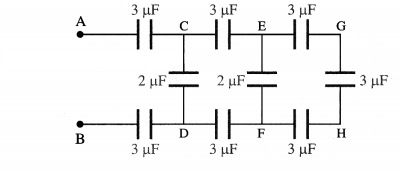
- ✓
$1 \mu F$
- B
$1.5 \mu F$
- C
$2 \mu F$
- D
$3 \mu F$.
AnswerCorrect option: A. $1 \mu F$
$1 \mu F$
View full question & answer→MCQ 201 Mark
A charged spherical conductor in a medium of permittivity e basa surface charge density $a$. At an outside point, a distance r from the centre of the conductor, the electric field intensity is
- ✓
$\frac{\sigma}{\varepsilon}$
- B
$\frac{\sigma}{\varepsilon r}$
- C
$\frac{1}{4 \pi \varepsilon_0} \frac{\sigma}{r^2}$
- D
$\frac{1}{4 \pi \varepsilon} \frac{\sigma}{r^2}$
AnswerCorrect option: A. $\frac{\sigma}{\varepsilon}$
$\frac{\sigma}{\varepsilon}$
View full question & answer→MCQ 211 Mark
A parallel-plate air capacitor of a plate area $A$ and plate separation d has capacitance $C_0, A$ dielectric of thickness $d$, width $A / 2$ and relative permittivity $k$, is inserted between the plates as shown. The capacitance of the capacitor is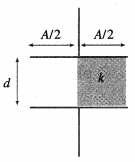
- A
$2(k+1) C_0$
- B
$(k+1) C_0$
- C
$kC _0$
- ✓
$\frac{k+1}{2} C_0$
AnswerCorrect option: D. $\frac{k+1}{2} C_0$
$\frac{k+1}{2} C_0$
View full question & answer→MCQ 221 Mark
Two capacitors each of capacitance $4 \mu F$ are connected in series, and a third capacitor of capacitance $4 \mu F$ is connected in parallel with the combination. Then, the equivalentcapacitance of the arrangement is
- A
$12 \mu F$
- B
$8 \mu F$
- ✓
$6 \mu F$
- D
$2.65 \mu F$
AnswerCorrect option: C. $6 \mu F$
$6 \mu F$
View full question & answer→MCQ 231 Mark
Three capacitors of capacitances $2 \mu F , 3 \mu F$ and $6 \mu F$ are connected in series. The equivalent capacitance of the combination is
- A
$0.5 \mu F$
- ✓
$1 \mu F$
- C
$1.1 \mu F$
- D
$11 \mu F$
AnswerCorrect option: B. $1 \mu F$
$1 \mu F$
View full question & answer→MCQ 241 Mark
A $2 \mu F$ capacitor, charged to a p.d. of $200 V$, is connected across an uncharged capacitor. If the common p.d. is $20 V$, the capacitance of the second capacitor is
- ✓
$18 \mu F$
- B
$20 \mu F$
- C
$36 \mu F$
- D
$40 \mu F$
AnswerCorrect option: A. $18 \mu F$
$18 \mu F$
View full question & answer→MCQ 251 Mark
A 5 pF capacitor is connected in series with a $10 \mu F$ capacitor and the combination is connected across a $9 V$ battery. The potential differences across the capacitors are in the ratio
- A
$4: 1$
- B
$3: 1$
- ✓
$2: 1$
- D
$1: 1$
AnswerCorrect option: C. $2: 1$
$2: 1$
View full question & answer→MCQ 261 Mark
A $5 \mu F$ capacitor is charged to a p.d. of $10 V$. If it is further charged, so that its p.d. increases to $20 V$, the electric energy stored in it increases by
- A
$450 \mu$
- B
$500 \mu J$
- ✓
$750 \mu J$
- D
$900 \mu J$
AnswerCorrect option: C. $750 \mu J$
$750 \mu J$
View full question & answer→MCQ 271 Mark
The energy density in the region between the plates of a charged parallel-plate air capacitor is given by the expression
- ✓
$\frac{1}{2} \varepsilon_0 E ^2$
- B
$\frac{1}{2} \varepsilon_0 E$
- C
$\frac{E^2}{2 \varepsilon_0}$
- D
$\frac{\sigma^2}{\varepsilon_0}$
AnswerCorrect option: A. $\frac{1}{2} \varepsilon_0 E ^2$
$\frac{1}{2} \varepsilon_0 E ^2$
View full question & answer→MCQ 281 Mark
If at a certain stage during the charging of a capacitor of capacitance $C$ the charge and potential difference are $q$ and $e$, the work $d W$ required to transfer an additional amount of charge do is
- ✓
- B
$\frac{d q}{v}$
- C
$\frac{v d q}{C}$
- D
$\frac{q^2}{2 C}$
View full question & answer→MCQ 291 Mark
A dielectric of relative permittivity $k$ completely fills the space between the plates of a parallelplate capacitor. When the surface charge density on the plates is $\sigma$, the polarization of the dielectric is
AnswerCorrect option: C. $\sigma\left(1-\frac{1}{k}\right)$
$\sigma\left(1-\frac{1}{k}\right)$
View full question & answer→MCQ 301 Mark
A paralel-plate capacitor is charged by connecting it to a battery. The battery is then disconnected and the distance between the plates is doubled. This doubles
- A
the electric field at each point
- B
the charge density on each conductor
- C
the potential difference between the conductors
- ✓
View full question & answer→MCQ 311 Mark
Electric Intensity due to a charged sphere at a point outside the sphere dectea.ses with
AnswerCorrect option: B. an increase in the dielectric constant
an increase in the dielectric constant
View full question & answer→MCQ 321 Mark
A parallel plate capacitor has circular plates of radius 8 cm and plate separation 1mm. What will be the charge on the plates if a potential difference of 100 V is applied?
- ✓
$1.78 \times 10^{-8} C$
- B
$1.78 \times 10^{-5} C$
- C
$4.3 \times 10^4 C$
- D
$2 \times 10^{-9} C$
AnswerCorrect option: A. $1.78 \times 10^{-8} C$
$1.78 \times 10^{-8} C$
View full question & answer→MCQ 331 Mark
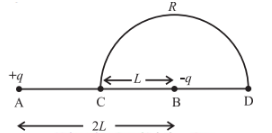
Charge + q and -q are placed at points A and B respectively which are distance 2L apart. C is the mid point of A and B. The work done in moving a charge +Q along the semicircle CRD as shown in the figure below is
- A
$\frac{-q Q}{6 \pi \varepsilon_0 L}$
- B
$\frac{q Q}{2 \pi \varepsilon_0 L}$
- C
$\frac{q Q}{6 \pi \varepsilon_0 L}$
- ✓
$\frac{-q_1 Q}{6 \pi \varepsilon_0 L}$
AnswerCorrect option: D. $\frac{-q_1 Q}{6 \pi \varepsilon_0 L}$
$-\frac{Q q_1}{6 \pi \varepsilon_0 L}$
View full question & answer→MCQ 341 Mark
Energy stored in a capacitor and dissipated during charging a capacitor bear a ratio.
- ✓
$1: 1$
- B
$1: 2$
- C
$2: 1$
- D
$1: 3$
AnswerCorrect option: A. $1: 1$
$1: 1$
View full question & answer→MCQ 351 Mark
A slab of material of dielectric constant k has the same area A as the plates of a parallel plate capacitor and has thickness (3/4d), where d is the separation of the plates. The change in capacitance when the slab is inserted between the plates is
- A
$C=\frac{A \varepsilon_0}{d}\left(\frac{k+3}{4 k}\right)$
- B
$C=\frac{A \varepsilon_0}{d}\left(\frac{2 k}{k+3}\right)$
- C
$C=\frac{A \varepsilon_0}{d}\left(\frac{k+3}{2 k}\right)$
- ✓
$C=\frac{A \varepsilon_0}{d}\left(\frac{4 k}{k+3}\right)$
AnswerCorrect option: D. $C=\frac{A \varepsilon_0}{d}\left(\frac{4 k}{k+3}\right)$
$C=\frac{A \varepsilon_0}{d}\left(\frac{4 k}{k+3}\right)$
View full question & answer→MCQ 361 Mark
A parallel plate capacitor is charged and then isolated. The effect of increasing the plate separation on the charge, potential, capacitance respectively are
- ✓
Constant, decreases, decreases
- B
Increases, decreases, decreases
- C
Constant, decreases, increases
- D
Constant, increases, decreases
AnswerCorrect option: A. Constant, decreases, decreases
Constant, decreases, decreases
View full question & answer→MCQ 371 Mark
Which of the following combination of 7 identical capacitors each of $2 \mu F$ gives a capacitance of $\frac{10}{11} \mu F$ ?
Answer(d) :
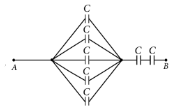
Capacitance, $C=2 \mu F$
Equivalent capacitance for the parallel combination
$
C_p=2+2+2+2+2=10 \mu F
$
Capacitance for the series combination,
$
\frac{1}{C_S}=\frac{1}{2}+\frac{1}{2} \Rightarrow C_S=1 \mu F
$
$\therefore \quad$ Equivalent capacitance between $A$ and $B$ is $\frac{1}{C}=\frac{1}{C_p}+\frac{1}{C_S}=\frac{1}{10}+1=\frac{11}{10}$ or $C=\frac{10}{11} \mu F$
Hence, 5 capacitors in parallel and 2 capacitors in series are required to get a resultant capacitance of $\frac{10}{11} \mu F$. View full question & answer→MCQ 381 Mark
A solid metallic sphere has a charge $+3 Q$. Concentric with this sphere is a conducting spherical shell having charge $-Q$. The radius of the sphere is ' $A$ ' and that of the spherical shell is ' $B$ ' $(B>A)$. The electric field at a distance 'R' (A < R < B) from the center is $\left(\varepsilon_0=\right.$ permittivity of vacuum $)$
Answer(c) : Electric field due to shell $=0$ Electric field due to sphere, $E=\frac{K 3 Q}{R^2}=\frac{3 Q}{4 \pi \varepsilon_0 R^2}$
View full question & answer→MCQ 391 Mark
A charge $17.7 \times 10^{-4} C$ is distributed uniformly over a large sheet of area $200 m ^2$. The electric intensity at a distance $20 cm$ from it in air will be $\left[\varepsilon_0=8.85 \times 10^{-12} C ^2 / Nm ^2\right]$
Answer(a) : Given, $q=17.7 \times 10^{-4} C ; A=200 m ^2$
As, $E=\frac{\sigma}{2 \varepsilon_0}=\frac{q}{2 A \varepsilon_0}=\frac{17.7 \times 10^{-4}}{2 \times 200 \times 8.85 \times 10^{-12}}$
$E=5 \times 10^5 N / C$
View full question & answer→MCQ 401 Mark
The charges $2 q,-q,-q$ are located at the vertices of an equilateral triangle. At the circumference of the triangle
Answer(d) : Both field and potential are non-zero at the circumference of the triangle.
View full question & answer→MCQ 411 Mark
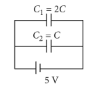
A parallel combination of two capacitors of capacities $2 C$ and $C$ is connected across $5 V$ battery. When they are fully charged, the charges and energies stored in them be $Q_1, Q_2$ and $E_1, E_2$ respectively. Then $\frac{E_1-E_2}{Q_1-Q_2}$ in J/C is (capacity is in Farad, charge in Coulomb and energy in J)
Answer(c): Here, $C_1=2 C, C_2=C, V=5 V$
As capacitors are in parallel,
$
\begin{aligned}
Q_1 & =2 C \times 5=10 C \\
Q_2 & = C \times 5=5 C \\
E_1 & =\frac{1}{2} \times 2 C \times 5 \times 5=25 C \\
E_2 & =\frac{1}{2} \times C \times 5 \times 5=\frac{25 C }{2}
\end{aligned}
$
$
\frac{E_1-E_2}{Q_1-Q_2}=\frac{25 C-\frac{25 C}{2}}{10 C-5 C}=\frac{25 C}{2 \times 5 C}=\frac{5}{2}
$
View full question & answer→MCQ 421 Mark
The potential energy of charged parallel plate capacitor is $v_0$. If a slab of dielectric constant $K$ is inserted between the plates, then the new potential energy will be
Answer(a) : As, energy stored $v_0=\frac{Q^2}{2 C}$. . . . .(i)
When dielectric is inserted, energy stored, $v=\frac{Q^2}{2 K C}$
$
C^{\prime}=K C
$. . . . .(ii)
On dividing equation (ii) by equation (i)
$
\frac{v}{v_0}=\frac{1}{K} ; v=\frac{v_0}{K}
$
View full question & answer→MCQ 431 Mark
The ratio of potential difference that must be applied across parallel and series combination of two capacitors $C_1$ and $C_2$ with their capacitance in the ratio $1: 2$ so that energy stored in these two cases becomes same is
Answer(b) : Given, $\frac{C_1}{C_2}=\frac{1}{2} \Rightarrow C_2=2 C_1$
Let energy stored in series and parallel combination be $U_s$ and $U_p$ respectively.
$
\begin{aligned}
& C_p=C_1+C_2=3 C_1 \\
& U_p=\frac{1}{2} C_p V_1^2=\frac{1}{2} \times 3 C_1 V_1^2. . . . . (i) \\
& \frac{1}{C_x}=\frac{1}{C_1}+\frac{1}{C_2}=\frac{1}{C_1}+\frac{1}{2 C_1} ; C_s=\frac{2}{3} C_1
\end{aligned}
$
$\begin{aligned} & U_P=\frac{1}{2} \times C_s V_2^2=\frac{1}{2} \times \frac{2}{3} C_1 \times V_2^2 \\ & \text { As, } U_s=U_p \\ & \frac{1}{2} \times 3 C_1 V_1^2=\frac{1}{3} \times C_1 \times V_2^2 ;\left(\frac{V_1}{V_2}\right)^2=\frac{2}{9} \Rightarrow \frac{V_1}{V_2}=\sqrt{2}: 3\end{aligned}$
View full question & answer→MCQ 441 Mark
Answer(b) : Let area of plate is $A$ and distance between plates is $d$. Thus capacitance,
$
C=\frac{\varepsilon_0 A}{d}=2.5 \mu F
$
When it is half filled with dielectric
$
C_1=\frac{\varepsilon_0 A / 2}{d}, C_2=\frac{\varepsilon_0 K A / 2}{d}
$
As they are in parallel, $C^{\prime}=C_1+C_2=5$
$
\frac{\varepsilon_0 A}{2 d}+\frac{K A \varepsilon_0}{2 d}=5 ; \frac{2.5}{2}+K \times \frac{2.5}{2}=5 ; 1+K=4, K=3
$
View full question & answer→MCQ 451 Mark
Answer(b) : As capacitors are in parallel so $V$ is same for both.
$
\begin{aligned}
& q_1=C V, q_2=\frac{C}{2} V ; q=q_1+q_2=C V+\frac{C V}{2}=\frac{3 C V}{2} \\
& =\frac{1}{2} q V=\frac{1}{2} \times \frac{3 C V}{2} V ; W=\frac{3 C V^2}{4}
\end{aligned}
$
View full question & answer→MCQ 461 Mark
Answer(c) : $C=10 \mu F =\frac{\varepsilon_0 A}{d}$. . . . . .(i)
Now, both dielectric part are in parallel, $C=C_1+C_2$ $C_1=\frac{K_1 \varepsilon_0 A}{2 d}, C_2=\frac{K_2 \varepsilon_0 A}{2 d} ; C_p=\frac{10}{2}(2+4) \quad$ from (i) $C_p=30 \mu F$
View full question & answer→MCQ 471 Mark
A uniformly charged semicircular arc of radius $'r\ '$ has linear charge density $' \lambda\ ' $.The electric field at its centre is $($ $\varepsilon_0=$ permittivity of free space$)$
- A
$\frac{\lambda}{4 \varepsilon_0}$
- B
$\frac{2 \varepsilon_0}{\lambda}$
- ✓
$\frac{\lambda}{4 \varepsilon_0 r}$
- D
$\frac{2 \pi \varepsilon_0}{\lambda}$
AnswerCorrect option: C. $\frac{\lambda}{4 \varepsilon_0 r}$
The electric field due to a small element,
$E=\frac{k d q}{r^2}$
$=\frac{1}{4 \pi \varepsilon_0} \frac{\lambda \cdot \pi r}{r^2}$
$E=\frac{\lambda}{4 \varepsilon_0 r}$
View full question & answer→MCQ 481 Mark
A conducting sphere of radius $0.1 m$ has uniform charge density $1.8 \mu C / m ^2$ on its surface. The electric field in free space at radial distance $0.2 m$ from a point on the surface is ( $\varepsilon_0=$ permittivity of free space)
Answer(c) : Here, $R=0.1 m , \sigma=1.8 \mu C / m ^2$ and $r=0.2 m$
$
\begin{aligned}
& E=\frac{k q}{r^2}=\frac{k \cdot \sigma A}{(r+R)^2} ; E=\frac{1}{4 \pi \varepsilon_0} \cdot \frac{1.8 \times 10^{-6} \times 4 \pi R^2}{(0.3)^2} \\
& E=\frac{1.8 \times 10^{-6} \times(0.1)^2}{\varepsilon_0(0.3)^2} ; E=\frac{2 \times 10^{-7}}{E_0} V / m
\end{aligned}
$
View full question & answer→MCQ 491 Mark
The electric field intensity on the surface of a solid charged sphere of radius ' $r$ ' and volume charge density ' $Q$ ' is ( $\varepsilon_0=$ permittivity of free space)
Answer(a) : As, $E=\frac{k Q}{r^2} ; \rho=\frac{\pi}{4 \pi r^3}$
$
E=\frac{1}{4 \pi \varepsilon_0} \frac{1}{r^2} \times \frac{4 \pi r^3 \rho}{3} \Rightarrow E=\frac{\rho r}{3 \varepsilon_0}
$
View full question & answer→MCQ 501 Mark
An uncharged capacitor is connected to a battery. While charging the capacitor, how much is the energy lost, from the energy supplied by the battery?
Answer(a) : Let the capacitance of the capacitor is ${ }^{\circ} C$ ' and the emf of the battery is $V$.
Then, eharge given to the capacitor is $Q=C V$.
Work done by the battery is, $W=Q V$. i.e., the battery supplies this energy.
Energy stored in capacitor, $U=\frac{1}{2} CV ^2=\frac{1}{2} QV$.
Remaining energy $=Q V-\frac{1}{2} Q V=\frac{1}{2} Q V$ i.e.,
$50 \%$ amount of energy is lost.
View full question & answer→