MCQ
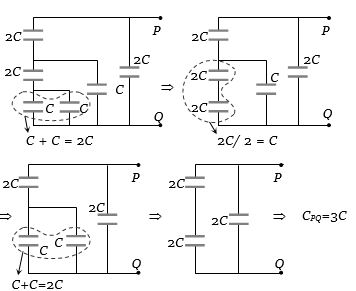
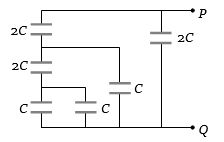
The resultant capacitance of given circuit is
  • $3C$
  • B
    $2C$
  • C
    $C$
  • D
    $\frac{C}{3}$

Answer

Correct option: A.
$3C$
a
(a)

Need a full question paper?

Generate a complete, print-ready paper with questions like this in minutes — across 16+ boards, with answer keys.
Start Generating Free

Similar questions

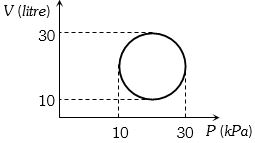
Heat energy absorbed by a system in going through a cyclic process shown in figure is
A smaller cube with side $b$ (depicted by dashed lines) is excised from a bigger uniform cube with side $\alpha$ as shown below, such that both cubes have a common vertex $P$. Let $X=a / b$. If the centre of mass of the remaining solid is at the vertex $O$ of smaller cube, then $X$ satisfies
The molar heat capacity in a process of a diatomic gas if it does a work of $\frac{Q}{4}$ when a heat of $Q$ is supplied to it is
For the structural analysis of crystals, $X-$ rays are used because
A body of mass $2\,kg$ makes an elastic collision with a second body at rest and continues to move in the original direction but with one fourth of its original speed. What is the mass of the second body? $......... \mathrm{kg}$
A capacitor is charged by a battery. The battery is removed and another identical uncharged capacitor is connected in parallel. The total electrostatic energy of resulting system 
A doubly ionised $Li$ atom is excited from its ground state $(n = 1)$ to $n = 3$ state. The wavelengths of the spectral lines are given by ${\lambda _{32}},{\lambda _{31}}$ and ${\lambda _{21}}$. The ratio ${\lambda _{32}}/{\lambda _{31}}$ and ${\lambda _{21}}/{\lambda _{31}}$ are, respectively
When photons of wavelength $\lambda _1$  are incident on an isolated sphere, the corresponding stopping potential is found to be $V.$  When photons of wavelength $\lambda _2$ are used, the corresponding stopping potential was thrice that of the above value . If light of wavelength $\lambda _3$ is used then find the stopping potential for this case
Consider the following

$I.$ Waves created on the surfaces of a water pond by a vibrating sources.

$II.$ Wave created by an oscillating electric field in air.

$III.$ Sound waves travelling under water.

Which of these can be polarized

The amplitude of the vibrating particle due to superposition of two $SHMs,$

$y_1 = \sin \left( {\omega t + \frac{\pi }{3}} \right)$ and $y_2 = \sin \omega t$ is :