MCQ
The resultant of $\vec{A} \times 0$ will be equal to
  • A
    Zero
  • Zero vector
  • C
    $A$
  • D
    Unit vector

Answer

Correct option: B.
Zero vector
b
The cross product $\vec{A} \times \vec{B}$ is a vector, with its direction perpendicular to both $\vec{A}$ and $\vec{B} . \vec{A} \times \vec{B}$ is area. If side $B$ is zero, area is zero. $\vec{A} \times 0$ is a zero vector.

If in case $0$ is a scalar, then also the product is zero. But a scalar $\times$ a vector is also a vector.

Need a full question paper?

Generate a complete, print-ready paper with questions like this in minutes — across 16+ boards, with answer keys.
Start Generating Free

Similar questions

Energy of all molecules of a monoatomic gas having a volume $V$ and pressure $P$ is $\frac{3}{2}PV$. The total translational kinetic energy of all molecules of a diatomic gas as the same volume and pressure is
A body of mass $M$ tied to a string is lowered at a constant acceleration of $(g/4)$ through a vertical distance $h$. The work done by the string will be..............
Two tubes of radii $r_1$ and $r_2$, and lengths $l_1$ and $l_2$, respectively, are connected in series and a liquid flows through each of them in streamline conditions. $P_1$ and $P_2$ are pressure differences across the two tubes. If $P_2$ is $4P_1$ and $l_2$ is $ \frac{l_1}{4}$ , then the radius $r_2$ will be equal to
The $SI$ unit of universal gas constant is
A weightless spring which has a force constant oscillates with frequency $n$ when a mass $m$ is suspended from it. The spring is cut into two equal halves and a mass $2m $ is suspended from it. The frequency of oscillation will now become
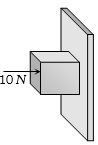
A horizontal force of $10 \,N$ is necessary to just hold a block stationary against a wall. The coefficient of friction between the block and the wall is $0.2$. the weight of the block is ........ $N$
A body performs $S.H.M.$ Its kinetic energy $K$ varies with time $t$ as indicated by graph
A body is moving under the action of two forces ${\vec F_1} = 2\hat i - 5\hat j\,;\,{\vec F_2} = 3\hat i - 4\hat j$. Its velocity will become uniform under an additional third force ${\vec F_3}$ given by
Two simple pendulum whose lengths are $1\,m$ and $121\, cm$ are suspended side by side. Their bobs are pulled together and then released. After how many minimum oscillations of the longer pendulum will the two be in phase again
A cyclist turns around a curve at $15\, miles/hour$. If he turns at double the speed, the tendency to overturn is