MCQ
A weightless spring which has a force constant oscillates with frequency $n$ when a mass $m$ is suspended from it. The spring is cut into two equal halves and a mass $2m $ is suspended from it. The frequency of oscillation will now become
  • $n$
  • B
    $2n$
  • C
    $\frac{n}{\sqrt2}$
  • D
    $n(2)^{1/2}$

Answer

Correct option: A.
$n$
a
(a) $n = \frac{1}{{2\pi }}\sqrt {\frac{k}{m}} $

==>$\frac{n}{{n'}} = \sqrt {\frac{k}{m} \times \frac{{m'}}{{K'}}} $

$ = \sqrt {\frac{k}{m} \times \frac{{2m}}{{2K}}} = 1$

==> $n' = n$

Need a full question paper?

Generate a complete, print-ready paper with questions like this in minutes — across 16+ boards, with answer keys.

Start Generating Free

Similar questions

Two speakers connected to the same source of fixed frequency are placed $2.0 m $ apart in a box. A sensitive microphone placed at a distance of $4.0m$ from their midpoint along the perpendicular bisector shows maximum response. The box is slowly rotated until the speakers are in line with the microphone. The distance between the midpoint of the speakers and the microphone remains unchanged. Exactly five maximum responses are observed in the microphone in doing this. The wavelength of the sound wave is .... $m$
If the unit of length and force be increased four times, then the unit of energy is
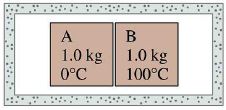
Objects $A$ and $B$ that are initially separated from each other and well isolated from their surroundings are then brought into thermal contact. Initially $T_A= 0^oC$ and $T_B = 100^oC$. The specific heat of $A$ is less than the specific heat of $B$. After some time, the system comes to an equilibrium state. The final temperatures are :
Two satellites $S _{1}$ and $S _{2}$ are revolving in circular orbits around a planet with radius $R _{1}=3200 \,km$ and $R _{2}=800\, km$ respectively. The ratio of speed of satellite $S_{1}$ to the speed of satellite $S_{2}$ in their respective orbits would be $\frac{1}{ x }$ where $x =$
Which of the following astronomer first proposed that sun is static and earth rounds sun
The speeds of $5$ molecules of a gas (in arbitrary units) are as follows : $2, 3, 4, 5, 6.$ The root mean square speed for these molecules is
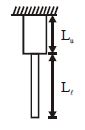
A composite heavy rope of two materials is suspended vertically from a high ceiling. The ratios of different quantities for upper to lower rope are length $\frac{{{L_u}}}{{{L_l}}} = \frac{1}{2}$ , cross sectional area $\frac{{{A_u}}}{{{A_l}}} = \frac{2}{1}$ ,density $\frac{{{d_u}}}{{{d_l}}} = \frac{2}{3}$ .What is the ratio of maximum stress in the two ropes
A rubber pipe of density $1.5 \times {10^3}\,N/{m^2}$ and Young's modulus $5 \times {10^6}\,N/{m^2}$ is suspended from the roof. The length of the pipe is $8 \,m$. What will be the change in length due to its own weight
It is found that $|\text{A}+\text{B}|=|\text{A}|.$ This necessarily implies,
Two discs $A$ and $\mathrm{B}$ are mounted coaxially on a vertical axle. The discs have moments of inertia $I$ and $2 I$ respectively about the common axis. Disc $\mathrm{A}$ is imparted an initial angular velocity $2 \omega$ using the entire potential energy of a spring compressed by a distance $x_1$. Disc $B$ is imparted an angular velocity $\omega$ by a spring having the same spring constant and compressed by a distance $x_2$. Both the discs rotate in the clockwise direction.

$1.$  The ratio of $x_1 / x_2$ is

$(A)$ $2$  $(B)$ $\frac{1}{2}$  $(C)$ $\sqrt{2}$  $(D)$ $\frac{1}{\sqrt{2}}$

$2.$  When disc $\mathrm{B}$ is brought in contact with disc $\mathrm{A}$, they acquire a common angular velocity in time $\mathrm{t}$. The average frictional torque on one disc by the other during this period is

$(A)$ $\frac{2 \mathrm{I} \omega}{3 \mathrm{t}}$  $(B)$ $\frac{9 \mathrm{I} \omega}{2 \mathrm{t}}$  $(C)$ $\frac{9 \mathrm{I} \omega}{4 \mathrm{t}}$  $(D)$ $\frac{3 \mathrm{I} \omega}{2 \mathrm{t}}$

$3.$  The loss of kinetic energy during the above process is

$(A)$ $\frac{\mathrm{I} \omega^2}{2}$  $(B)$ $\frac{\mathrm{I} \omega^2}{3}$  $(C)$ $\frac{\mathrm{I} \omega^2}{4}$  $(D)$ $\frac{\mathrm{I} \omega^2}{6}$

Give the answer question $1,2$ and $3.$