MCQ
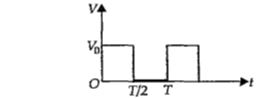
The $r.m.s.$ value of potential difference $V$ shown in the figure is 
  • A
    $\frac{{V_0}}{{\sqrt 3 }}$
  • B
    $V_0$
  • $\frac{{V_0}}{{\sqrt 2 }}$
  • D
    $\frac{{V_0}}{2}$

Answer

Correct option: C.
$\frac{{V_0}}{{\sqrt 2 }}$
c
$V=V_{0}$ for $0 \leq t \leq \frac{T}{2}$

$V=0$ for $\frac{T}{2} \leq t \leq T$

${V_{rms}} = \left[ {\frac{{\int\limits_0^T {{V^2}\,dt} }}{{\int\limits_0^T {dt} }}} \right] = {\left[ {\frac{{\int\limits_0^{T/2} {V_0^2\,dt}  + \int\limits_{T/2}^T {(0)\,dt} }}{{\int\limits_0^T {dt} }}} \right]^{1/2}}$

$ = {\left[ {\frac{{V_0^2}}{T}[t]_0^{T/2}} \right]^{1/2}}$

$ = {\left[ {\frac{{V_0^2}}{T}\left( {\frac{T}{2}} \right)} \right]^{1/2}}$

$ = {\left[ {\frac{{V_0^2}}{2}} \right]^{1/2}}$

${V_{rms}} = \frac{{{V_0}}}{{\sqrt 2 }}$
Need a full question paper?

Generate a complete, print-ready paper with questions like this in minutes — across 16+ boards, with answer keys.
Start Generating Free

Similar questions

A hemisphere is uniformely charged positively. The electric field at a point on a diameter away from the centre is directed.
The distance between two points is 30 cm . If $20 \mu C$ charge is kept at point A and $-10 \mu C$ charge is kept at point B, then at which point between A and B the potential will be zero :
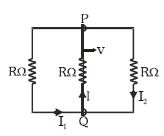
A rectangular loop has a sliding connector $PQ $of length $l$ and resistance $R\,\Omega $ and it is moving with a speed $v$ as shown. The set-up is placed in a uniform magnetic field going into the plane of the paper. The three currents $I_1$, $I_2$ and $I$ are
A $25\, watt$, $220\, volt$ bulb and a $100\, watt$, $220\, volt$ bulb are connected in series across a $220\, volt$ lines. Which electric bulb will glow more brightly
Assertion : Only a change in magnetic flux will maintain an induced current the coil.
Reason : The presence of large magnetic flux through a coil maintains a current in the coil if the circuit is continuous.
In $n-p-n$ transistor circuit the collector current is $10\, mA$. If $90\%$ of the electron reach the collector, then emitter current will be
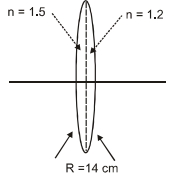
A bi-convex lens is formed with two thin plano-convex lenses as shown in the figure. Refractive index $n$ of the first lens is $1.5$ and that of the second lens is $1.2$. Both the curved surfaces are of the same radius of curvature $R=$ $14 \ cm$. For this bi-convex lens, for an object distance of $40 \ cm$, the image distance will be
Ray optics fails when
A radioactive sample with a half life of 1 month has the label : “Activity=2 micro curies on 1.8.1991.'' What will be its activity two months later
Electric lines of force about negative point charge are