MCQ
The $\text{r.m.s.}$ velocity of a gas is:
  • A
    Directly proportional to the density of the gas.
  • B
    Inversely proportional to the density of the gas.
  • C
    Directly proportional to the square of density.
  • Inversely proportional to the square root of the density of the gas.
Answer

Correct option: D.
Inversely proportional to the square root of the density of the gas.
Need a full question paper?

Generate a complete, print-ready paper with questions like this in minutes — across 16+ boards, with answer keys.

Start Generating Free

Similar questions

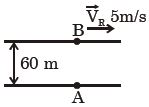
A man is crossing a river flowing with velocity of $5\, m/s$. He reaches a point directly across at a distance of $60\, m$ in $5\, sec$. His velocity in still water should be........$m/s$
If the diameter of a capillary tube is doubled, then the height of the liquid that will rise is
A ring and a disc are initially at rest, side by side, at the top of an inclined plane which makes an angle $60^{\circ}$ with the horizontal. They start to roll without slipping at the same instant of time along the shortest path. If the time difference between their reaching the ground is $(2-\sqrt{3}) / \sqrt{10} \mathrm{~s}$, then the height of the top of the inclined plane, in metres, is. . . . . . Take $g=10 \mathrm{~m} \mathrm{~s}^{-2}$.
A body is suspended from a spring balance kept in a satellite. The reading of the balance is $\mathrm{W}_1$ when the satellite goes in an orbit of radius $R$ and is $W_2$ when it goes in an orbit of radius $2 R$.
 
A tuning fork produces $4\text{beats/ sec}$ with another fork of frequency $288\ \text{c.p.s}$. A little wax is placed on the unknown fork and it then produces $2\text{beats/ sec.}$ The unknown frequency is:
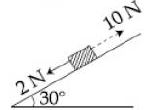
A block kept on a rough inclined plane, as shown in the figure, remains at rest upto a maximum force $2\,N$ down the inclined plane. The maximum external force up the inclined plane that does not move the block is $10\,N.$ The coefficient of static friction between the block and the plane is : [Take $g = 10\,m/s^2$ ]
On a solid sphere lying on a horizontal surface a force $F$ is applied at a height of $R/2$ from the centre of mass. The initial acceleration of a point at the top of the sphere is (there is no slipping at any point)
A man sitting in a bus travelling in a direction from west to east with a speed of $40 \,km/h $observes that the rain-drops are falling vertically down. To the another man standing on ground the rain will appear
If a person can throw a stone to maximum height of $h$ metre vertically, then the maximum distance through which it can be thrown horizontally by the same person is:
If the mass of the earth is doubled and its radius halved, then new acceleration due to the gravity $g’$ is: