MCQ
The same radioactive nucleus may emit?
  • A
    All the three $\alpha,\ \beta$ and $\gamma$ one after another.
  • B
    All the three $\alpha,\ \beta$ and $\gamma$ radiations simultaneously.
  • C
    Only $\alpha$ and $\beta$ simultaneously.
  • Only one $\alpha,\ \beta$ and $\gamma$ at a time.
Answer

Correct option: D.
Only one $\alpha,\ \beta$ and $\gamma$ at a time.
Need a full question paper?

Generate a complete, print-ready paper with questions like this in minutes — across 16+ boards, with answer keys.

Start Generating Free

Similar questions

Electron of mass $m$ and charge $q$ is travelling with a speed along a circular path of radius $r$ at right angles to a uniform magnetic field of intensity $B$. If the speed of the electron is doubled and the magnetic field is halved the resulting path would have a radius
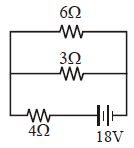
In the given circuit The current through the battery is........$A$
A parallel plate capacitor of capacitance $12.5 \mathrm{pF}$ is charged by a battery connected between its plates to potential difference of $12.0 \mathrm{~V}$. The battery is now disconnected and a dielectric slab $\left(\in_{\mathrm{r}}=6\right)$ is inserted between the plates. The change in its potential energy after inserting the dielectric slab is_______.$\times 10^{-12} \mathrm{~J}$.
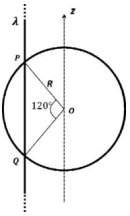
An infinitely long thin non-conducting wire is parallel to the $z$-axis and carries a uniform line charge density $\lambda$. It pierces a thin non-conducting spherical shell of radius $R$ in such a way that the arc $PQ$ subtends an angle $120^{\circ}$ at the centre $O$ of the spherical shell, as shown in the figure. The permittivity of free space is $\in_0$. Which of the following statements is (are) true?

$(A)$ The electric flux through the shell is $\sqrt{3} R \lambda / \in_0$

$(B)$ The z-component of the electric field is zero at all the points on the surface of the shell

$(C)$ The electric flux through the shell is $\sqrt{2} R \lambda / \in_0$

$(D)$ The electric field is normal to the surface of the shell at all points

Two niclos are crossed to each other. Now one of them is rotated through $60^o$. What percentage of incident light will pass through the system?
An initially uncharged capacitor $C$ is being charged by a battery of emf $E$ through a resistance $R$ upto the instant, when the capacitor is charged to the potential $E / 2$, then the ratio of the work done by the battery to the heat dissipated by the resistor is given by
The given figure shows, two parallel plates $A$ and $B$ of charge densities $+\sigma$ and $-\sigma$ respectively. Electric intensity will be zero in region
First, a set of ${n}$ equal resistors of $10\; \Omega$ each are connected in series to a battery of emf $20\; {V}$ and internal resistance $10\; \Omega .$ A current $I$ is observed to flow. Then, the $n$ resistors are connected in parallel to the same battery. It is observed that the current is increased $20$ times, then the value of $n$ is .... .
The wavelength of an $X-$ray beam is $10 \, \mathring A$. The mass of a fictitious particle having the same energy as that of the $X-$ray photons is $\frac{ x }{3} h \,kg$. The value of $x$ is ....... . $(h =$ Planck's constant $)$
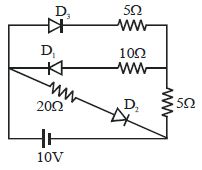
The total power dissipated (in $watt$ ) in the circuit shown is