Question
The saturation current in a triode valve can be changed by changing:
  1. The grid voltage.
  2. The plate voltage.
  3. The separation between the grid and the cathode.
  4. The temperature of the cathode.

Answer

  1. The grid voltage.

Explanation:

Since the triode value consists of a space charge region near the cathode, this space charge region is affected by the grid voltage. If the grid voltage is made negative, it repels the electrons coming from the cathode and reduces current. If this voltage is made positive, it helps the electrons move towards the anode. Hence, this voltage is more effective in changing the plate current. Since, the saturated current in the triode is the maximum value of plate current, the saturated current in the triode valve is effectively controlled by the grid voltage. More negative is the grid voltage, less is the value of saturated current.

Need a full question paper?

Generate a complete, print-ready paper with questions like this in minutes — across 16+ boards, with answer keys.

Start Generating Free

Similar questions

A container contains water upto a height of 20cm and there is a point source at the centre of the bottom of the container. A rubber ring of radius r floats centrally on the water. The ceiling of the room is 2.0m above the water surface.
  1. Find the radius of the shadow of the ring formed on the ceiling if r = 15cm.
  2. Find the maximum value of r for which the shadow of the ring is formed on the ceiling. Refractive index of water $\frac{4}{3}.$
Answer the following :
(a) The casing of a rocket in flight burns up due to friction. At whose expense is the heat energy required for burning obtained? The rocket or the atmosphere?
(b) Comets move around the sun in highly elliptical orbits. The gravitational force on the comet due to the sun is not normal to the comet’s velocity in general. Yet the work done by the gravitational force over every complete orbit of the comet is zero. Why?
(c) An artificial satellite orbiting the earth in very thin atmosphere loses its energy gradually due to dissipation against atmospheric resistance, however small. Why then does its speed increase progressively as it comes closer and closer to the earth?
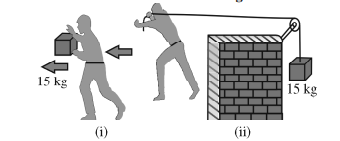
(d) In Fig. (i) the man walks 2m carrying a mass of 15 kg on his hands. In Fig. (ii), he walks the same distance pulling the rope behind him. The rope goes over a pulley, and a mass of 15 kg hangs at its other end. In wich case is the work done greater?
 Image
A saturn year is 29.5 times the earth year. How far is the saturn from the sun if the earth is 1.50 × 10⁸ km away from the sun ?
You are holding a cage containing a bird. Do you have to make less effort if the bird flies from its position in the cage and manages to stay in the middle without touching the walls of the cage? Does it make a difference whether the cage is completely closed or it has rods to let air pass?
A tangent galvanometer shows a deflection of 45° when 10mA of current is passed through it. If the horizontal component of the earth's magnetic field is BH = 3.6×10⁻⁵ T and radius of the coil is 10cm, find the number of turns in the coil.
Read the passage given below and answer the following questions from 1 to 5.
When we speak, the sound moves outward from us, without any flow of air from one part of the medium to another. The disturbances produced in air are much less obvious and only our ears or a microphone can detect them. These patterns, which move without the actual physical transfer or flow of matter as a whole, are called waves. The most familiar type of waves such as waves on a string, water waves, sound waves, seismic waves, etc. is the so-called mechanical waves. These waves require a medium for propagation, they cannot propagate through vacuum. They involve oscillations of constituent particles and depend on the elastic properties of the medium. The electromagnetic waves that you will learn in Class XII are a different type of wave. Electromagnetic waves do not necessarily require a medium – they can travel through vacuum. Light, radio waves, X-rays, are all electromagnetic waves. We have seen that motion of mechanical waves involves oscillations of constituents of the medium. If the constituents of the medium oscillate perpendicular to the direction of wave propagation, we call the wave a transverse wave. If they oscillate along the direction of wave propagation, we call the wave a longitudinal wave. In transverse waves, the particle motion is normal to the direction of propagation of the wave. Therefore, as the wave propagates, each element of the medium undergoes a shearing strain. Transverse waves can, therefore, be propagated only in those media, which can sustain shearing stress, such as solids and not in fluids. Fluids, as well as, solids can sustain compressive strain; therefore, longitudinal waves can be propagated in all elastic media.
For example, in medium like steel, both transverse and longitudinal waves can propagate, while air can sustain only longitudinal waves. Answer the following.
  1. Air can sustain:
  1. Transverse waves
  2. Longitudinal waves
  3. Both a and b
  4. None of these
  1. The electromagnetic waves can pass through
  1. Solids only
  2. Fluids only
  3. Any medium even through vacuum
  4. None of these
  1. Define Transverse waves
  1. Define longitudinal waves
  1. Differentiate between Transverse waves and longitudinal waves
In a TV picture tube electrons are ejected from the cathode with negligible speed and reach a velocity of 5 × 10⁶m/s in travelling one centimeter. Assuming straight line motion, find the constant force exerted on the electron. The mass of the electron is 9.1 × 10⁻³¹kg.
In a microwave oven, the food is kept in a plastic container and the microwave is directed towards the food. The food is cooked without melting or igniting the plastic container. Explain.
Mr. Verma (50kg) and Mr. Mathur (60kg) are sitting at the two extremes of a 4m long boat (40kg) standing still in water. To discuss a mechanics problem, they come to the middle of the boat. Neglecting friction with water, how far does the boat move on the water during the process?
Read the passage given below and answer the following questions from (i) to (v).
When a system (such as a simple pendulum or a block attached to a spring) is displaced from its equilibrium position and released, it oscillates with its natural frequency $\omega,$ and the oscillations are called free oscillations. All free oscillations eventually die out because of the ever present damping forces. However, an external agency can maintain these oscillations. These are called forced or driven oscillations. We consider the case when the external force is itself periodic, with a frequency wd called the driven frequency. The most important fact of forced periodic oscillations is that the system oscillates not with its natural frequency $\omega,$ but at the frequency $\omega,$ d of the external agency; the free oscillations die out due to damping. The most familiar example of forced oscillation is when a child in a garden swing periodically presses his feet against the ground (or someone else periodically gives the child a push) to maintain the oscillations. The maximum possible amplitude for a given driving frequency is governed by the driving frequency and the damping, and is never infinity. The phenomenon of increase in amplitude when the driving force is close to the natural frequency of the oscillator is called resonance. In our daily life, we encounter phenomena which involve resonance. Your experience with swings is a good example of resonance. You might have realized that the skill in swinging to greater heights lies in the synchronization of the rhythm of pushing against the ground with the natural frequency of the swing.
  1. When a system oscillates with its natural frequency ω, and the oscillations are called:
  1. Free oscillations.
  2. Forced oscillations.
  1. All free oscillations eventually die out because of:
  1. Damping force.
  2. electromagnetic force.
  3. None of these.
  1. What is free oscillation?
  2. What is forced oscillations?
  3. What is resonance?