Questions

4 Marks Question

🎯

Test yourself on this topic

43 questions · timed · auto-graded

Question 14 Marks
A triode has mutual conductance = 2.0milli mho and plate resistance $=20\text{k}\Omega$ It is desired to amplify a signal by a factor of 30. What load resistance should be added in the circuit?
Answer
$\text{r}_\text{p}=20\text{K}\Omega$ = Plate Resistance

Mutual conductance = gm = 2.0milli mho = 2 × 10-3mho

Amplification factor $\mu=30$

Load Resistance = RL = ?

We know,

$\text{A}=\frac{\mu}{1+\frac{\text{r}_\text{p}}{\text{R}_\text{L}}}$ where A = Voltage amplification factor

$\Rightarrow\text{A}=\frac{\text{r}_\text{g}\times\text{g}_\text{m}}{1+\frac{\text{r}_\text{p}}{\text{R}_\text{L}}}$ where $\mu=\text{r}_\text{p}\times\text{g}_\text{m}$

$\Rightarrow30=\frac{20\times10^{3}\times2\times10^{-3}}{1+\frac{20000}{\text{R}_\text{L}}}$

$\Rightarrow3=\frac{4\text{R}_\text{L}}{\text{R}_\text{L}+20000}$

$\Rightarrow3\text{R}_\text{L}+60000=4\text{R}_\text{L}$

$\Rightarrow\text{R}_\text{L}=6000\Omega=60\text{K}\Omega$
View full question & answer
Question 24 Marks
The plate resistance of a triode is $8\text{k}\Omega$ and the transconductance is 2.5 milliohm. (a) If the plate voltage is increased by 48V and the grid voltage is kept constant, what will be the increase in the plate current? (b) With plate voltage kept constant at this increased value, by how much should the grid voltage be decreased in order to bring the plate current back to its initial value?
Answer
$\text{r}_\text{p}=8\text{K}\Omega=8000\Omega$

$\delta\text{V}_\text{p}=48\text{V},\ \delta\text{I}_\text{p}=?$

$\delta\text{I}_\text{p}=\frac{\Big(\frac{\delta\text{V}_\text{p}}{\text{r}_\text{p}}\Big)}{\text{V}_\text{g}}=\text{constant}$

So, $\delta\text{I}_\text{p}=\frac{48}{8000}=0.006\text{A}=6\text{mA}$

Now, Vp is constant.

$\delta\text{I}_\text{p}=6\text{mA}=0.006\text{A}$

$\text{g}_\text{m}=0.0025\Omega$

$\delta\text{V}_\text{g}=\frac{\Big(\frac{\delta\text{I}_\text{p}}{\text{g}_\text{m}}\Big)}{\text{V}_\text{p}}=\text{constant}$

$=\frac{0.006}{00025}=2.4\text{V}$

View full question & answer
Question 34 Marks
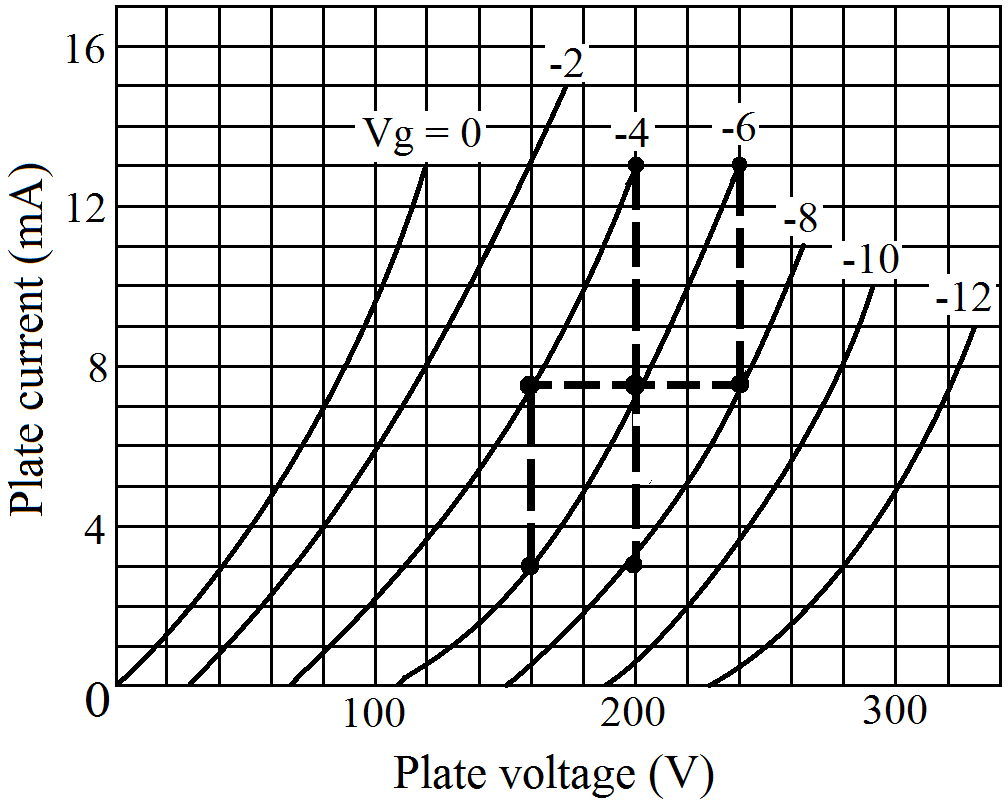
Find the values of $\text{r}_\text{p},\ \mu$ and gm of a triode operating at plate voltage 200V and grid voltage -6. The plate characteristics are shown in the figure.

Answer
$\text{r}_\text{p}=\Big(\frac{\delta\text{V}_\text{p}}{\delta\text{I}_\text{p}}\Big)$ at constant Vg

Consider the two points on Vg = -6 line

$\text{r}_\text{p}=\frac{(240-160)\text{V}}{(13-3)\times10^{-3}\text{A}}=\frac{80}{10}\times10^{3}\Omega=8\text{K}\Omega$

$\text{g}_\text{m}=\Big(\frac{\delta\text{I}_\text{p}}{\delta\text{V}_\text{g}}\Big)\text{v}_\text{p}=\text{constant}$

Considering the points on 200V line,

$\text{g}_\text{m}=\Big(\frac{\delta\text{I}_\text{p}}{\delta\text{V}_\text{g}}\Big)\text{v}_\text{p}=\text{constant}$

Considering the points on 200V line,

$\text{g}_\text{m}=\frac{(13-3)\times10^{-3}}{\big[(-4)+(-8)\big]}\text{A}$

$=\frac{10\times10^{-3}}{4}=2.5\text{milli}\Omega$

$\mu=\text{r}_\text{p}\times\text{gm}$

$\mu=8\times10^{3}\Omega\times2.5\times10^{-3}\Omega^{-1}$

$\mu=8\times1.5=20$

View full question & answer
Question 44 Marks
The plate current in a triode can be written as $\text{i}_\text{p}=\text{k}\Big(\text{V}_\text{g}+\frac{\text{V}_\text{p}}{\mu}\Big)^{\frac{3}{2}}$ Show that the mutual conductance is proportional to the cube root of the plate current.
Answer
$\text{i}_\text{p}=\text{k}\Big(\text{V}_\text{g}+\frac{\text{V}_\text{p}}{\mu}\Big)^{\frac{3}{2}}\ ....(\text{i})$

Diff. the equation,

$\text{di}_\text{p}=\text{K}\frac{3}{2}\Big(\text{V}_\text{g}+\frac{\text{V}_\text{p}}{\mu}\Big)^{\frac{1}{2}}\text{dV}_\text{g}$

$\frac{\text{di}_\text{P}}{\text{dV}_\text{g}}=\frac{3}{2}\text{K}\Big(\text{V}_\text{g}+\frac{\text{V}_0}{\mu}\Big)^{\frac{1}{2}}$

$\text{g}_\text{m}=\frac{3}{2}\text{K}\Big(\frac{\text{V}_\text{g}+\text{V}_\text{p}}{\mu}\Big)^{\frac{1}{2}}\ ....(\text{ii})$

From (i) $\text{i}_\text{p}=\text{k}'(\text{gm})^{3}$

$\text{g}_\text{m}\propto3\sqrt{\text{i}_\text{p}}$

View full question & answer
Question 54 Marks
A plate current of 10mA is obtained when 60 volts are applied across a diode tube. Assuming the Langmuir-Child equation $\text{i}_\text{p}\propto\text{V}_\text{p}^{\frac{3}{2}}$ to hold, find the dynamic resistance rin this operating condition.
Answer
$\text{i}_\text{p}=\text{CV}_\text{p}^{\frac{3}{2}}\ ...(\text{i})$

$\Rightarrow{\text{di}_\text{p}}=\text{C}\frac{3}{2}\text{V}_\text{p}^{(\frac{3}{2})-1\text{dv}_\text{p}}$

$\Rightarrow\frac{{\text{di}_\text{p}}}{\text{dv}_\text{p}}=\frac{3}{2}\text{CV}_\text{p}^{\frac{1}2}\ ....(\text{ii})$

Dividing (ii) and (i)

$\frac{\text{i}}{\text{i}_\text{p}}\frac{{\text{di}_\text{p}}}{\text{dv}_\text{p}}=\frac{\frac{3}{2}\text{CV}_\text{p}^{\frac{1}2}}{\text{CVp}^{\frac{3}2}}$

$\Rightarrow\frac{\text{i}}{\text{i}_\text{p}}\frac{{\text{di}_\text{p}}}{\text{dv}_\text{p}}=\frac{3}{2\text{V}}$

$\Rightarrow\frac{{\text{dv}_\text{p}}}{\text{di}_\text{p}}=\frac{2\text{V}}{3\text{i}_\text{p}}$

$\Rightarrow\text{R}=\frac{2\text{V}}{3\text{i}_\text{p}}=\frac{2\times60}{3\times10\times10^{-3}}$

$\Rightarrow\text{R}=4\times10^3=4\text{k}\Omega$

View full question & answer
Question 64 Marks
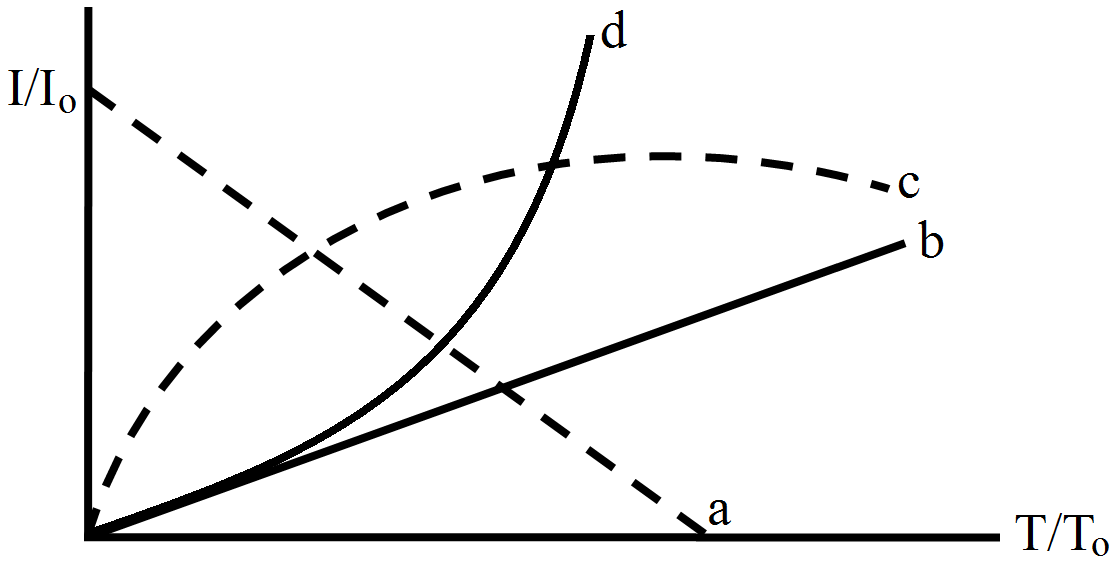
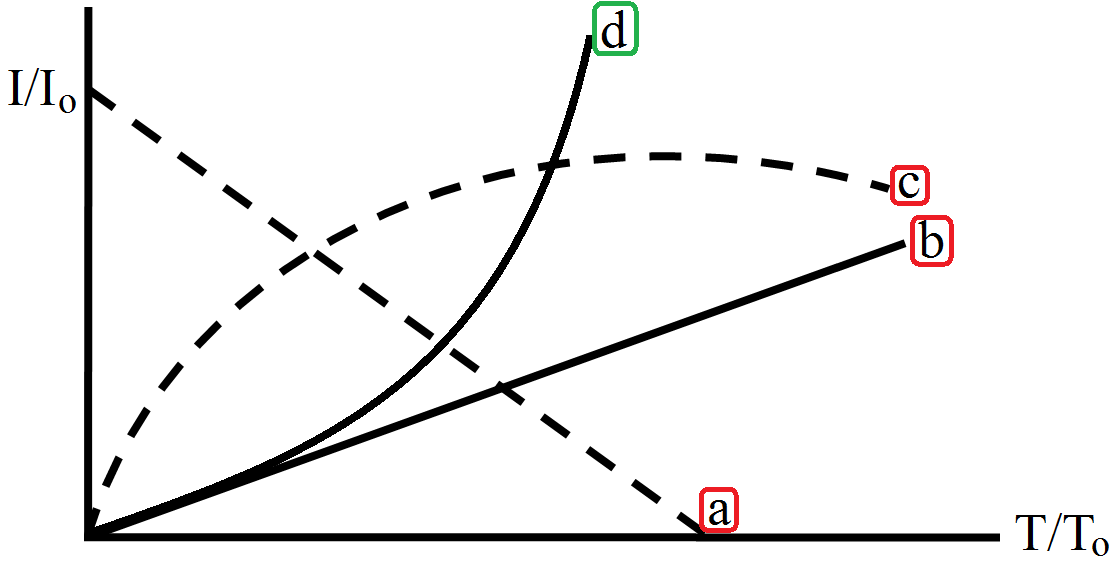
Let i0 be the thermionic current from a metal surface when the absolute temperature of the surface is T0. The temperature is slowly increased and the thermionic current is measured as a function of temperature. Which of the following plots may represent the variation in $\Big(\frac{\text{i}}{\text{i}_0}\Big)$ against $\Big(\frac{\text{T}}{\text{T}_0}\Big)?$

Answer
  1.  

Explanation:

Since the thermionic current is directly proportional to the square of the temperature of the surface emitting thermions, the graph is parabolic.

View full question & answer
Question 74 Marks
Because to the space charge in a diode valve:
  1. The plate current decreases.
  2. The plate voltage increases.
  3. The rate of emission of thermions increases.
  4. The saturation current increases.
Answer
  1. The plate current decreases.

Explanation:

A diode valve consists of a negatively-charged region between the cathode and anode, called the space charge region. This negatively-charged region repels the electrons coming from the cathode and, thus, it reduces the plate current. On the other hand, this region has no effect on plate voltage, rate of emission of thermions and the saturation current.

View full question & answer
Question 84 Marks
The amplification factor of a triode operating in the linear region depends strongly on:
  1. The temperature of the cathode.
  2. The plate potential.
  3. The grid potential.
  4. The separations of the grid from the cathode and the anode.
Answer
  1. The separations of the grid from the cathode and the anode.

Explanation:

When the triode operating in the linear region, value of plate voltage, grid voltage and plate current is already specified (or fixed). If the grid is near the cathode, then we assume that grid lie in the region where the space charge density is more. There is a chance that grid will pick up electrons from the space charge region of cathode and effect the plate current and hence amplification factor (as we know that amplification factor will depend on the plate current). If the grid is far from the cathode, it will reduce the grid voltage and hence the amplification factor also get affected.

View full question & answer
Question 94 Marks
Cathode rays are passing through a discharge tube. In the tube, there is:
  1. An electric field but no magnetic field.
  2. A magnetic field but no electric field.
  3. An electric as well as a magnetic field.
  4. Neither an electric nor a magnetic field.
Answer
  1. An electric as well as a magnetic field.

Explanation:

Cathode rays consist of beams of electrons that constitute current and, hence, magnetic field. We know electric field is produced by a charge, whether it is stationary or moving, So, electric field will also be present inside the tube.

View full question & answer
Question 104 Marks
When the diode shows saturated current, dynamic place resistance is:
  1. Zero.
  2. Infinity.
  3. Indeterminate.
  4. Different for different diodes.
Answer
  1. Infinity.

Explanation:

Saturated current is the maximum current beyond which, there is no effect of plate voltage (VP) on the plate current (IP). At this stage, dynamic resistance is infinite.

View full question & answer
Question 114 Marks
Which of the following is true for a cathode ray?
  1. It travels in a straight line.
  2. It emits an X-ray when it strikes a metal.
  3. It is an electromagnetic wave.
  4. It is not deflected by a magnetic field.
Answer
  1. It travels in a straight line.
  2. It emits an X-ray when it strikes a metal.

Explanation:

A cathode ray travels in a straight line. When cathode rays strike a solid metal, X-rays are emitted from the metal. When a cathode ray tube is brought in a magnetic field, the path of cathode rays gets deflected. Cathode rays are the matter waves that consists of electrons thus they are not electromagnetic waves.

View full question & answer
Question 124 Marks
The dynamic plate resistance of a triode value is $10\text{k}\Omega$ Find the change in the plate current if the plate voltage is changed from 200V to 220V.
Answer
Dynamic Plate Resistance $\text{r}_\text{p}=10\text{k}\Omega=10^{4}\Omega$

$\delta\text{I}_\text{p}=?$

$\delta\text{V}_\text{p}=220-220=20\text{V}$

$\delta\text{I}_\text{p}=\frac{\Big(\frac{\delta\text{V}_\text{p}}{\text{r}_\text{p}}\Big)}{\text{V}_\text{g}}=\text{constant}$

$=\frac{20}{10^4}=0.002\text{A}=2\text{mA}$

View full question & answer
Question 134 Marks
The gain factor of an amplifier in increased from 10 to 12 as the load resistance is changed from $4\text{k}\Omega\text{ to }8\text{k}\Omega$ Calculate (a) the amplification factor and (b) the plate resistance.
Answer
Voltage gain $=\frac{\mu}{1+\frac{\text{r}_\text{p}}{\text{R}_\text{L}}}$

When $\text{A}=10,\ \text{R}_\text{L}=4\text{K}\Omega$

$10=\frac{\mu}{1+\frac{\text{r}_\text{p}}{4\times10^{3}}}$

$10=\frac{\mu\times4\times\times10^{3}}{4\times10^{3}+\text{r}_\text{p}}$

$40\times10^{3}\times10\text{r}_\text{p}=4\times10^{3}\mu\ ....(\text{i})$

When $\text{A}=12,\text{R}_\text{L}=8\text{K}\Omega$

$12=\frac{\mu}{1+\frac{\text{r}_\text{p}}{8\times10^{3}}}$

$12=\frac{\mu\times8\times10^{3}}{8\times10^{3}+\text{r}_\text{p}}$

$96\times10^{3}+12\text{r}_\text{p}=8\times10^{3}\mu\ ...(\text{ii})$

Multiplying (ii) in equation (i) and equating with equation (ii)

$2(40\times10^{3}+10\text{r}_\text{p})=96\times10+3+12\text{r}_\text{p}$

$\text{r}_\text{p}=2\times10^{3}\Omega=2\text{K}\Omega$

Putting the value in equation (i)

$40\times10^{3}+10(2\times10^{3})=4\times10^{3}\mu$

$40\times10^{3}+20\times10^{3}=4\times10^{3}\mu$

$\mu=\frac{60}{4}=15$

View full question & answer
Question 144 Marks
A molecule of a gas, filled in a. discharge tube, gets ionized when an electron is detacbed from it. An electric field of 5.0kV/m exists in the vicinity of the event. (a) Find the distance travelled by the free electron in $1\mu\text{s}$ assuming no collision. (b) If the mean free path of the electron is 1.0mm, estimate the time of transit of the free electron between successive collisions.
Answer
$\text{E}=5\text{Kv/m}=5\times10^3\text{v/m},\ \text{t}=1,\ \mu\text{s}=1\times10^{-6}\text{s}$

$\text{F}=\text{qE}=1.6\times10^{-9}\times5\times10^{3}$

$\text{a}=\frac{\text{qE}}{\text{m}}=\frac{1.6\times5\times10^{-16}}{9.1\times10^{-31}}$

  1. S = Distance travelled

$=\frac{1}{2}\text{at}^2=439.56\text{m}=440\text{m}$

  1. $\text{d}=1\text{mm}=1\times10^{-3}\text{m}$

$1\times10^{-3}=\frac{1}{2}\times\frac{1.6\times5}{9.1}10^5\times\text{t}^2$

$\text{t}^2=\frac{9.1}{0.8\times5}\times10^{-18}$

$\text{t}=1.508\times10^{-9}\sec$

$\text{t}=1.5\text{ns.}$ 

View full question & answer
Question 154 Marks
The constant A in the Richardson-Dushman equation for tungsten is 60 × 104Am-2K-2. The work function of tungsten is 4.5eV. A tungsten cathode with a surface area 2.0 × 10⁻⁵m2 is heated by a 24W electric heater. In steady state, the heat radiated by the heater and the cathode equals the energy input by the heater and the temperature becomes constant. Assuming that the cathode radiates like a blackbody, calculate the saturation current due to thermions. Take Stefan's Constant $ 6 × 10^{-8}\omega/\text{m}^2-\text{K}^4.$ Assume that the thermions take only a small fraction of the heat supplied.
Answer
$\text{A}=60\times10^{4}\text{A/m}^2-\text{k}^2$

$\phi=4.5\text{ev}$

$\sigma=6\times10^{-8}\omega/\text{m}^2-\text{k}^4$

$\text{S}=2\times10^{-5}\text{m}^2$

$\text{K}=1.38\times10^{23}\text{J/K}$

$\text{H}=24\omega'$

The cathode acts as a black body,i.e. emissivity = 1

$\therefore\text{ E}=\sigma\text{AT}^4\ (\text{A is area})$

$\text{T}^4=\frac{\text{E}}{\sigma\text{A}}=\frac{24}{6\times10^{-8}\times2\times10^{-5}}=2\times10^{13}\text{K}=20\times10^{12}\text{K}$

$\text{T}=2.1147\times10^{3}=2114.7\text{K}$

Now, $\text{i}=\text{AST}^2\text{e}^{\frac{-\phi}{\text{KT}}}$

$=6\times10^5\times2\times10^{-5}\times(2114.7)^2\times\text{e}^{\frac{-45\times1.6\times10^{-19}}{1.38\times\text{T}\times10^{-23}}}$

$=1.03456\times10^{-3}\text{A}=1\text{mA}$

View full question & answer
Question 164 Marks
Calculate the amplification factor of a triode valve that has plate resistance of $2\text{k}\Omega$ and transconductance of 2 millimho.
Answer
$\text{r}_\text{p}=2\text{k}\Omega=2\times10^3\Omega$

$\text{g}_\text{m}=2\text{milli mho}=2\times10^{-3}\text{mho}$

$\mu=\text{r}_\text{p}\times\text{g}_\text{m}=2\times10^{3}\times2\times10^{-3}=4$ Amplification factor is 4.

View full question & answer
Question 174 Marks
Calculate $\frac{\text{n(T)}}{\text{n}(1000\text{K})}$ for tungsten emitter at T = 300K, 2000K and 3000K, where n(T) represents the number of thermions emitted per second by the surface at temperature T. Work function of tungsten is 4.52eV.
Answer
$\text{i}=\text{ne or n}=\frac{\text{i}}{\text{e}}$

‘e’ is same in all cases.

We know,

$\text{i}=\text{AST}^2\text{e}^{\frac{-\phi}{\text{RT}}}\ \phi=4.52\text{eV},\ \text{K}=1.38\times10^{-23}\text{J/k}$

$\text{n(1000)}=\text{As}\times(1000)^2\times\text{e}^{-4.52\times1.6\times10^{-19}/1.38\times10^{-23}\times1000}$

$1.7396\times10^{-17}$

  1. $\text{T}=300\text{K}$

$\frac{\text{n(T)}}{\text{n(1000K)}}=\frac{\text{AS}\times(300)^2\times\text{e}^{-4.52\times1.6\times10^{-19}/1.38\times10^{-23}\times300}}{\text{AS}\times1.7396\times10^{-17}}=7.05\times10^{-55}$

  1. $\text{T}=2000\text{K}$

$$$\frac{\text{n(T)}}{\text{n(1000K)}}=\frac{\text{AS}(2000)^2\times\text{e}^{-4.52\times1.6\times10^{-19}/1.38\times10^{-23\times2000}}}{\text{AS}\times1.7396\times10^{-17}}=9.59\times10^{11}$

  1. $\text{T}=3000\text{K}$

$\frac{\text{n(T)}}{\text{n(1000K)}}=\frac{\text{AS}\times(3000)^2\times\text{e}^{-4.52\times1.6\times10^{-19}/1.38\times10^{-23}\times3000}}{\text{AS}\times1.7396\times10^{-17}}=1.340\times10^{16}$

View full question & answer
Question 184 Marks
The plate current, plate voltage and grid voltage of a 6F6 triode tube are related as $\text{i}_\text{p}=41(\text{V}_\text{p}+7\text{V}_\text{g})^{1.41}$ where Vp and Vg are in volts and ip in microamperes. The tube is operated at Vp = 250V, Vg = -20V. Calculate (a) the tube current, (b) the plate resistance, (c) the mutual conductance and (d) the amplification factor.
Answer
$\text{V}_\text{p}=250\text{V},\text{ V}_\text{g}=-20\text{V}$

  1. $\text{i}_\text{p}=41(\text{V}_\text{p}+7\text{V}_\text{g})^{1.41}$

$41(250-140)^{1.41}=41\times(110)^{1.41}$

$=30984\mu\text{A}=30\text{mA}$

  1. $\text{i}_\text{p}=41(\text{V}_\text{p}+7\text{V}_\text{g})^{1.41}$

Differentiating,

$\text{di}_\text{p}=41\times1.41\times(\text{V}_\text{p}+7\text{V}_\text{g})^{0.41}\times(\text{dV}_\text{p}+7\text{dV}_\text{g})$

Now, $\text{r}_\text{p}=\frac{\text{dV}_\text{p}}{\text{di}_\text{p}}\text{V}_\text{g}=\text{constant}$

or $\frac{\text{dV}_\text{p}}{\text{di}_\text{p}}=\frac{1\times10^{6}}{41\times1.41\times110^{0.41}}$

$=10^{6}\times2.510\times10^{-3}$

$2.5\times10^{3}\Omega=2.5\text{K}\Omega$

  1. From above,

$\text{dI}_\text{p}=41\times1.41\times6.87\times7\text{d V}\text{g}$

$\text{g}_\text{m}=\frac{\text{dI}_\text{p}}{\text{dV}_\text{g}}=41\times1.41\times6.87\times7\mu\Omega$

$=2780\mu\Omega=2.78\Omega$

  1. Amplification factor,

$\mu=\text{r}_\text{p}\times\text{g}_\text{m}$

$=2.5\times10^{3}\times2.78\times10^{-3}=6.95=7$

View full question & answer
Question 194 Marks
The plate resistance and amplification factor of a triode are $10\text{k}\Omega$ and 20. The tube is operated at plate voltage 250V and grid voltage -7.5V. The plate current is 10mA. (a) To what value should the grid voltage be changed so as to increase the plate current to 15mA? (b) To what value should the plate voltage be changed to take the plate current back to 10mA?
Answer
$\text{r}_\text{p}=10\text{K}\Omega=10\times10^{3}\Omega$

$\mu=20,\ \text{V}_\text{p}$

$\text{V}_\text{g}=-7.5\text{V},\ \text{I}_\text{p}=10\text{mA}$

  1. $\text{g}_\text{m}=\Big(\frac{\delta\text{I}_\text{p}}{\delta\text{V}_\text{g}}\Big)\text{V}_\text{p}=\text{constant}$

$\delta\text{V}_\text{g}=\frac{\delta\text{I}_\text{p}}{\text{g}_\text{m}}=\frac{15\times10^{3}-10\times10^{-3}}{\frac{\mu}{\text{r}_\text{p}}}$

$\delta\text{V}_\text{g}=\frac{5\times10^{-3}}{\frac{20}{10\times10^{3}}}=\frac{5}{2}=2.5$

$\text{r}'\text{g}=+2.5-7.5=-5\text{V}$

  1. $\text{r}_\text{p}=\Big(\frac{\delta\text{V}_\text{p}}{\delta\text{I}_\text{p}}\Big)\text{V}_\text{g}=\text{constant}$

$10^{4}=\frac{\delta\text{V}_\text{p}}{(15\times10^{-3}-10\times10^{-3})}$

$\delta\text{V}_\text{p}=10^4\times5\times10^{-3}=50\text{v}$

$\text{V}'_\text{p}-\text{V}_\text{p}=50$

$\text{V}'_\text{p}=-50+\text{V}_\text{p}=200\text{V}$

View full question & answer
Question 204 Marks
If the temperature of a tungsten filament is raised from 2000K to 2010K, by what factor does the emission current change? Work function of tungsten is 4.5eV.
Answer
$\text{i}=\text{AST}^2\text{e}^{\frac{-\phi}{\text{KT}}}$

$\text{i}'=\text{AST}^{12}\text{e}^{\frac{-\phi}{\text{KT}}}$

$\frac{\text{i}}{\text{i}'}=\frac{\text{T}^2}{\text{T}^{12}}\frac{\text{e}^{\frac{-\phi}{\text{KT}}}}{\text{e}^{\frac{-\phi}{\text{KT}}}}$

$\Rightarrow\frac{\text{i}}{\text{i}'}=\Big(\frac{\text{T}}{\text{T}'}\Big)^2\text{e}^{\frac{-\phi}{\text{KT}+\phi\text{KT}'}}=\Big(\frac{\text{T}}{\text{T}'}\Big)^2\text{e}^{\phi\text{KT}'-\phi/\text{KT}}$

$\Rightarrow\frac{\text{i}}{\text{i}'}=\Big(\frac{2000}{2010}\Big)^2\text{e}^{\frac{4.5\times1.6\times10^{-19}}{1.38\times10^{-23}}}\Big(\frac{1}{2010}-\frac{1}{2000}\Big)=0.8690$

$\Rightarrow\frac{\text{i}}{\text{i}'}=\frac{1}{0.8699}=1.1495=1.14$

View full question & answer
Question 214 Marks
The power delivered in the plate circular of a diode is 1.0W when the plate voltage is 36V. Find the power delivered if the plate voltage is increased to 49V. Assume Langmuir-Child equation to hold.
Answer
$\text{P}=1\text{W},\ \text{p}=?$

$\text{V}_\text{p}=36\text{V},\ \text{V}_\text{p}=49\text{V},\ \text{P}=\text{I}_\text{p}\text{V}_\text{p}$

$\text{I}_\text{p}=\frac{\text{P}}{\text{V}_\text{p}}=\frac{1}{36}$

$\text{I}_\text{p}\propto(\text{V}_\text{p})^{3/2}$

$\text{I}'_\text{p}\propto(\text{V}'_\text{p})^{3/2}$

$\Rightarrow\frac{\text{I}_\text{p}}{\text{I}'_\text{p}}=\frac{(\text{V}_\text{p})^{3/2}}{\text{V}'_\text{p}}$

$\Rightarrow\frac{\frac{1}{36}}{\text{I}'_\text{p}}=\Big(\frac{36}{49}\Big)^{3/2}$

$\Rightarrow\frac{1}{36\text{I}'_\text{p}}=\frac{36}{49}\times\frac{6}{7}$

$\Rightarrow\text{I}'_\text{p}=0.4411$

$\Rightarrow\text{P}'=\text{V}'_\text{p}\text{I}'_\text{p}$

$\Rightarrow\text{P}'=49\times0.4411$

$\Rightarrow\text{P}=2.1613\text{W}=2.2\text{W}$

View full question & answer
Question 224 Marks
The saturation current from a thoriated-tungsten cathode at 2000K is 100mA. What will be the saturation current for a pure-tungsten cathode of the same surface area operating at the same temperature? The constant A in the Richardson-Dushman equation is 60 × 104Am-2K-2 for pure tungsten and 3.0 × 10⁴Am-2k-2 for thoriated tungsten. The work function of pure tungsten is 4.5eV and that of thoriated tungsten is 2.6eV.
Answer
$\text{i}=\text{AST}^2\text{ e}^{\frac{-\phi}{\text{KT}}}$

$\text{i}_1=\text{i},\ \text{i}_2=100\text{mA}$

$\text{A}_1=60\times10^4,\ \text{A}_2=3\times10^4$

$\text{S}_1=\text{S},\ \text{S}_2=\text{S}$

$\text{T}_1=2000,\ \text{T}_2=2000$

$\phi_1=4.5\text{eV},\ \phi_2 =2.6\text{eV}$

$\text{i}=(60\times10^{4})(\text{S})\times(2000)^2\frac{-45\times1.6\times10^{-19}}{\text{e}^{1.38\times10^{-23}\times2000}}$

$100=(3\times10^{4})(\text{S})\times(2000)^2\frac{-2.6\times1.6\times10^{-19}}{\text{e}^{1.38\times10^{-23}\times2000}}$

Dividing the equation,

$\Rightarrow\frac{\text{i}}{100}=\text{e}^{\big[\frac{-4.5\times1.6\times10}{1.38\times2}\big(\frac{-2.6\times1.6\times10}{1.38\times20}\big)\big]}$

$\Rightarrow\frac{\text{i}}{100}=20\times\text{e}^{-11.014}$

$\Rightarrow\frac{\text{i}}{100}=20\times0.000016$

$\Rightarrow\text{i}=20\times0.0016=0.0329\text{mA}=33\mu\text{A}$

View full question & answer
Question 234 Marks
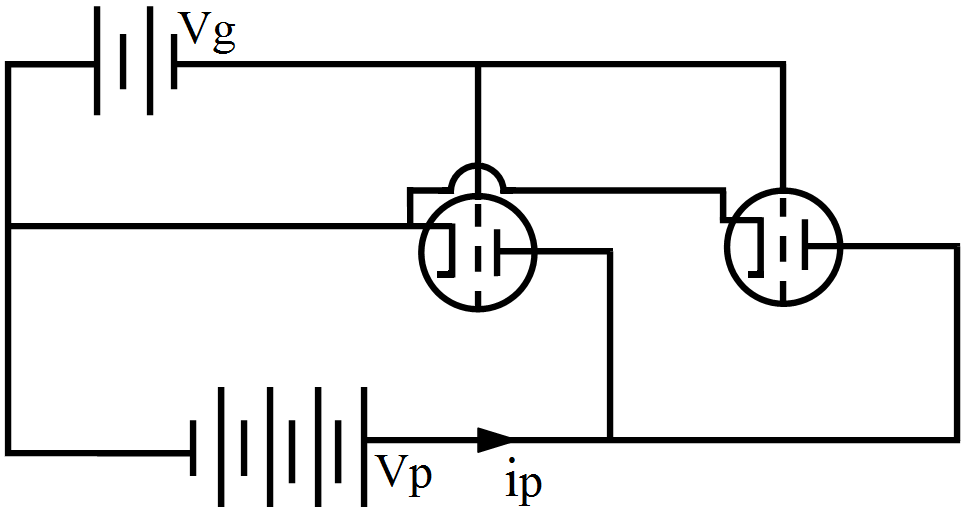
The figure shows two identical triode tubes connected in parallel. The anodes are connected together and the cathodes are connected together. Show that the equivalent plate resistance is half the individual plate resistance, the equivalent mutual conductance is double the

individual mutual conductance and the equivalent amplification factor is the same as the individual amplification factor.
Answer
From the circuit, Cathode of both the triodes are connected to a common point and their anodes are also connected together. Thus, the 2 triodes are connected in parallel.

As plate resistance is obtained by observing the variation of plate voltage with plate current, keeping grid voltage as constant.

Hence equivalent plate resistance,

$\text{R}_\text{p}=\frac{\text{rp}_1\times\text{rp}_2}{\text{rp}_1+\text{rp}_2}$

if both the triodes have equal plate resistance

i.e., $\text{R}_\text{p}=\frac{\text{r}_\text{p}}{2}$

To find the equivalent transconductance.

We need to look at the variation of current with respect to grid voltage, keeping plate voltage as constant.

From the circuit

Now the 2 triodes are in series w.r.t grid voltage.

Hence equivalent transconductance will be equal to

$\text{G}_\text{m}=2\text{g}_\text{m}$

if the 2 triodes have equal trens conductance i.e., $\text{g}_{\text{m}_1}=2\text{g}_{\text{m}_2}=\text{g}_{\text{m}}$

Now the equivalent amplification factor is,

$\mu_{\text{equivalent}}=\text{G}_{\text{m}}\times\text{R}_{\text{p}}$

$\mu_{\text{equivalent}}=2\text{g}_{\text{m}}\times\frac{\text{r}_{\text{p}}}{2}$

$\mu_{\text{equivalent}}=\mu$

View full question & answer
Question 244 Marks
The mean free path of electrons in a gas in a discharge tube is inversely proportional to the pressure inside it. The Crookes dark space occupies half the length of the discharge tube when the pressure is 0.02mm of mercury. Estimate the pressure at which the dark space will fill the whole tube.
Answer
Let the mean free path be ‘L’ and pressure be ‘P’

$\text{L}\propto\frac{1}{\text{p}}$ for L = half of the tube length, P = 0.02mm of Hg

As ‘P’ becomes half, ‘L’ doubles, that is the whole tube is filled with Crook’s dark space.

Hence the required pressure $=\frac{0.02}{2}=0.01\text{m of Hg}$

View full question & answer
Question 254 Marks
A triode value operates at Vp = 225V and Vg = -0.5V. The plate current remains unchanged if the plate voltage is increased to 250V and the grid voltage is decreased to -2.5V. Calculate the amplification factor.
Answer
Amplification factor for triode value

$=\mu=\frac{\text{Charge in Plate Voltage}}{\text{Charge in Grid Voltage}}=\frac{\delta\text{V}_\text{p}}{\delta\text{v}_\text{g}}$

$=\frac{250-225}{2.5-0.5}=\frac{25}{2}=12.5$ $\big[\therefore\ \delta\text{Vp}=250-225,\delta\text{V}_\text{g}=2.5-0.5\big]$

View full question & answer
Question 264 Marks
The plate current in a triode valve is zero. The temperature of the filament is high. It is possible that:
  1. Vg > 0, Vp > 0
  2. Vg > 0, Vp < 0
  3. Vg < 0, Vp > 0
  4. Vg < 0, Vp < 0
Answer
  1. Vg > 0, Vp < 0

  2. Vg < 0, Vp > 0

  3. Vg < 0, Vp < 0

Explanation:

If the temperature of the filament is high, then it will emit electrons. Other conditions for the  plate current in the diode are:

  1. Positive grid voltage, Vg
  2. Positive plate voltage, VP

If any of the above conditions is not satisfied, then plate current in a triode will be zero.

View full question & answer
Question 274 Marks
The saturation current in a triode valve can be changed by changing:
  1. The grid voltage.
  2. The plate voltage.
  3. The separation between the grid and the cathode.
  4. The temperature of the cathode.
Answer
  1. The grid voltage.

Explanation:

Since the triode value consists of a space charge region near the cathode, this space charge region is affected by the grid voltage. If the grid voltage is made negative, it repels the electrons coming from the cathode and reduces current. If this voltage is made positive, it helps the electrons move towards the anode. Hence, this voltage is more effective in changing the plate current. Since, the saturated current in the triode is the maximum value of plate current, the saturated current in the triode valve is effectively controlled by the grid voltage. More negative is the grid voltage, less is the value of saturated current.

View full question & answer
Question 284 Marks
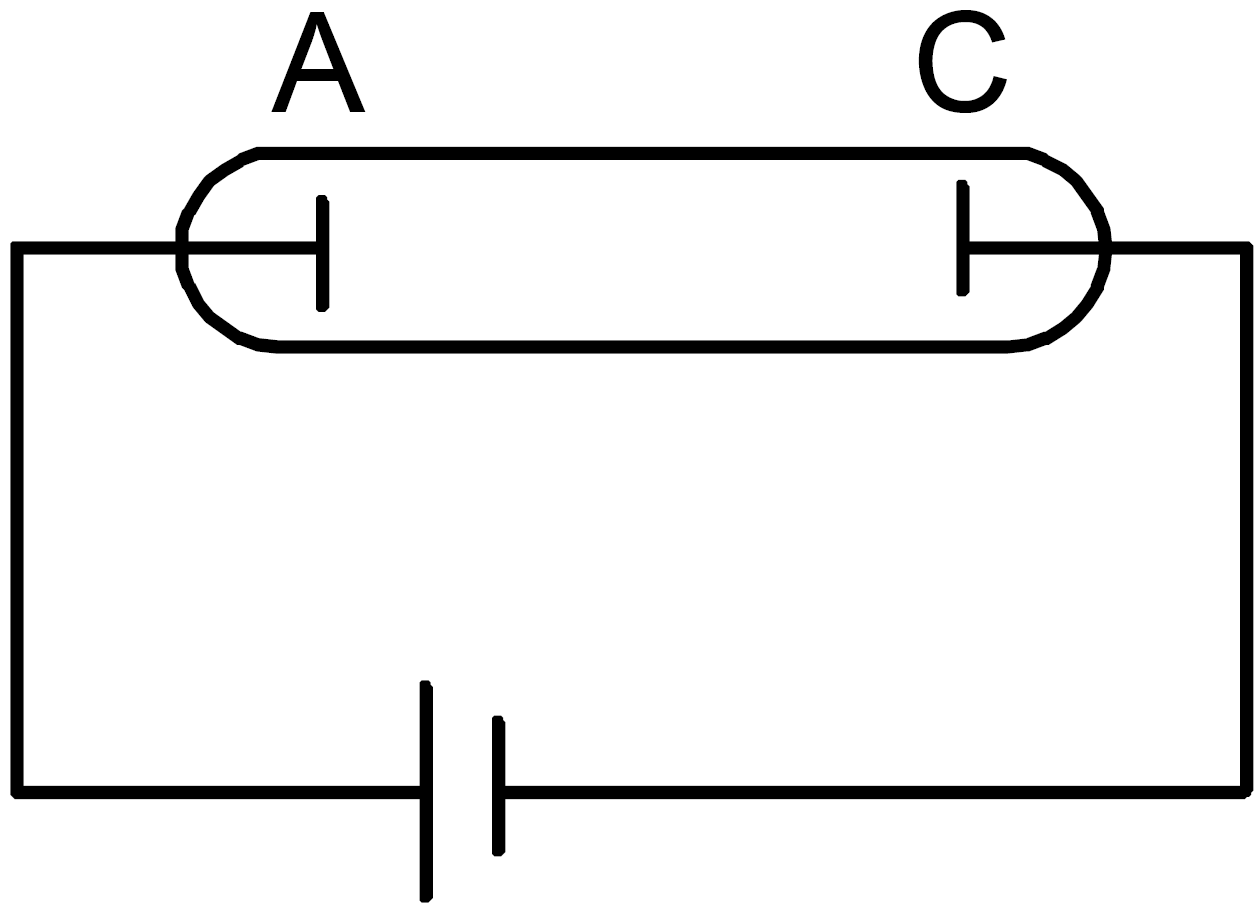
A discharge tube contains helium at low pressure. A large potential difference is applied across the tube. Consider a helium atom that has just been ionised due to the detachment of an atomic electron. Find the ratio of the distance travelled by the free electron to that by the positive ion in a short time dt after ionisation.
Answer
Let the two particles have charge ‘q’

Mass of electron ma = 9.1 × 10-31kg

Mass of proton mp = 1.67 × 10-27kg

Electric field be E

Force experienced by Electron = qE

$\text{accln.}=\frac{\text{qE}}{\text{m}_\text{e}}$

For time dt

$\text{S}_\text{e}=\frac{1}{2}\times\frac{\text{qE}}{\text{m}_\text{e}}\times\text{dt}^2\ ....(\text{i})$

For the positive ion,

$\text{acceleration}=\frac{\text{qE}}{4\times\text{m}_\text{p}}$

$\text{S}_\text{p}=\frac{1}{2}\times\frac{\text{qE}}{4\times\text{m}_\text{p}}\times\text{dt}^2\ ....(\text{ii})$

$\frac{\text{S}_\text{e}}{\text{S}_\text{p}}=\frac{4\text{m}_\text{p}}{\text{m}_\text{e}}=7340. 6$

View full question & answer
Question 294 Marks
A tungsten cathode and a thoriated-tungsten cathode have the same geometric dimensions and are operated at the same temperature. The thoriated-tungsten cathode gives 5000 times more current than the other cathode. Find the operating temperature. Take relevant data from the previous problem.
Answer
Pure tungsten:

$\phi=4.5\text{eV}$

$\text{A}=60\times10^{4}\text{A/m}^2-\text{k}^2$

$\text{i}=\text{AST}^2\text{e}^{\frac{\phi}{\text{KT}}}$

Thoriated tungsten:

$\phi=2.6\text{eV}$

$\text{A}=3\times10^{4}\text{A/m}^2-\text{k}^2$

$\text{i}_{\text{Thoriated Tungsten}}=5000\text{i}_{\text{Tungsten}}$

So, $5000\times\text{S}\times60\times10^{4}\times\text{T}_2\times\text{e}^{\frac{-4.5\times1.6\times10^{-19}}{1.38\times\text{t}\times10^{-23}}}$

$\Rightarrow\text{S}\times3\times10^{4}\times\text{T}^2\times\text{e}^{\frac{-2.56\times1.6\times10^{-19}}{1.38\times\text{T}\times10^{-23}}}$

$\Rightarrow3\times10^{8}\times\text{e}^{\frac{-4.5\times1.6\times10^{-19}}{1.38\times\text{t}\times10^{-23}}}=\text{e}^{\frac{-2.56\times1.6\times10^{-19}}{1.38\times\text{T}\times10^{-23}}}\times3\times10^4$

Taking 'in'

$\Rightarrow9.21\text{T}=220.29$

$\Rightarrow\text{T}=\frac{22029}{9.21}=2391.856\text{K}$

View full question & answer
Question 304 Marks
Would you prefer a material with a high melting point or a low melting point to be used as a cathode in a diode?
Answer
We will prefer a material with high melting point to be used as the cathode in a diode. The material of the cathode of a diode should be resistant to high temperature, have high melting point and be electrically conductive because thermionic emission occurs at high temperature.
View full question & answer
Question 314 Marks
How will the thermionic current vary if the filament current is increased?
Answer
If the filament current is increased, it will increase the temperature of the cathode (metal) and the cathode will emit more electrons. This will lead to an increase in the number of thermions emitted per unit time. As a result, the thermionic current will increase.
View full question & answer
Question 324 Marks
Two discharge tubes have identical material structures and the same gas is filled in them. The length of one tube is 10cm and that of the other tube is 20cm. Sparking starts in both the tubes when the potential difference between the cathode and the anode is 100V. If the pressure in the shorter tube is 1.0mm of mercury, what is the pressure in the longer tube?
Answer
$\text{V}=\text{f(Pd)}$

$\text{V}_\text{s}=\text{P}_\text{s}\text{d}_\text{s}$

$\text{V}_\text{L}=\text{P}_\text{L}\text{d}_\text{L}$

$\Rightarrow\frac{\text{V}_\text{s}}{\text{V}_\text{L}}=\frac{\text{P}_\text{s}}{\text{P}_\text{L}}\times\frac{\text{d}_\text{s}}{\text{d}_\text{L}}$

$\Rightarrow\frac{100}{100}=\frac{10}{20}\times\frac{1\text{mm}}{\text{x}}$

$\Rightarrow\text{x}=\frac{1\text{mm}}{2}=0.5\text{mm}$

View full question & answer
Question 334 Marks
Cathode rays constitute a stream of:
  1. Electrons.
  2. Protons.
  3. Positive ions.
  4. Negative ions.
Answer
  1. Electrons.

Explanation:

Cathode rays consist of a stream of fast moving electrons.

View full question & answer
Question 344 Marks
The plate current in a triode value is maximum when the potential of the grid is:
  1. Positive.
  2. Zero.
  3. Negative.
  4. Non-positive.
Answer
  1. Positive.

Explanation:

If the grid voltage is made positive, it will help the electrons move towards the anode, which will help in increasing the current. Thus, the plate current in the triode value is maximum when the potential of the grid is positive.

View full question & answer
Question 354 Marks
The plate current in a diode is 20mA when the plate voltage is 50V or 60V. What will be the current if the plate voltage is 70V?
Answer
For plate current 20mA, we find the voltage 50V or 60V. Hence it acts as the saturation current.Therefore for the same temperature, the plate current is 20mA for all other values of voltage. Hence the required answer is 20mA.
View full question & answer
Question 364 Marks
Would you prefer a material with a high work-function or a low work-function to be used as a cathode in a diode?
Answer
We will prefer a material with low work-function to be used as a cathode in a diode, so that electron emission can occur using a small amount of energy.
View full question & answer
Question 374 Marks
Why is the linear portion of the triode characteristic chosen to operate the triode as an amplifier?
Answer
When the operating point lies on the linear portion of the characteristics curve, change in voltage across the load resistance follows the pattern of the input signal, but the amplitude is much larger. This can be done by choosing the linear portion of triode characteristic.
View full question & answer
Question 384 Marks
The cathode of a diode valve is replaced by another cathode of double the surface area. Keeping the voltage and temperature conditions the same, will the place current decrease, increase or remain the same?
Answer
As the rate of emission of thermions is directly proportional to the surface area of the surface emitting it, the plate current doubles if the cathode of a diode valve is replaced by another cathode of double the surface area. Hence plate current increases.
View full question & answer
Question 394 Marks
An AC source is connected to a diode and a resistor in series. Is the current thorough the resistor AC or DC?
Answer
If the diode and resistor are in series, for the positive half cycle of AC, the current through the resistor will be DC. But for the next half cycle the current through the resistor will be zero. As a diode is a device that converts AC into DC, current through the resistor will be DC.
View full question & answer
Question 404 Marks
A diode value is connected to a battery and a load resistance. The filament is heated, so that a constant current is obtained in the circuit. As the cathode continuously emits electrons, does it become more and more positively charged?
Answer
No, the cathode does not become more and more positively charged. In the diode circuit, the cathode of the diode valve is always connected to the negative terminal of the battery. So, the battery will supply the electrons to the cathode and the cathode will continuously emit electrons without becoming more and more positively charged.
View full question & answer
Question 414 Marks
Why does thermionic emission not take place in non-conductors?
Answer
For thermionic emission, material should have low work function and large number of free electrons. But nonconductor does not have free electrons and they have higher work function. So, thermionic emission does not takes place in non-conductors.
View full question & answer
Question 424 Marks
Why is conducting easier in gases if the pressure is low? Will the conduction continue to improve if the pressure is made as low as nearly zero?
Answer
When electrons move through a gas, they collide with the gaseous particles and lose energy. This increases the resistance and, hence, reduces the current. But at low pressure, as the gas particle are widely spread, there are fewer collisions. So, the electrons can pass easily and with less collisions. If the pressure is reduced to nearly zero, the current through the gas will decrease. This is because the mean free-path of the electrons (distance that the electrons travel between collisions) is longer and they can, therefore, be accelerated to higher speeds before collision with an atom and they have more chance of causing ionisation.
View full question & answer
Question 434 Marks
An isolated metal sphere is heated to a high temperature. Will it become positively charged due to thermionic emission?
Answer
Yes, it will become positively charged due to thermionic emission. When the metal sphere is heated, average kinetic energy of the electrons will increases, due to which, the free electrons of the metal sphere will be able to escape. As a result, they will leave a positive charge on the isolated metal sphere.
View full question & answer
4 Marks Question - Physics STD 11 Science Questions - Vidyadip