MCQ
The screening effect of $d$-electons is
- AEqual to that of $p$-electrons
- BMore than that of $p$-electrons
- ✓Less than $p$-electrons
- DSame as $f$-electrons
Generate a complete, print-ready paper with questions like this in minutes — across 16+ boards, with answer keys.
$1 \mathrm{~mol}$ of an ideal gas is kept in a cylinder, fitted with a piston, at the position $\mathrm{A}$, at $18^{\circ} \mathrm{C}$. If the piston is moved to position $B$, keeping the temperature unchanged, then ' $x$ ' $L$ atm work is done in this reversible process.
$\mathrm{x}=$ . . . . . . $\mathrm{L} \mathrm{atm.} \mathrm{(nearest} \mathrm{integer)}$
[Given : Absolute temperature $={ }^{\circ} \mathrm{C}+273.15$, $\left.\mathrm{R}=0.08206 \mathrm{~L} \mathrm{~atm} \mathrm{~mol}^{-1} \mathrm{~K}^{-1}\right]$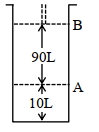
(Molar Mass : Bromine $=80\; g / mol$ )
$Cr{(OH)_3} + Cl{O^ - } + O{H^ - } \to CrO_4^{2 - } + C{l^ - } + {H_2}O$
$Cr{(OH)_3}$ $-$ $Cl{O^ - }$ - $CrO_4^{2 - }$ $-$ $Cl^-$