The sensitivity of a Galvenometer of resistance $171\,\Omega $ becomes $20\,times$ when we used shunt of $x \,\Omega .$ Find $x$ ................. $\Omega$
Medium
Download our app for free and get started
$S=\frac{i_{g}}{i-i_{g}} G=\left(\frac{1}{i / i_{g}-1}\right) G \Rightarrow S=\left(\frac{1}{20-1}\right) 171$

Download our appand get started for free
Experience the future of education. Simply download our apps or reach out to us for more information. Let's shape the future of learning together!No signup needed.*
Similar Questions
- 1An electron is moving on a circular path of radius $r$ with speed $v$ in a transverse magnetic field $B$. $e/m$ for it will beView Solution
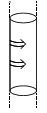
- 2A hollow cylinder having infinite length and carrying uniform current per unit length $\lambda$ along the circumference as shown. Magnetic field inside the cylinder isView Solution
- 3A solenoid of length $0.5 \mathrm{~m}$ has a radius of $1 \mathrm{~cm}$ and is made up of ' $m$ ' number of turns. It carries a current of $5 \mathrm{~A}$. If the magnitude of the magnetic field inside the solenoid is $6.28 \times 10^{-3} \mathrm{~T}$, then the value of $m$ is :View Solution
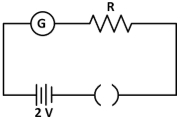
- 4A galvanometer has a $50$ $division$ scale. Battery has no internal resistance. It is found that there is deflection of $40$ $divisions$ when $R = 2400\,\Omega $. Deflection becomes $20$ $divisions$ when resistance taken from resistance box is $4900\,\Omega $ . Then we can concludeView Solution
- 5A proton of mass $m$ and charge $+e$ is moving in a circular orbit in a magnetic field with energy $1\, MeV$. What should be the energy of $\alpha - $particle (mass = $4m$ and charge = $+ 2e),$ so that it can revolve in the path of same radius.......$MeV$View Solution
- 6A particle of charge $ - 16 \times {10^{ - 18}}$ $coulomb$ moving with velocity $10\,\,m{s^{ - 1}}$ along the $x$-axis enters a region where a magnetic field of induction $B$ is along the $y$-axis, and an electric field of magnitude ${10^4}\,\,V/m$ is along the negative $z$-axis. If the charged particle continues moving along the $x$-axis, the magnitude of $B$ isView Solution
- 7A charge $q$ $coulomb$ moves in a circle at $n$ revolutions per second and the radius of the circle is $r$ $metre$. Then magnetic field at the centre of the circle isView Solution
- 8Two particles each of mass $m$ and charge $q$ are attached to the two ends of a light rigid rod of length $2R$. The rod is rotated at constant angular speed about a perpendicular axis passing through its centre. The ratio of the magnitudes of the magnetic moment of the system and its angular momentum about the centre of the rod isView Solution
- 9Two parallel, long wires are kept $0.20\,m$ apart in vacuum, each carrying current of $x$ in the same direction. If the force of attraction per meter of each wire is $2 \times 10^{-6}\,N$, then the value of $x$ is approximatelyView Solution
- 10A straight wire of length $({\pi ^2})$ $metre$ is carrying a current of $2\,A$ and the magnetic field due to it is measured at a point distant $1\, cm$ from it. If the wire is to be bent into a circle and is to carry the same current as before, the ratio of the magnetic field at its centre to that obtained in the first case would beView Solution